Content Marketing for D2C Brands in India: The Complete 2026 Playbook
Content marketing for D2C brands in India: pillars, funnel mapping, weekly cadence, and budget for growth-stage teams in 2026.
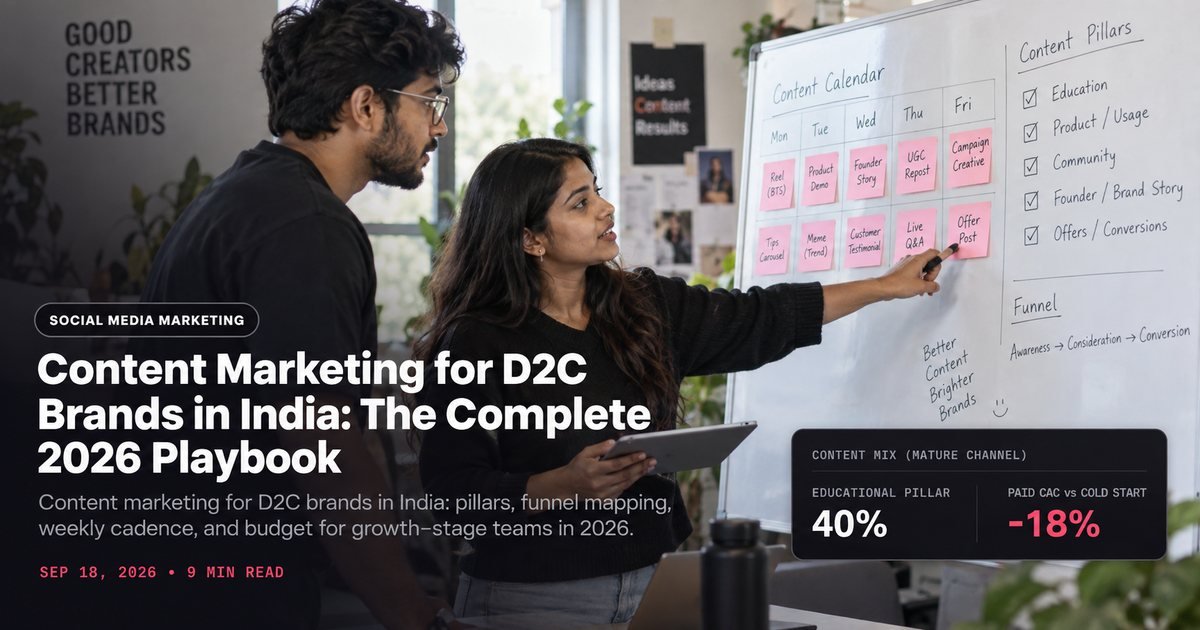
Most D2C founders in India treat content marketing as whatever the social media intern posts when there's nothing else on the calendar. That's backwards.
Content marketing, done properly, makes your paid ads cheaper. It makes your influencer spend go further. It makes your brand worth searching for by name.
I've watched two skincare brands with near-identical ad budgets end up in completely different places by month eight. One had 40 pieces of content feeding its Meta account, three founder videos ranking on YouTube, and a blog picking up branded search. The other had a logo and some product shots. Guess whose CAC dropped and whose didn't.
This is a practical playbook, not a manifesto. Pillars, funnel mapping, a real weekly cadence, a budget structure for a growth-stage brand, and how it all plugs into paid and influencer work instead of sitting in its own silo.
What content marketing actually means for a D2C brand
Content marketing is the content you own and control, published on a schedule, aimed at specific stages of the buying journey. It's your Instagram grid, your Reels, your YouTube channel, your blog, your email flows, and increasingly your WhatsApp broadcast list.
It is not the same thing as influencer marketing (creators posting about you) or performance marketing (paid distribution). Those three should reinforce each other, but content marketing is the only one you fully own.
When Meta's CPMs spike during festive season, or an algorithm update tanks reach overnight, your content library is the asset that doesn't disappear.
A brand with 18 months of consistent content marketing behind it gets cheaper paid CAC than one starting from zero, because the pixel has more signal, the audience already recognizes the creative style, and organic search brings in free branded traffic that never touches an ad account.

The four content pillars, and why sequencing matters
Most brands jump straight to product content because it feels like the "real" marketing. That's the mistake. Here's how the four pillars should actually stack, in the order a growth-stage brand should build them.
1. Educational content (build this first)
Content that teaches something the customer didn't know, unrelated to a direct sell. For a supplements brand: "why your multivitamin isn't absorbing." For a skincare brand: "why your niacinamide serum is pilling."
This is the pillar that earns trust before anyone's ready to buy, and it's what ranks on Google and YouTube long after a paid campaign ends. It should be roughly 40% of your content mix once the channel is mature.
2. Founder-led content (build this second)
Founder-led video, especially on Instagram and YouTube Shorts, converts better than polished brand content in almost every D2C category we've run. Viewers trust a person's face over a product shot.
A founder talking through a formulation decision, a sourcing trip, or a customer complaint they fixed does more for consideration-stage trust than five product carousels. Budget 20-25% of output here.
3. UGC and customer-voice content (build this third)
Real customers, reviews, unboxings, before-and-afters. This is proof, not promise, and it's what a cold audience actually believes at the bottom of the funnel.
For sourcing and rights, this connects directly to your creator sourcing strategy, since most usable UGC comes from micro-creators you're already working with.
Aim for 25-30% of the mix, weighted toward Reels and Stories where the format feels native.
4. Product content (build this last, and keep it thin)
Straight product shots, feature call-outs, and offer posts. Necessary, but it's the pillar with the shortest shelf life and the least trust-building power. Cap it at 10-15%, mostly reserved for launches and sale windows.
Mapping content to the funnel
Content marketing without funnel intent is just noise. Every piece should have a job.
- Awareness (cold audience): educational Reels, trend-jacked audio content, YouTube Shorts. Goal is watch time and shares, not clicks.
- Consideration (warm audience, has seen you once or twice): founder explainer videos, comparison content ("why we don't use X ingredient"), longer YouTube or blog pieces that answer a specific search query.
- Conversion (retargeting-ready or on-site): UGC compilations, review carousels, founder FAQ videos addressing objections directly, product demos with a clear offer.
A common failure: brands run 90% awareness-stage content and wonder why nothing converts. The fix isn't more content, it's matching format to the stage the viewer is actually at.
A realistic weekly cadence for a growth-stage brand
Here's what we actually run for D2C clients doing ₹15-60 lakh a month in revenue, across Instagram, YouTube, and a blog.
| Channel | Weekly output | Pillar mix |
|---|---|---|
| Instagram Reels | 5-7 | 2 educational, 2 UGC, 2 founder/BTS, 1 product |
| Instagram Stories | Daily | Mixed, poll/Q&A heavy |
| YouTube Shorts | 3-4 | Repurposed from Reels, retitled for search |
| YouTube long-form | 1 every 2 weeks | Founder deep-dive or category education |
| Blog | 1-2 posts | SEO-led, answers a real search query |
| WhatsApp broadcast | 2-3 | Offer-led, drawn from top-performing content |
This isn't arbitrary. Instagram's algorithm rewards accounts that post daily-ish without going dark for days at a time.
Our Instagram algorithm breakdown covers why erratic posting hurts reach more than low volume does.
A brand posting 5 Reels a week consistently for 90 days will almost always outperform one posting 15 a week for two weeks and then going quiet.
Team and budget structure that actually works
For a brand at this revenue stage, you need roughly:
- 1One content lead (in-house or agency-managed) who owns the calendar and pillar mix, roughly 15-20 hours a week.
- 2One editor working ₹25,000-₹60,000/month, or an editing subscription service if volume is under 20 pieces a week.
- 3A shoot day every 2-3 weeks, batching 15-20 pieces of raw footage in one session rather than shooting daily.
- 4A UGC pipeline of 3-5 micro-creators sending raw footage monthly, which usually costs less than a single paid shoot.
Total monthly spend for a mid-stage brand typically lands between ₹80,000 and ₹2,50,000, depending on whether shoots are in-house or outsourced. That's before any paid amplification budget.
Whoever owns this either sits in-house or gets handed to a social media marketing partner. Neither is automatically right.
It depends on whether the founder has the bandwidth to direct a content lead weekly, which is worth its own breakdown depending on your team's bandwidth.

Connecting content to paid and influencer spend
Content marketing that lives in its own silo wastes its best asset: proof of what actually works before you spend a rupee on distribution.
- Feed paid with organic winners. Any Reel that crosses 3x your average save rate organically should get whitelisted or spark-ad boosted within 48 hours, while it's still relevant.
- Brief creators using your top content. Send influencers your best-performing hooks and formats as creative direction, not just a product brief. It shortens their learning curve and raises your hit rate.
- Repurpose UGC into ad creative. The UGC strategy from sourcing to reposting we've written up covers the rights and repurposing workflow in detail; most brands under-use footage they've already paid for once.
- Let paid data pick your next content topics. If a comparison ad outperforms a benefit-led ad, that tells you which educational angle to build organic content around next.
Numbered takeaway
- 1Build educational content first, product content last. Educational content compounds; product content doesn't.
- 2Match every piece to a funnel stage before you shoot it, not after.
- 3Post consistently at a sustainable cadence rather than in bursts.
- 4Budget ₹80,000-₹2,50,000/month for a mid-stage brand's content operation, separate from paid spend.
- 5Feed your best organic content into paid and influencer briefs within 48 hours of it proving itself.
If your content calendar is still built around "what do we post today," you're running a content marketing operation without a content marketing strategy. Book a free strategy call and we'll map your pillar mix against your actual funnel data.
Book a call