Ecommerce in India for D2C Brands: The State of the Market in 2026
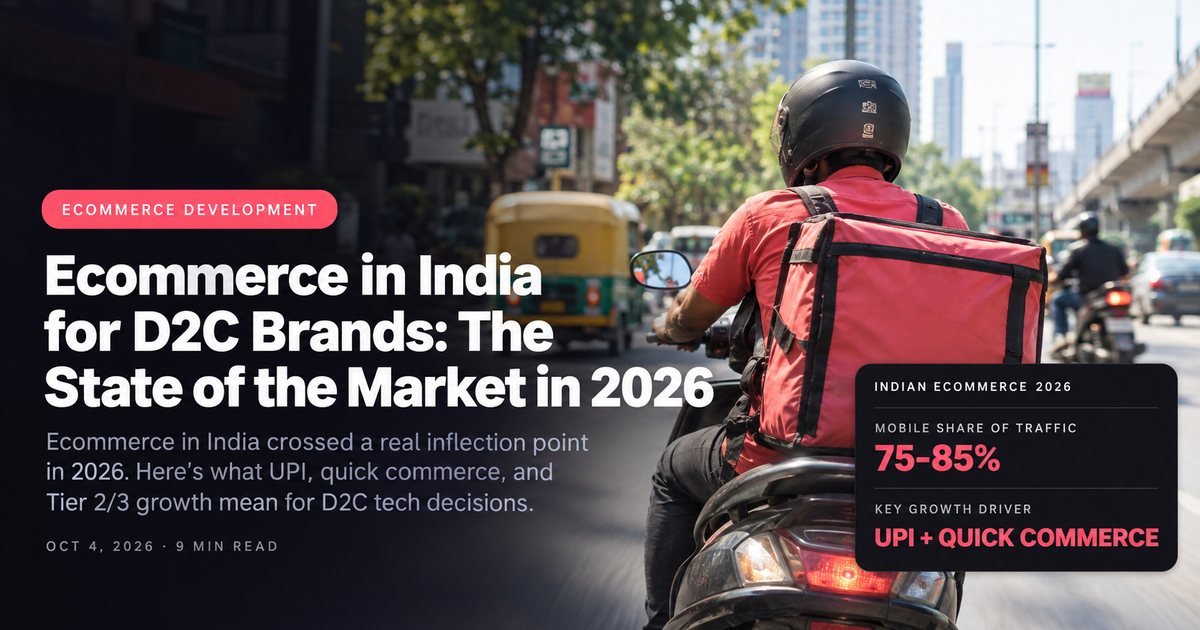
Ecommerce in India crossed a real inflection point in 2026. Here's what UPI, quick commerce, and Tier 2/3 growth mean for D2C tech decisions.
Every founder pitch deck has a slide about how big electronic commerce in India is getting. Same three stats, every time. None of them tell you what to do about it.
This post is the opposite of that slide. Electronic commerce in India now runs on a handful of specific shifts: how people pay, where they buy, and on what device. Each shift is a decision you have to make this quarter. Which platform to build on. Which cities to target. Where the ad budget goes.
Here's what's actually happening, and what it means for your store. We'll walk through market size, UPI adoption, quick commerce, Tier 2/3 growth, and mobile-first shopping, and tie each one to a decision you can make this week.
How big is ecommerce in India, really
Industry estimates put India's online retail market somewhere in the ₹7-9 lakh crore range for 2026. Bain, Redseer, and IBEF reports are the usual sources; there's no single hard government count. Growth is running roughly 18-20% a year. Treat the number as directional. Nobody has a clean census of every transaction happening across the country.
What matters more than the total is the shape of the growth. Fashion and beauty are still the two biggest categories by order volume. Grocery and quick commerce are smaller in absolute terms but growing far faster.
That split changes what "ecommerce growth" means for your specific brand. The size of the whole market matters less than which slice you're competing in. A skincare brand is fighting for share in beauty ecommerce, a category growing around 15% a year and crowded with both D2C challengers and legacy FMCG players who finally showed up. A snacks brand riding quick commerce distribution is in a category growing 40%+ a year, with far less entrenched competition.
Two very different budgets. Two very different growth ceilings. Know which curve you're actually on before you plan next year off a market-size headline.

UPI killed the biggest ecommerce objection in India
For years, the single biggest reason Indian shoppers abandoned a checkout wasn't price. It was trust in the payment step.
UPI fixed that quietly. It now carries the large majority of digital retail transaction volume in India. For anyone under 35 with a smartphone, it's the default. Cash on delivery hasn't disappeared. But it's no longer the safe fallback it was in 2019. It's a cost and fraud problem now, more than a conversion necessity.
Here's the practical implication most stores get wrong. Your checkout should treat UPI as the primary path, not an add-on next to cards. Bury it behind a card-first UI, or let your payment gateway add friction to UPI intent flows on mobile, and you're losing conversions to a problem that's already solved.
We've covered the actual data on this trade-off in our breakdown of cash on delivery versus prepaid checkout for Indian D2C brands, including how much COD is really costing brands in returns and RTO.
Quick commerce changed where "ecommerce" even happens
Blinkit, Zepto, and Swiggy Instamart have quietly become a genuine third distribution channel, sitting between your own website and Amazon or Flipkart. In some categories, they're outgrowing both.
Food, beauty, personal care, even small electronics. Meaningful order volume is moving to 10-minute delivery across all of them. For a D2C brand, that's a live decision about where your product needs to physically sit, today, not a trend to read about.
We wrote a full cost and setup comparison in Blinkit vs Zepto vs Swiggy Instamart for D2C brands, and a separate breakdown of what quick commerce ads actually cost once you're listed. Both are worth reading before you commit inventory to any one platform.
The strategic question underneath quick commerce is bigger than any single app: should you even be building your own website first, or should marketplaces and quick commerce come before it? We laid out the actual trade-offs in D2C versus marketplace selling in India.

Tier 2 and Tier 3 cities are where the next order actually comes from
Metro ecommerce growth has flattened. Delhi, Mumbai, and Bangalore are still huge markets, but they aren't where the incremental customer is coming from anymore. That customer is showing up in Jaipur, Coimbatore, Indore, and dozens of towns most brands still lump into a single "rest of India" ad set.
Tier 2 and Tier 3 towns now account for a growing share of new online shoppers every year. They behave differently than metro buyers, too.
They're more price-sensitive. More likely to pay cash or use UPI directly rather than a saved card. And they respond better to vernacular-language ads and regional creators than to English-first campaign creative shot for a Mumbai audience.
This has three concrete implications for a D2C brand:
- Ad creative needs a regional variant, not just a translated one. Hindi, Tamil, Telugu, and Bengali creative written for that audience outperforms subtitled English creative in these markets.
- Your logistics partner needs real Tier 2/3 coverage, not just metro-plus-nearby-district service. Check actual delivery SLAs to pin codes outside the top 20 cities before you promise a date.
- Pricing and pack sizes may need a smaller SKU. Price-sensitive first-time buyers often won't commit to a full-size product on order one.
Brands still marketing to Bhopal with the same creative and pricing they use in Mumbai are leaving real growth on the table. It's a small fix. Most just haven't made it yet.
Mobile-first is the whole market, not a design trend
More than 80% of ecommerce transactions in India happen on a phone. Not a desktop, a phone. That share has been climbing for years and shows no sign of turning around.
Here's what that means in practice. If your product page takes more than 2-3 seconds to load on a mid-range Android phone over 4G, you lose buyers before they even see your product. Core Web Vitals turn into a direct revenue number here, checked every single day, and stop being just a Google ranking checkbox.
Test your store on an actual mid-range Android device, not your own iPhone on office WiFi. Most founders never do this. They're shocked when they finally check load times on the hardware their real customer owns.
What this actually means for your ecommerce tech stack
Pull the trends together and a pattern shows up. Indian ecommerce growth in 2026 concentrates hard around three things: UPI-first mobile checkout, quick commerce distribution, and non-metro buyers, rather than spreading evenly across geography, device, or payment method.
Follow that concentration. Don't fight it.
- 1Audit your checkout for a UPI-first flow, not card-first with UPI bolted on.
- 2Decide your quick commerce posture deliberately. Price it and track it, don't just react because a competitor listed first.
- 3Build at least one regional-language ad creative variant if Tier 2/3 towns are a real share of your traffic.
- 4Run your store on a mid-range Android phone over throttled 4G. Fix whatever breaks.
- 5Re-check your logistics partner's actual Tier 2/3 delivery SLAs, not their sales deck's claimed coverage.
None of this needs a rebuild from scratch. Most of it is a focused two-to-three-week fix to an existing Shopify or custom store, tackled in the right order. We've seen brands ship this in a single sprint once they know what to prioritize, and the payback usually shows up in the very next month's conversion numbers rather than some distant quarter.
The brands winning share in Indian ecommerce right now aren't the ones with the biggest ad budgets. They're the ones who matched their checkout, distribution, and creative to where the actual growth is happening, instead of where it used to happen five years ago.
If you want a second pair of eyes on where your store is actually losing conversions against these trends, book a free strategy call and we'll walk through your checkout and channel mix together.
Book a call