Facebook Video Ads vs Static Creative: What Static Is Quietly Costing You
Facebook video promotion beats static creative in some categories and loses in others. A practical comparison for Indian D2C brands, with real cost tradeoffs.
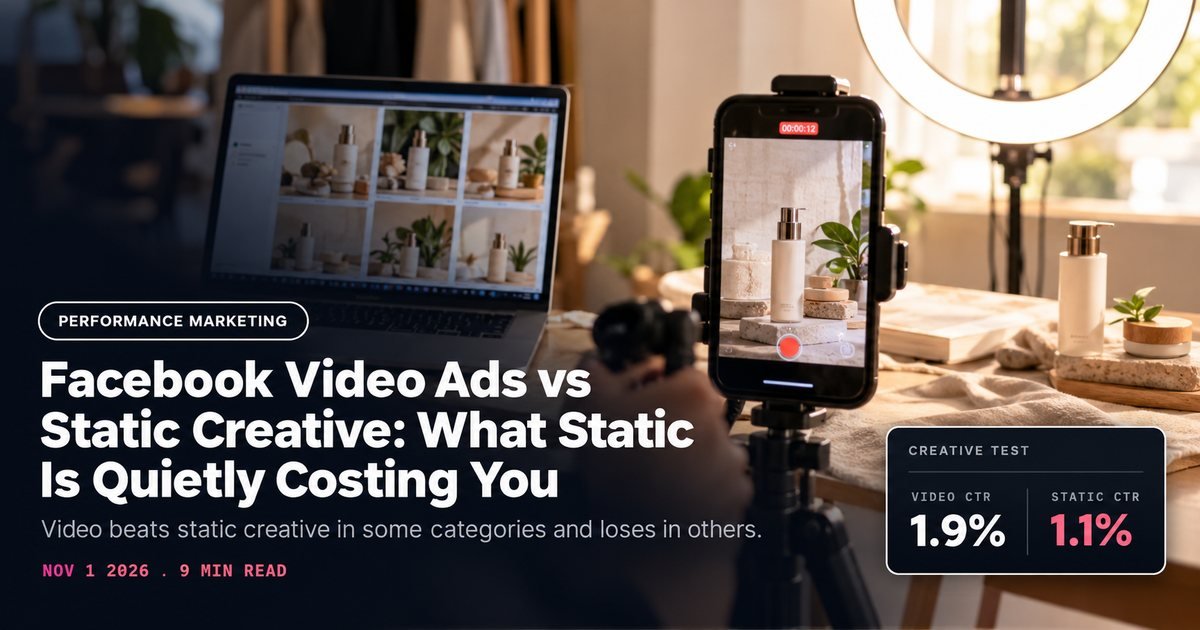
A haircare brand we work with ran the same offer, 20% off a bestselling serum, as both a UGC-style video and a static product shot for three weeks. The static image won on CAC by a wide margin.
Two months later, launching a new product nobody had heard of, the exact same brand saw video outperform static by almost double. Same brand. Same team. Same budget range. A completely different format winning, for a completely different reason.
That's the real answer to the facebook video promotion versus static debate. Stop asking which format is better. Ask which job the ad is doing.
Founders asking "should I run video or static" are usually asking the wrong question. The right answer depends on funnel stage, category, and what the viewer already believes about the product before they see your ad, the same funnel-stage thinking behind our performance marketing work for D2C accounts.
Why video usually wins for cold, unfamiliar products
When someone has never heard of your brand or product, video does something a static image structurally can't: it demonstrates. A serum's texture, a gadget's actual function, a garment's fit and drape in motion, these are things a still photo implies and video shows.
UGC-style video, a real person talking to camera or showing the product in a believable, unpolished setting, tends to outperform highly produced video for cold audiences specifically. It reads as a recommendation rather than an ad.
In a cold-audience context, where the viewer has zero trust built up yet, that distinction matters more than production quality. We've seen UGC video shot on a phone with a ₹3,000-8,000 creator fee outperform a ₹60,000 produced video on CAC, repeatedly, for exactly this reason.
The job video does best is answering "what even is this and why would I trust it," and that job matters most at the very top of a cold funnel. Once a viewer already knows roughly what your product is and is deciding whether to buy now, video's advantage narrows considerably.

When static wins, and it's more often than people assume
Static creative tends to win in a few specific situations that cut against the common assumption that video always performs better.
For retargeting and warm audiences, people who've already visited your site or seen your brand before, a clean static image with a clear offer (price, discount, a specific claim) often converts faster than video. The viewer doesn't need convincing again.
They need a reason to act now. A static ad communicates that in the first half-second of a scroll, before a video has even started playing sound off.
For categories where the product's value is visual and immediately legible, think jewellery, home decor, or a visibly premium packaging design, a well-shot static image can out-convert video because the product sells itself on sight and doesn't need demonstration or explanation. The same sell-on-sight logic shows up in Instagram influencer marketing for D2C brands, where a strong product shot in a creator's feed often does more work than a produced video.
For bottom-of-funnel retargeting specifically, a static carousel showing multiple SKUs or a clear price comparison often beats a single video ad, simply because it lets a near-ready buyer compare options in one glance rather than sitting through footage.
Static also wins on cost and speed. A static ad can be produced, tested, and iterated in hours. Five creative variations cost a fraction of five video variations.
For brands running high-volume creative testing to find a winning angle before investing in production, static is often the smarter first pass. Save video for the angle that's already proven itself.
A practical creative testing framework
Rather than picking one format and committing, the brands getting this right run a structured test across both, and the structure matters more than any individual asset.
Start by separating tests by funnel stage, not just by format. Test video versus static specifically within a cold-audience campaign, and separately within a retargeting campaign. Combining both audiences in one test muddies the result. A format that wins cold can lose warm, and vice versa, exactly as the haircare example above shows.
Within each stage, test concept before you test production quality. A UGC video with a weak hook and a polished UGC video with a strong hook will perform wildly differently regardless of budget spent on either. Isolate the variable you're actually trying to learn from.
The same applies to static. Test genuinely different angles: a problem-agitation headline, a social-proof headline, a direct-offer headline. Minor colour or layout tweaks won't move the needle enough to teach you anything.
Give each test enough spend to reach statistical relevance before calling a winner, roughly 1,000-3,000 impressions per variant minimum depending on your audience size, and resist killing a variant after a few hours of noisy early data. Conversion rate optimisation for D2C Shopify stores covers a similar discipline around giving tests enough runway before reading results, and the same principle applies to ad creative testing.
Track cost-per-result by funnel stage separately, not blended. A blended CAC across cold and warm campaigns hides which format is actually doing the work in which stage, and that's the exact distinction that determines your next production budget decision.

Production cost versus performance, the real tradeoff
Here's where the budget conversation gets honest. A produced brand video, scripted, shot with proper lighting and a crew, typically runs ₹40,000-1.5 lakh in the Indian D2C market depending on scope. A UGC-style video from a mid-tier creator runs ₹3,000-15,000 per piece. A batch of five or six for creative testing often costs less than one produced video.
For a new brand or product with no proven angle yet, spending on a single expensive produced video before testing cheap UGC variants is usually backwards. Test cheap first. Then invest production budget in the concept that's already proven itself with real ad spend behind it, not the one that looked best in a creative review meeting.
That said, once a brand has a proven hero product and a winning angle confirmed through cheaper testing, a produced video can earn its place. Top-of-funnel brand awareness facebook campaigns aimed at reach rather than direct response are where polish starts to matter, because at that stage you're optimising for perception rather than discovery.
Static creative's cost advantage is even starker. A single photoshoot can produce dozens of static variants, different crops, headlines, offers, for a fraction of what proportional video variants would cost. That's part of why static remains the backbone of most high-volume retargeting campaigns even at brands that lead with video up top.
A quick gut check before you shoot anything new
Before briefing another video or booking another photoshoot, pull your last 90 days of ad performance and sort by format and funnel stage together, not just overall CAC. Most accounts we review have never done this split, so the account-level average is quietly hiding a format that's underperforming badly in one stage while looking fine blended with the other.
If your cold campaigns are running mostly static with a mediocre CAC, that's your first test. If your retargeting is running mostly video with a mediocre CAC, that's your second. Fix the clearer mismatch first, then move to the next one once that test has run its course.
What to actually do this month
If you're running cold prospecting campaigns with only static creative, test two or three cheap UGC videos against your current best static performer before assuming video "doesn't work for your brand." Most brands that say that haven't actually tested it properly. Usually they ran one overproduced video, once, instead of several cheap variants against a real control.
If you're running retargeting campaigns entirely on video, test a clean static offer-led creative against it. The format switch alone, with no change to the actual offer, often moves CAC meaningfully in categories where the product sells on sight.
If you're not sure where to start, what is performance marketing: a D2C guide covers how creative testing fits into the broader performance marketing process, and a free strategy call is a good next step if you want a second opinion on your current creative mix before committing more production budget either direction.
Takeaways
- 1Test video and static separately by funnel stage; a winner cold can lose warm.
- 2Use cheap UGC variants to find a winning angle before investing in produced video.
- 3Static often wins on retargeting and for visually self-explanatory product categories.
- 4Give each creative test enough impressions before calling a result.
- 5Track cost-per-result by funnel stage, not blended, to know which format is actually working where.
Want us to audit where your CAC is leaking?
Book a call