Setting Up Google Ads for the First Time: What Month-One Mistakes Actually Cost
Learning to set up Google Ads the hard way is expensive. These are the month-one mistakes that waste budget fastest, and how to avoid them.
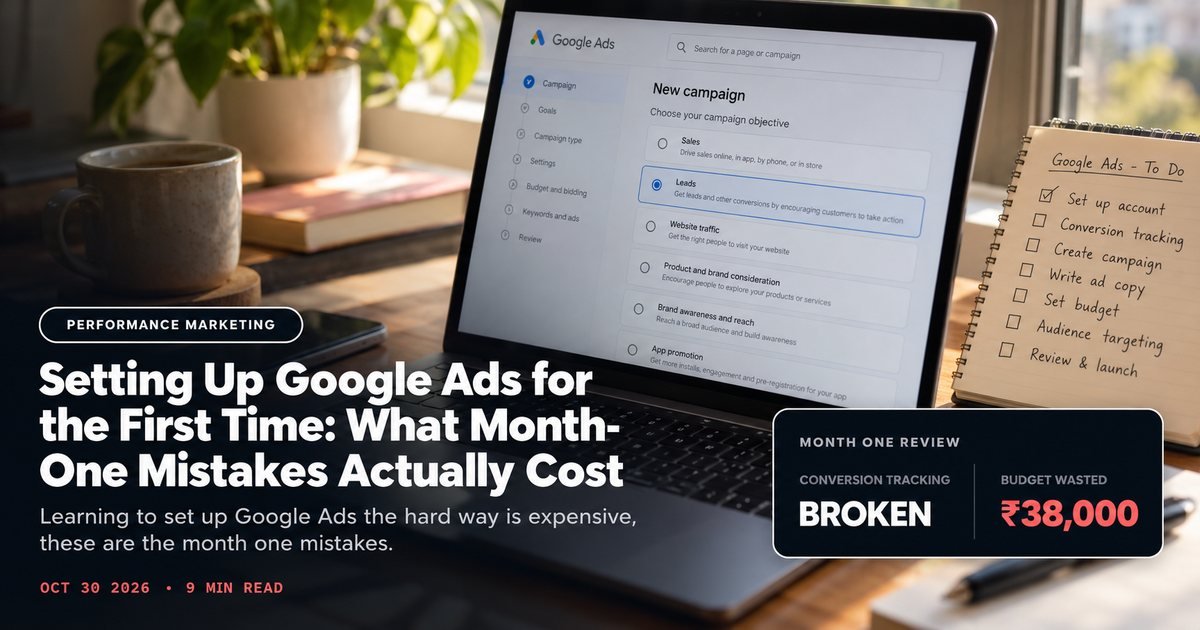
A home decor brand came to us after burning through ₹1.8 lakh in three weeks on a first Google Ads campaign. Almost nothing to show for it.
The product was fine. The market was there. Conversion tracking had been firing on every page load instead of actual purchases. Every optimisation decision for three weeks had been based on a number that meant nothing.
If you're trying to set up google ads for the first time, the mistakes that cost the most money aren't exotic. They're a short, predictable list. Almost all of them happen before you ever see a single click. If you're weighing Google against Meta for that first budget, online marketing for D2C brands in India is worth reading alongside this one.
Here's what actually burns budget in month one, roughly in the order it tends to happen.
Mistake one: launching before conversion tracking is verified
This is the single most expensive mistake on this list, and the one we see most often. Conversion tracking looks set up. The tag fires. Google shows conversions in the dashboard.
Everything appears fine. Right up until someone checks whether those conversions actually correspond to a purchase, a lead form, or a sign-up. Often, they don't.
Three failure modes show up constantly. The conversion tag fires on the order confirmation page load regardless of whether payment actually completed. A duplicate tag fires twice per purchase, inflating your reported count. Or the tag sits on a "thank you" page that's reachable without buying anything, through a direct URL, a bookmark, or a back button.
Before you spend a single rupee, place a test order yourself and confirm one real conversion shows up in Google Ads, not just Google Analytics. These two tools can disagree. Google Ads is the one making your bidding decisions.
If you can't verify it cleanly, don't launch yet. Every day of spend on broken tracking is a day Google's algorithm learns the wrong lesson about who converts.

Mistake two: broad match with zero negative keywords
Broad match is the default match type Google nudges you toward during campaign creation. It's genuinely useful once a campaign has enough data for Google's algorithm to understand who converts.
In week one, with zero historical signal, it's a different story. Broad match with no negative keyword list is how a candle brand ends up paying for clicks on "candle making classes near me" and "how to put out a candle fire."
That's not a fluke. Google's algorithm has nothing to learn from yet, so it casts wide to find any signal at all, the same undisciplined-spend pattern we flag often in performance marketing agency cost in India when auditing a new account.
The fix takes twenty minutes before launch. Build a negative keyword list covering obvious non-buying intent: jobs, classes, DIY, free, reviews if you don't want comparison shoppers, competitors' brand names if you don't want to bid on them. Add it at the campaign level before your first rupee spends.
Then review the search terms report daily for the first week, not weekly, and add new negatives as irrelevant terms show up. One founder we worked with cut cost-per-click by 40% in ten days doing nothing else.
Mistake three: sending traffic to a mismatched landing page
An ad promising "20% off your first order" that lands on a generic homepage, with no mention of the offer above the fold, loses a meaningful share of clicks immediately. The product is fine. The mismatch between the click and the page is the real problem.
A visitor who clicked for a specific reason feels misled within two seconds of arriving.
This happens constantly in month one. It's easier to point every ad at the homepage than to build dedicated landing pages for each offer or product line.
It's also the fastest way to inflate your cost-per-acquisition without realising why. The ad itself looks fine in every metric Google shows you: CTR, impressions, even clicks. Only your actual conversion rate tells the real story.
The headline and offer in your ad should be visible, word for word where possible, within the first screen of the landing page. Running an ad for a specific product? Link to that product page. Not the category page. Not the homepage.
This is also where conversion rate optimisation for D2C Shopify stores becomes relevant, once your traffic volume is high enough to test landing page variants properly.

Mistake four: underfunding the learning phase
Google Ads campaigns go through a learning phase, typically the first 7-14 days or roughly 50 conversions. During this window the algorithm figures out who to show your ads to and at what bid.
Campaigns that exit learning with too little data tend to perform erratically afterward. Cost-per-acquisition swings wildly week to week, a pattern worth checking against real conversion rate benchmarks for Indian ecommerce stores once you have a few weeks of data to compare.
A small budget on its own rarely causes this. The real mistake is a budget too small to generate meaningful conversion volume during that window.
That gets followed by panic at the daily numbers, then pausing or drastically changing the campaign before it's had a real chance to learn. Every pause, every major change: a new bid strategy, a new budget, a new target CPA, restarts the learning phase.
A reasonable rule of thumb: budget enough for at least 15-20 conversions in the first two weeks. Run fewer campaigns at a higher budget each, rather than spreading a thin budget across five campaigns that all learn too slowly to stabilise.
If your margins or average order value make that unrealistic right now, delay launch and build toward it. Launching underfunded just means drawing the wrong conclusions from noisy early data.
Mistake five: ignoring the search term report in week one
This one compounds every other mistake on this list. The search term report shows exactly what people typed before your ad showed up and they clicked. Updated daily. The clearest signal you have of whether your targeting matches real intent.
First-time advertisers often don't check it until a weekly or monthly review. By then, a broad match campaign with no negatives has already spent a meaningful chunk of budget on irrelevant searches.
By the time the pattern shows up in an aggregate report, the money's gone.
Check the search term report daily for the first two weeks of any new campaign. Five minutes a day. It's the fastest feedback loop you have, faster than waiting for enough conversion data to tell the same story through CPA and ROAS.
This one habit, more than any single setting, separates accounts that stabilise quickly from ones that bleed budget for a month before anyone notices.
One more thing worth checking in week one
Account-level conversion settings often get left on defaults that quietly skew your numbers from day one. Attribution windows, for instance, frequently default to a 30-day click window, which can make a campaign look better than it really is if purchases trickle in weeks after the click for reasons unrelated to the ad itself.
Check your conversion action settings before you trust any CPA number in the first month. Confirm the attribution window matches your actual sales cycle, confirm whether a conversion counts once per click or every time, and confirm the value being tracked is the order value, not a flat placeholder number someone set during initial setup and forgot about.
This looks like a small detail, but it has real teeth. A mismatched attribution window alone can make a losing campaign look profitable for weeks, long enough to double down on the wrong thing before anyone catches it.
Takeaways
- 1Verify a real conversion fires correctly in Google Ads itself before spending anything.
- 2Build a negative keyword list before launch; don't let broad match learn on your money.
- 3Match every ad's landing page to its specific offer, not a generic homepage.
- 4Fund campaigns enough to clear the learning phase with 15-20 conversions in two weeks.
- 5Check the search term report daily for the first two weeks, not weekly.
None of these five mistakes requires technical depth to fix. They require someone checking the right thing at the right time, in the first two weeks, before the pattern compounds into a wasted month.
For a broader view of how Google fits inside a full-funnel media plan, our performance marketing team handles exactly this kind of first-campaign setup for D2C brands day to day.
If you want a second set of eyes on a first campaign before it goes live, or a review of one that's already underperforming, a free strategy call is a quick way to catch these mistakes before they cost another month of budget.
Book a call