Media Buying Agency vs Performance Marketing Agency: What You Lose by Hiring the Wrong One
A media buying agency and a performance marketing agency sound interchangeable but do very different jobs. Here's which one a D2C brand actually needs.
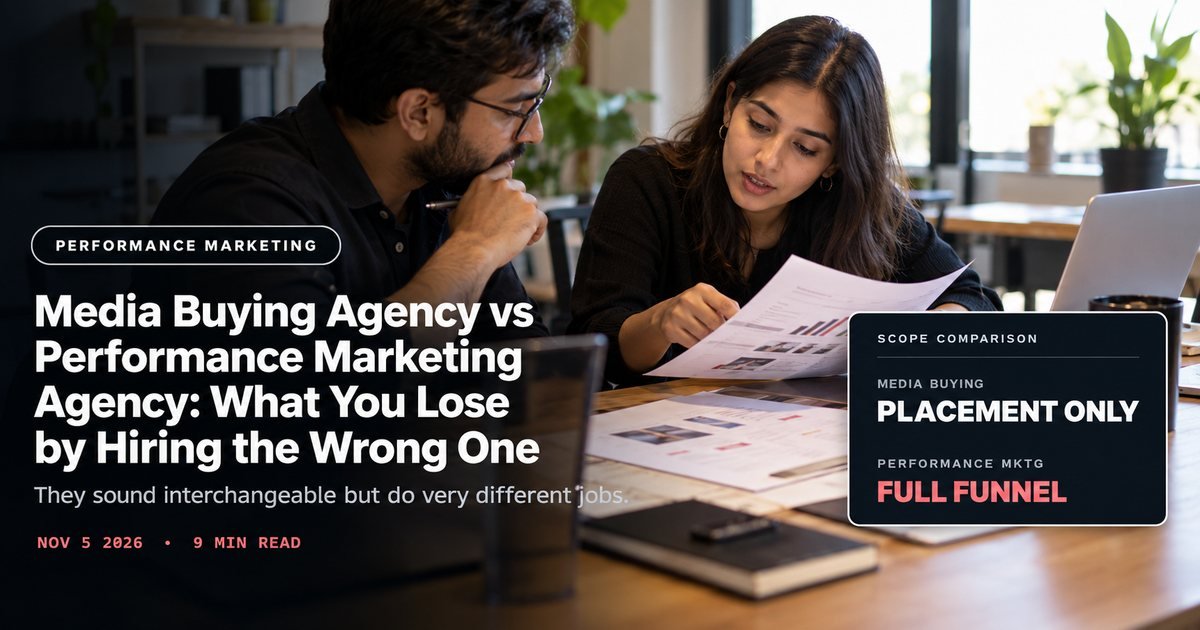
A founder we spoke with last year had signed a contract with a "media buying agency" expecting full campaign management, creative testing, and CAC reporting. What they got was a team that placed ads where instructed and sent a spend report once a month. Neither side was wrong, exactly. Same term, two different jobs.
That confusion is common, and it's worth clearing up before you sign anything. A media buying agency and a performance marketing agency can look identical on a pitch deck and operate completely differently once the contract starts.
This post breaks down what each one actually does, where the line blurs in 2026, and which a D2C brand should be hiring for depending on what stage it's at.
What a media buying agency traditionally does
Media buying, as a discipline, predates digital advertising by decades. It started with negotiating and purchasing ad placements across TV, print, radio, and outdoor, where the core skill was relationship-driven: knowing which publication or network to buy from, negotiating rate cards down, and securing better placement or timing than a brand could get on its own.
The job was transactional, in a specific sense. A brand (or its creative agency) decided what the ad should say. The media buyer decided where it ran and negotiated the price. These were often separate agencies entirely, a creative shop handling the "what" and a media buying agency handling the "where and how much."
That split carried over into digital. A traditional media buying agency today might manage programmatic display buys, negotiate direct ad placements with publishers, or handle large-scale TV and OOT media alongside a digital component. The core value is buying efficiency and placement access, not campaign strategy or creative direction.

Some agencies calling themselves media buying shops have adapted this into programmatic digital buying, managing demand-side platforms, negotiating direct deals with publishers, and optimizing bid strategy across a media mix. That's a legitimate, still-relevant service. Still worth paying for, in the right case. Especially for brands running large-scale awareness campaigns across many channels at once.
What a performance marketing agency does instead
A performance marketing agency works from a different starting point entirely, the measurable outcome rather than the placement itself. The job is managing Meta and Google Ads (and often other platforms) end to end, tied directly to a CAC or ROAS target the brand has agreed to.
That means owning creative testing (not just running whatever creative is handed over), audience and campaign structure, bid strategy, landing page and conversion flow input, and constant iteration based on what the data says is or isn't working, with a performance marketing team living inside the ad account daily rather than checking in monthly.
The accountability structure is different too. Judged on different things entirely. A media buying agency is typically judged on efficient placement and reach at the agreed rate. A performance marketing agency is judged on whether CAC stayed under target and ROAS held up, outcomes the brand actually cares about at the P&L level.
This is the structural difference that matters most: one gets paid for buying media well, the other gets paid for the business result the media produces. Neither is inherently better; they're solving different problems.
Where the line blurs in 2026
Here's where it gets genuinely confusing, and why the terms get used interchangeably even by people who should know better. Modern performance marketing agencies also "buy media," in the sense of managing ad spend across Meta, Google, and increasingly platforms like Amazon Ads or quick commerce ad placements.
Many agencies that call themselves a ppc agency or google ads agency are really doing performance marketing work: full account management tied to outcomes rather than pure placement buying. The term "PPC agency" has become a near-synonym for performance marketing in most small-to-mid D2C contexts, even though pay-per-click technically just describes the billing model, not the scope of service.

Conversely, some self-described facebook advertising agencies operate closer to the traditional media buying model: they'll set up and run your campaigns competently but won't touch your creative strategy, landing pages, or broader funnel, leaving those pieces for you or another vendor to manage. The agency name alone tells you very little; the scope in the contract tells you everything.
The honest way to tell the difference before signing anything: ask directly whether they do creative testing and development, whether they'll touch your landing pages or product pages, and whether they're accountable to a CAC/ROAS number or just a spend-efficiency number. The answers reveal which model you're actually getting, regardless of what's on their homepage.
Which one a D2C brand actually needs
For the overwhelming majority of D2C brands, a performance marketing agency is the right hire over a pure media buying agency, for a simple reason. D2C growth depends on the full loop of creative, targeting, landing experience, and iteration working together against a CAC target, rather than just efficient placement of a fixed creative asset.
A brand that already has strong in-house creative production and just needs execution and optimization on the media side might genuinely be better served by a narrower media-buying-style engagement. That's a smaller, rarer case, usually bigger brands with established creative teams and brand guidelines already locked down.
A brand still figuring out what creative works, what audience responds, and how to turn ad spend into a profitable loop needs the fuller performance marketing scope: someone testing and iterating on the actual message, not just placing a fixed asset efficiently. This is almost every early and growth-stage D2C brand in India right now.
If you're evaluating vendors and keep hearing both terms, our guide on how to choose a marketing agency walks through the broader evaluation checklist beyond just this one distinction, including questions to ask about reporting, contract length, and creative ownership.
Questions to ask before signing with either type
Before signing with any vendor calling themselves a media buying agency, performance marketing agency, or either flavor of PPC/Google Ads/Facebook advertising agency, get clear answers on these:
- 1Who owns creative strategy and testing, the agency or your internal team? If it's "whatever you send us," you're getting pure media buying regardless of what they call themselves.
- 2What's the accountability metric: spend efficiency and placement, or a specific CAC/ROAS target they'll be held to?
- 3Will they touch the funnel beyond the ad click, meaning landing pages, product pages, or checkout flow, or does their scope end the moment someone clicks?
- 4How often do they report, and on what: platform-reported numbers only, or blended and true profitability numbers too?
- 5What's the minimum contract length, and what happens to campaign structure and learnings if you leave?
The label on the pitch deck matters less than the actual answers to these five questions. Plenty of agencies calling themselves a media buying agency are doing full performance marketing work under the hood, and plenty of self-described performance marketing shops are really just running media on autopilot.
What this looks like in a real contract
The clearest way to see the difference in practice is to compare two scopes of work for the same ₹1.5 lakh monthly retainer. A media-buying-style scope typically covers: campaign setup and daily bid management, placement optimization within given creative assets, and a monthly spend report broken down by platform and placement.
A performance-marketing-style scope for the same money usually covers: everything above, plus creative concept development and testing cadence (often 15-25 new creative variants a month), landing page or product page recommendations tied to conversion data, audience and retargeting structure ownership, and reporting against an agreed CAC or ROAS target rather than just spend efficiency.
Neither scope is automatically overpriced or underpriced; the right one depends on what you already have in-house. A brand with a strong internal creative team and a clear brand playbook might genuinely only need the narrower, cheaper media-buying scope, paying for execution rather than strategy.
A brand without that internal capability is usually overpaying if it buys the narrower scope and then has to hire separately for creative and funnel work anyway. The coordination cost between two vendors often outweighs any savings.
This is worth working out on paper before any proposal conversation, because agencies rarely volunteer which scope they're quoting unless asked directly.
Want us to audit where your CAC is leaking?
Book a call