Meta Advertising Agency vs DIY: What You Lose When You Do Everything Yourself
When does hiring a meta advertising agency actually pay for itself versus running Meta Ads yourself? A real spend and time-based break-even framework.
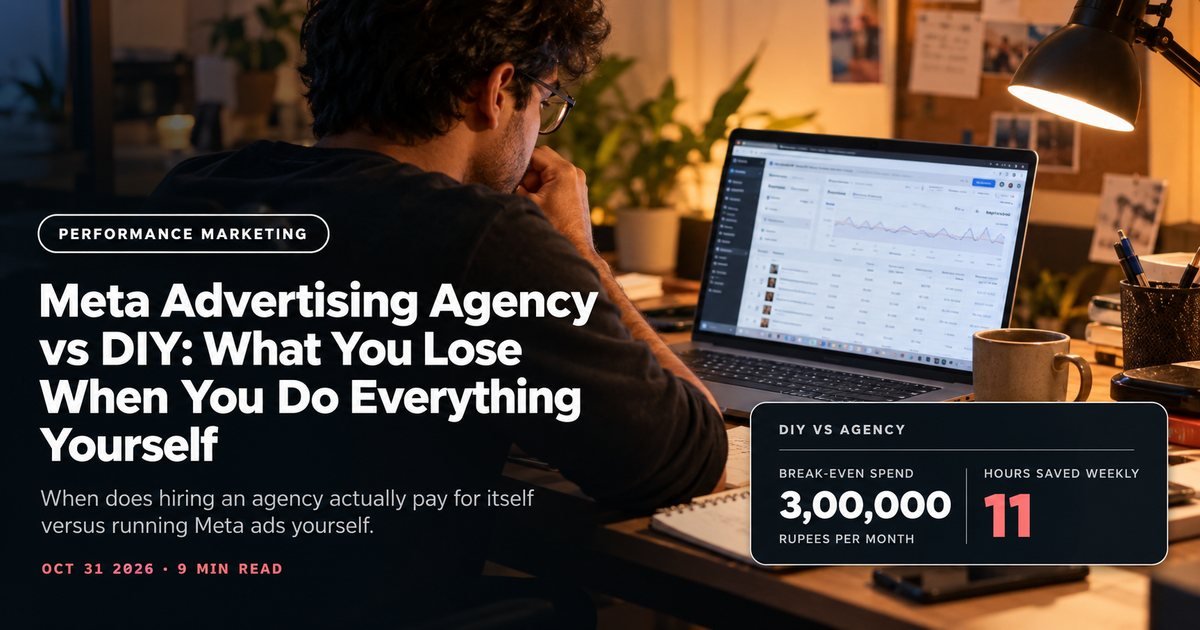
A founder running a ₹4 lakh a month skincare brand asked us last quarter whether she should finally hire a meta advertising agency or keep running Meta Ads herself. She'd been doing it solo for eight months. Roughly 11 hours a week. Her CAC had been flat for three months straight.
That's the exact situation this piece is written for. The honest answer here is a specific break-even point, and most founders cross it without noticing. It's the same question we walk through on strategy calls with founders deciding whether to hand off paid media for the first time.
What DIY actually costs, hour by hour
The biggest blind spot in the DIY-versus-agency decision is that founders rarely count their own time as a real cost. It is one, and it's usually larger than people think once you add it up honestly.
Running Meta Ads properly means more than turning campaigns on and checking them occasionally. Creative testing: briefing or sourcing new ad variants, launching them, killing underperformers. Audience and placement review. Budget pacing across campaigns. Catalogue and pixel maintenance. Genuine analysis of what's actually driving CAC up or down versus what's just noise.
For a brand spending ₹2-5 lakh a month, that realistically takes 8-15 hours a week, done properly. Below that threshold, most founders run a lighter version. Fine at low spend. It starts leaking money as spend grows.
Value that time at your own real hourly rate, whatever you'd pay a strong marketing hire, or what an hour of your own time is worth doing the parts of the business only you can do. At even a conservative ₹1,000/hour, 10 hours a week is ₹40,000 a month of unaccounted cost sitting inside what looks like a "free" DIY setup.

The spend threshold where agency fees start paying for themselves
Agency retainers for Meta-focused management in the Indian D2C space typically start around ₹35,000-50,000/month at lower spend tiers and scale with complexity, similar to the structure covered in performance marketing agency cost in India.
Affordability alone misses the point. What matters is whether the agency's output, CAC improvement plus your reclaimed time, exceeds that fee.
Here's a rough framework that holds up across most of the accounts we've reviewed:
Under ₹2 lakh/month ad spend: DIY usually wins. The rupee impact of a CAC improvement is small at this scale, and a founder with reasonable marketing instincts can run this level competently with a few hours a week. An agency fee here tends to eat a disproportionate share of the budget relative to what it returns.
₹2-6 lakh/month ad spend: The real break-even zone. Where it lands depends on two things: how many hours a week you're actually spending, and whether your CAC has plateaued. More than 10 hours a week, CAC flat for two consecutive months? The math favours an agency. Under 5 hours a week with gradual improvement still showing? DIY is probably still working.
Above ₹6-8 lakh/month ad spend: DIY almost always becomes the more expensive option, fee included. The complexity curve, creative testing volume, catalogue structure, cross-channel budget allocation against Google, grows faster than one founder's available hours can cover without the rest of the business suffering.
This is also the spend tier where running Meta and Google under one blended CAC target starts to matter more than either channel on its own.
A simple back-of-envelope check: take your current monthly ad spend, multiply by your current CAC as a percentage above what you believe is achievable (even a rough 15-20% estimate), and compare that monthly rupee gap to the agency's quoted fee. If closing even half that gap would cover the fee, the math favours hiring out.
Signs your plateau is a skill gap, not a market ceiling
This is the distinction that trips up most founders deciding whether to hire a meta ad agency, because a flat CAC can mean two very different things, and they call for opposite responses.
A genuine market ceiling looks like this. You've tested meaningfully different creative concepts, not just colour or copy variations of the same idea. You've tried multiple audience strategies, including broad targeting with Advantage+ campaigns. Your CAC has stayed within a narrow band despite real variation in approach.
That's a signal about market saturation or category demand, not execution. An agency can't manufacture demand that genuinely isn't there.
A skill-gap plateau looks different. Creative testing has been narrow, mostly iterating on the same one or two ad concepts rather than testing structurally different angles. Campaign structure hasn't changed in months, even though Meta's own ad products have; Advantage+ shopping campaigns, for instance, restructured how a lot of accounts should be built. Budget allocation runs on gut feel rather than a regular reallocation process.
If your testing has been narrow and your structure hasn't evolved, what looks like a market ceiling is often an execution ceiling. That's exactly the gap an experienced team closes fastest.
One honest way to check: look back at your last 90 days of ad creative. If you can count genuinely distinct concepts tested (not variations) on one hand, you likely haven't tested enough to know whether you've hit a real ceiling yet. Our guide to AI UGC ads and their real ROAS covers how cheap that testing can actually be done.

What to check before you switch either direction
Before moving from DIY to an agency, or deciding to keep going solo, a few questions clarify the decision faster than general advice does.
How many hours a week, honestly, have you spent on Meta Ads over the last month, not the ideal number but the actual one? Write it down before you estimate the opportunity cost.
Has your CAC moved, in either direction, over the last 60 days, or has it been flat regardless of what you've changed? Flat despite real changes is the clearer signal than flat with no changes attempted.
If you hired an agency tomorrow, what would you do with the reclaimed hours, and is that time worth more than the fee elsewhere in the business? If the honest answer is "probably nothing specific," the time-cost side of the equation weakens considerably.
Have you genuinely tested Advantage+ or broad-audience campaigns, or are you still running narrow interest-based targeting from 2023? Meta's own platform has shifted enough that outdated structure alone can explain a plateau that has nothing to do with market saturation.
For brands still early in this decision and weighing Meta against the broader channel mix, online marketing for D2C brands in India is a useful starting point before committing budget either way.
One more check worth running: pull your last three invoices or ad spend statements and add up what you actually spent on creative production over that period, separate from media spend.
Founders doing DIY well often underspend here too, running the same two or three ad assets for months because producing new ones competes with everything else on their plate. That's a quieter cost than the hours question, but it shows up in a stale creative library just the same.
The honest middle path
Not every brand needs a full handoff. Some founders are better served by a lighter engagement: an agency or freelancer doing a monthly audit and creative strategy session, while the founder still executes day to day.
This works best when the real problem is a lack of expert eyes on strategy, not a lack of execution hours. It costs meaningfully less than a full retainer too, usually a fraction of a full management fee, since the deliverable is direction rather than daily hands-on-keyboard work.
We've set brands up this way for a quarter or two before they eventually moved to a full retainer once spend grew enough to justify it, and it worked because the gap being filled was specific rather than open-ended.
If you're not sure which side of the break-even point you're on, a free strategy call is a low-commitment way to get an outside read on your account before deciding either way.
Takeaways
- 1Count your own time honestly; 10 hours a week at even a modest rate is real money.
- 2The ₹2-6 lakh/month spend range is the real break-even zone for most D2C brands.
- 3A flat CAC despite genuinely varied testing suggests a market ceiling; a flat CAC with narrow, repetitive testing suggests a skill gap.
- 4Check whether you've actually tested Advantage+ and broad campaigns before concluding you've plateaued.
- 5Consider a lighter monthly audit engagement if the gap is strategy, not execution hours.
Want us to audit where your CAC is leaking?
Book a call