Quick Commerce Ads: What Blinkit, Zepto and Instamart Really Cost D2C Brands
Quick commerce ads India cost D2C brands ₹2-10 lakh a month across Blinkit, Zepto, and Instamart before a single unit sells. Here's the real math.
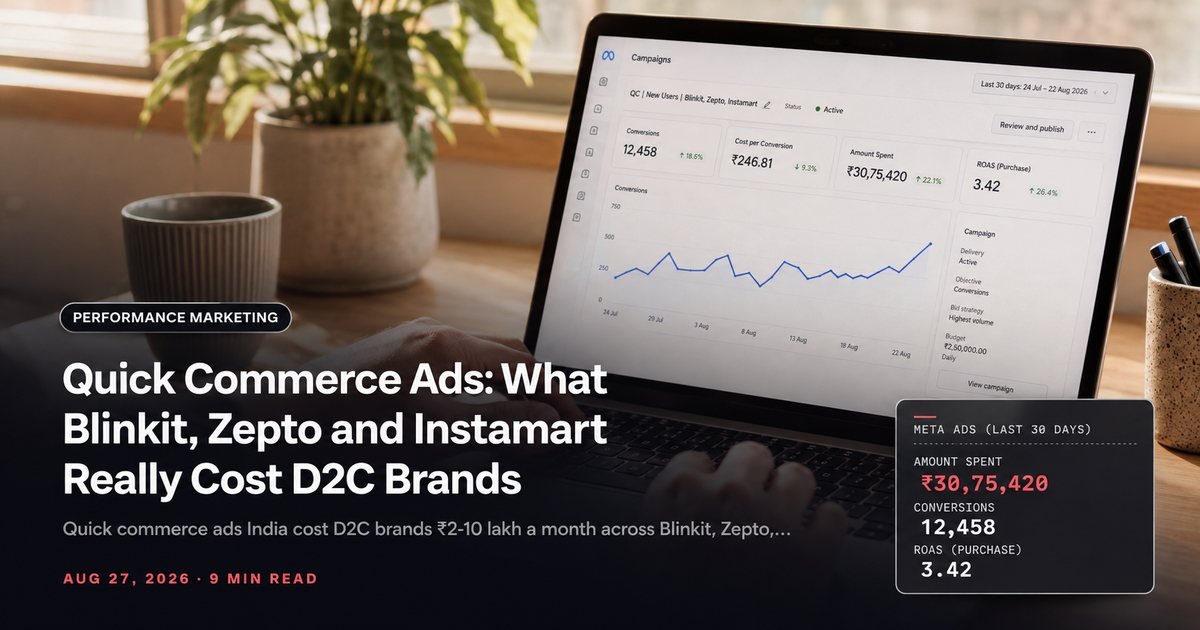
Every founder who lists on Blinkit eventually gets the same call from their account manager: "You're ranking low, boost your visibility." That pitch is quick commerce ads India brands now budget lakhs for every quarter, and most of them signed up without knowing the real fee structure.
I've sat through three of these onboarding calls this year for clients. The pitch always sounds reasonable. The invoice rarely does.
What Blinkit, Zepto and Instamart actually charge
There's no single "ad cost" on these platforms. It's a stack of fees, and each one hits before you've made a rupee back.
Blinkit charges a mandatory listing fee of roughly ₹25,000 per SKU per state, credited to an ad wallet that expires in 12 months if unused. On top of that, minimum monthly marketing spend runs ₹2-3 lakh, and homepage banner slots are auctioned separately.
Zepto bundles things differently. Their onboarding packages start at ₹5-6 lakh and fold in influencer marketing, ad slots, and a listing fee together. You can't buy just the ad slot; you buy the bundle.
Swiggy Instamart quotes a listing-cum-ad-wallet fee of ₹8-10 lakh per quarter for a decent shelf position. That's before performance-based ad spend on top.
Add platform commission, which runs 35-50% depending on category, and you're looking at ₹10-20 lakh a month in combined advertising and listing costs if you want visibility across all three apps at once.

Why the margins rarely work for small brands
Here's the number that should worry you more than any of the above: ROAS on quick commerce platforms rarely clears 1.2x to 1.5x for a self-funded brand without deep pockets.
Compare that to a well-run Meta account, where a mature D2C brand should be sitting closer to 3x-4x blended ROAS. Quick commerce runs on different math entirely. You're buying shelf space in an app, and the spend behaves more like rent than a growth channel.
Three things eat the margin before you even see a sale:
- The listing fee is sunk the moment you pay it, sale or no sale.
- Platform commission takes 35-50% off the top of every order.
- Banner and search-boost auctions push up costs during exactly the festive windows when you need visibility most.
When it's actually worth the spend
Quick commerce ads still make sense in specific cases. A brand with strong repeat purchase behaviour, like food, personal care, or FMCG, can use the platform for discovery and recover margin on reorders where there's no ad cost attached.
A brand launching a new SKU can also justify a short, capped burst of quick commerce spend purely for velocity data. Retailers and category managers watch sell-through rate. A strong 30-day push earns better organic shelf placement afterward.
What doesn't work is treating quick commerce like a always-on performance marketing channel with the same budget discipline as Meta or Google. The unit economics are different, and the platforms know it.

How to budget for it without wrecking your P&L
Treat every rupee on Blinkit, Zepto, or Instamart as trade spend, not as a growth channel with a target CAC. That single mental shift changes how you plan.
Set a hard quarterly cap per platform and never touch it mid-quarter, even if the account manager promises a "limited window" placement. These windows exist every month; the urgency is a sales tactic, not scarcity.
Track contribution margin per platform separately from your website and marketplace numbers. A brand that blends all channels into one CAC number usually doesn't notice quick commerce is bleeding until the quarter's already closed. If your ecommerce stack already tracks channel-level margin, extend that same discipline here instead of treating quick commerce as a black box.
Renegotiate before renewal, not after. Listing fees and ad wallet minimums are quoted as if they're fixed, but account managers have room to move, especially for brands doing consistent volume that the platform wants to keep.
A realistic three-step plan
- 1Audit your current spend by platform. Pull the last two quarters of Blinkit, Zepto, and Instamart invoices and calculate contribution margin per order, not blended ROAS.
- 2Cap listing renewal at one platform if you're running all three and margins are thin. Pick the one with your best sell-through rate and pause the rest for a quarter.
- 3Rebuild the case for scale. If margins recover, use that data to negotiate better ad wallet terms at renewal instead of accepting the standard quote.
Founders who've already compared listing priority across these three apps should also read our breakdown on which platform to list on first if you haven't picked yet.
If you want a second pair of eyes on whether your quick commerce spend is actually paying for itself, book a free strategy call and we'll run the contribution-margin math together.
Book a call