Retargeting Ads on Facebook: What Bad Frequency Caps Are Costing You in Fatigue
Retargeting ads should be your highest-ROAS campaign. Here's why most D2C setups waste budget on frequency, window length, and audience overlap.
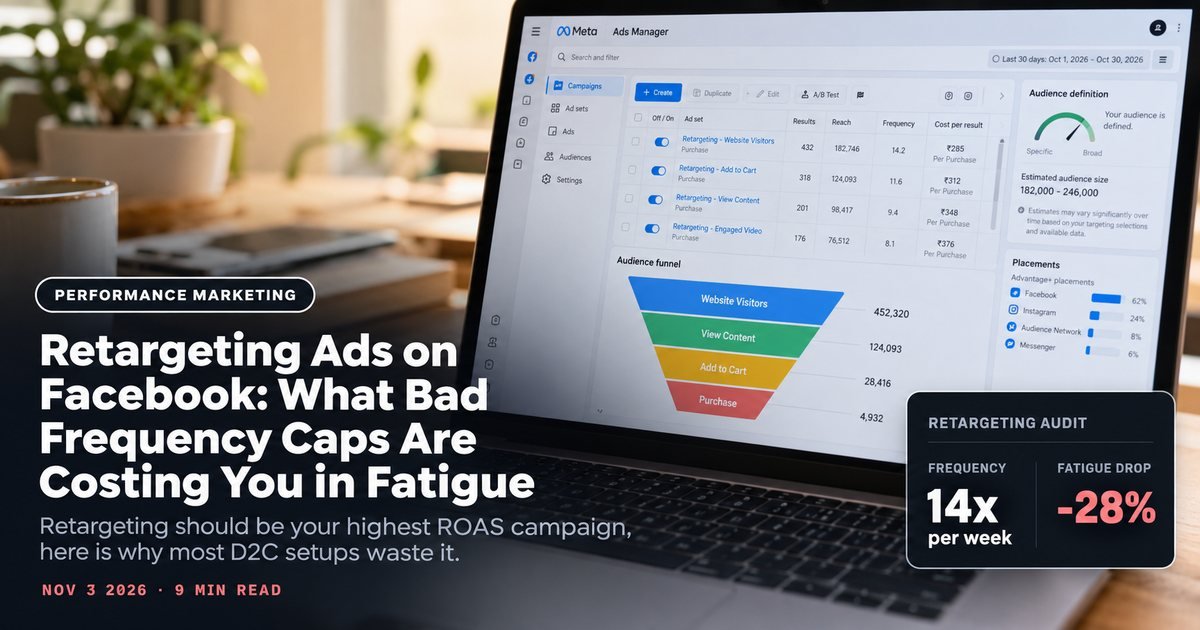
Pull up any D2C Meta ads account and the retargeting campaign is usually the best-performing line item by ROAS, sometimes by a factor of three or four over cold prospecting. That's expected: these are people who already looked at the product.
What's not expected: how often that same campaign is quietly wasting a third of its budget. We audit a lot of client accounts coming from a previous agency or an in-house setup, and retargeting ads facebook campaigns have the most consistent, fixable mistakes of anything we see.
This isn't a "retargeting is underrated" post. Everyone already runs it. The problem is structure. Almost nobody built it with any real structure, and that structure is where the extra 20-40% ROAS is sitting unclaimed.
Mistake one: one audience doing three jobs
The most common setup we inherit is a single retargeting campaign targeting "all website visitors, last 30 days," running one ad, with no exclusions. That one audience is being asked to do three completely different jobs at once.
A person who viewed a product page once and bounced needs a different message than someone who added to cart and abandoned, who in turn needs a different message than someone who already bought and might buy again. Collapsing all three into one audience means your creative has to compromise for all of them and does none of them well.
Split retargeting into at least three separate audiences with separate ad sets: site visitors who haven't added to cart, cart abandoners who haven't purchased, and past purchasers. Each gets its own message, its own budget, and its own performance read.

Site visitors who didn't add to cart usually need reassurance or a stronger offer; they weren't sold on the product yet. Cart abandoners need something else entirely: urgency, a nudge, often a small discount or a reminder that the item is still waiting in their cart.
Past purchasers need a completely different ask. A replenishment reminder, a cross-sell, or simply exclusion from everything else so you're not paying to resell someone who's already converted.
Mistake two: the window is either too short or absurdly long
Retargeting windows in Meta are set per audience, and we see both failure modes constantly. A 1-day window is too short for most considered purchases; the buyer hasn't finished thinking it over yet and your ad disappears before they're ready to act.
A 180-day window, on the other hand, keeps showing ads to people who looked at a face serum five months ago and have long since bought something else or forgotten the brand entirely. You're paying impression costs to reach people with essentially zero remaining intent.
For most D2C categories, 7-14 days works for product-page viewers, 3-7 days for cart abandoners (urgency decays fast here), and 30-60 days for past purchasers depending on how often the product gets repurchased. A skincare serum used daily might warrant a 30-day replenishment window; a mattress brand needs something closer to a year, if it retargets past purchasers at all.
Match the window to how long your actual sales cycle runs, not to whatever Meta's default suggests. Pull your own time-to-purchase data from Shopify or GA4 before setting these, rather than guessing.
Mistake three: no frequency cap, so the same five people see the ad forty times
Ad fatigue shows up fastest in retargeting because the audience pool is small. Cold prospecting campaigns reach millions of people, so frequency naturally stays low. Retargeting pools might only have 5,000-20,000 people in them, and without a cap, Meta will happily show the same creative to the same person daily.
Past a frequency of roughly 4-6 impressions per week, retargeting ads stop converting and start annoying people, sometimes to the point of prompting ad complaints or page unfollows. We've seen accounts running retargeting at frequency 15+ for weeks, burning spend on an audience that's already tuned the ad out.
Set a frequency cap at the ad set level, and just as importantly, refresh creative every 10-14 days for retargeting specifically. Prospecting creative can last longer because new people see it constantly; retargeting creative gets shown to the same small pool repeatedly and goes stale faster.
Mistake four: not excluding recent purchasers
This sounds obvious written out, but it's the single most common thing we find missing in an inherited account: a purchase-event exclusion on every retargeting (and often prospecting) campaign.
Without it, someone who bought your product yesterday keeps seeing "still thinking it over? Here's 10% off" ads for the thing they already own. That's wasted spend at best and a confusing, slightly embarrassing brand experience at worst.

Add a "purchased in last X days" exclusion to every non-purchaser retargeting audience, where X matches your typical repurchase cycle. This single fix alone often recovers 5-15% of retargeting budget that was being spent on people who had nothing left to buy.
Mistake five: static product ads everywhere, no dynamic creative
Dynamic product ads, also called meta shopping ads in some interfaces, pull the exact product someone viewed or added to cart and show it back to them automatically, with current price and stock status, no manual ad building required per SKU.
A lot of accounts skip this and run static, hand-built ads showing a hero product instead. That works fine for a brand with three SKUs. It falls apart for a brand with fifty, because a cart abandoner who looked at a specific ₹1,200 moisturizer doesn't want to see your bestselling serum; they want to see the exact thing they were about to buy.
Dynamic retargeting needs a properly tagged product catalog feed synced to Meta, which usually means the same feed infrastructure used for shopping ads facebook campaigns and Google Shopping. If your ecommerce development setup isn't pushing clean product feeds with accurate pricing and inventory, dynamic retargeting will show broken or outdated listings, which hurts trust more than it helps.
A retargeting funnel structure that actually works
Here's the structure we build for most D2C clients, adjustable by category:
- 1Site visitors, no cart activity (7-14 day window): reassurance-focused creative, social proof, reviews, UGC. Frequency capped at 4/week.
- 2Cart abandoners (3-7 day window): urgency-focused creative, limited-time offer or simple reminder. Frequency capped at 5/week, creative refreshed every 10 days.
- 3Past purchasers (30-90 day window, category-dependent): replenishment or cross-sell creative, with a hard exclusion window matching the product's repurchase cycle so you're never retargeting someone who still has product left.
- 4Purchase exclusion applied across audiences 1 and 2, pulling anyone who's bought in the last X days out of the non-purchaser pools entirely.
This structure takes maybe an extra hour to set up over the single-audience version, and in our client accounts it consistently lifts blended retargeting ROAS by 20-40% within the first month, mostly by cutting wasted spend rather than finding new winners.
Fixing an existing account vs starting fresh
If you're inheriting an account from a previous setup, don't rebuild everything on day one. Pull the last 90 days of performance by audience first, and you'll usually find the single-audience campaign is masking one strong segment and one weak one.
Split those out, add the purchase exclusion immediately (that's the fastest win), then layer in windows and frequency caps over the next two weeks. This is also a good moment to audit whether your broader performance marketing agency relationship is tracking these fundamentals, since retargeting hygiene is a basic hygiene check, not an advanced tactic.
Want us to audit where your CAC is leaking?
Book a call