WhatsApp Ads for D2C Brands: The Channel Your COD Orders Are Begging For
WhatsApp ads turn a cold Facebook or Instagram click straight into a conversation. Here's how click-to-WhatsApp works, what it costs, and who it suits.
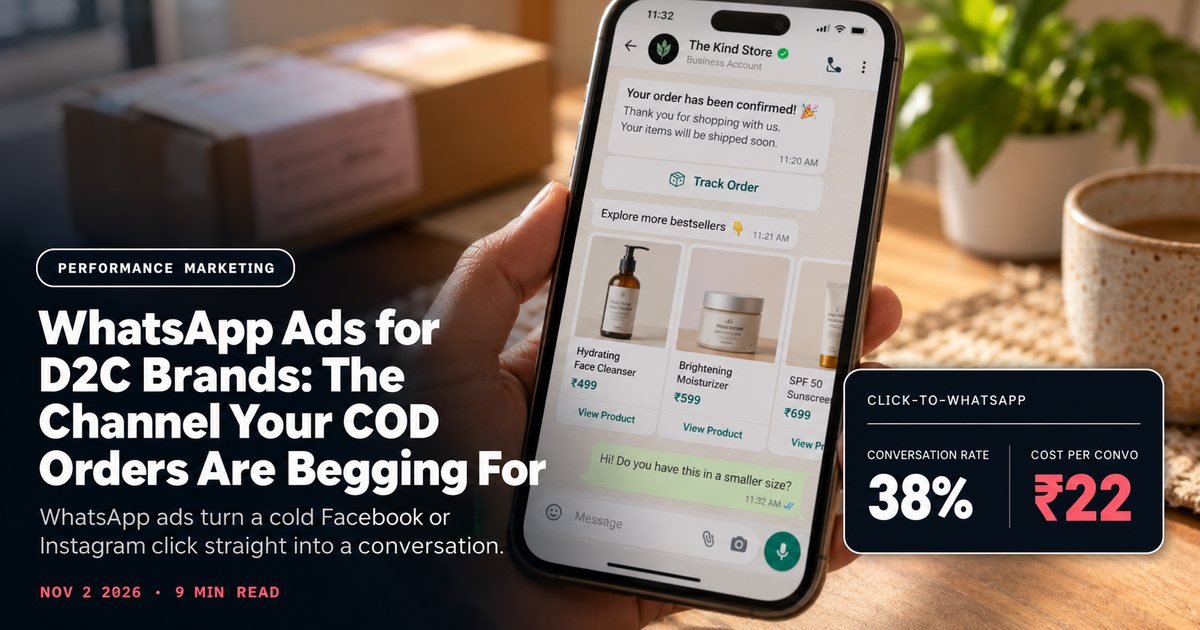
Open your own WhatsApp right now. Count how many business chats are sitting in there, a courier update, a clinic appointment reminder, maybe a D2C brand you ordered from once. That's the inbox your next campaign could land in, and almost nobody is running whatsapp ads on purpose yet.
Most D2C brands in India run the same three plays: Meta website-conversion campaigns, a Shopify checkout, and influencer content pointing at both. Click-to-WhatsApp ads sit quietly in Ads Manager, usually set up once by accident and never touched again.
That's a gap worth closing, especially for anyone selling COD-heavy, trust-sensitive, or higher-consideration products. This post covers how the ad format actually works, why it fits Indian buying behavior so well, and what to expect on cost and conversion once you turn it on properly.
What a click-to-WhatsApp ad actually is
A click-to-WhatsApp ad looks identical to a normal Meta ad in the feed, same image or video, same headline. The difference is the button underneath.
Instead of "Shop Now" taking someone to a landing page, it opens a WhatsApp chat with your business number, pre-filled with a message like "Hi, I'm interested in the overnight repair serum." The person taps once, lands in a conversation, and your team (or an automated flow) picks it up from there.
You can run this from both Facebook and Instagram placements, and the targeting, bidding, and optimization inside Ads Manager work the same way a normal conversion campaign does. The only real change is the destination: a chat thread instead of a web page.

The conversion event moves from "purchased" to "started a conversation," which is a much lower bar to clear and a much higher-intent signal than a page view. That trade-off is the whole reason this format works as well as it does for the right kind of product.
Why this fits Indian D2C buying behavior specifically
Three things make WhatsApp unusually well suited to the Indian market, more than most performance marketers give it credit for.
First, cash on delivery is still a huge share of first-time orders for new D2C brands, often 40-60% depending on category. A buyer paying on delivery wants reassurance before they commit, and a real-time chat answering "will this actually work for oily skin" closes that gap faster than an FAQ accordion on a product page ever will.
Second, trust in an unfamiliar brand's website is lower than trust in a conversation with a human-sounding account. A DTC skincare brand running its first big push can get more out of ten minutes of back-and-forth on WhatsApp than out of three more landing page sections.
Third, WhatsApp is already the default communication layer in India. People check it constantly, reply fast, and don't need to download or learn a new app to interact with your brand. That's a lower-friction path than clicking through to an unfamiliar site on mobile data.
WhatsApp Business API basics you need before scaling
Running click-to-WhatsApp ads at any real volume needs more than the free WhatsApp Business app. Here's the setup that actually scales:
The WhatsApp Business API (now usually accessed through Meta's own Business Manager or a BSP like Interakt, WATI, or AiSensy) lets multiple agents handle one number, supports automated quick replies, and connects to a CRM so leads don't sit unanswered in someone's personal phone.
Expect to pay a BSP ₹3,000-₹15,000 a month depending on conversation volume, plus Meta's per-conversation fees, which run roughly ₹0.35-₹0.95 per business-initiated conversation in India as of this writing and are free for the first user-initiated reply within a 24-hour window.

The catalog feature matters too. You can upload your Shopify or product catalog directly into WhatsApp Business, so a buyer can browse, add to a cart-like list, and checkout inside the chat without ever leaving the app. For brands running ecommerce development work alongside this, syncing the catalog feed from your store to WhatsApp automatically (rather than manually re-uploading SKUs) saves real operational time every week.
Setting it up: the practical steps
- 1Get a dedicated business number, not a personal one, and verify it through Meta Business Manager.
- 2Connect a BSP if you expect more than roughly 50 conversations a day; the native app's single-device limit breaks down fast past that volume.
- 3Build a quick-reply template for the top 5 questions you already get (ingredients, return policy, delivery time, sizing, COD availability) so first responses go out in under two minutes, not two hours.
- 4Launch the ad itself inside Ads Manager exactly like a normal conversion campaign, same creative testing discipline, same audience structure, just with the WhatsApp destination selected instead of a website URL.
- 5Track conversation-to-order rate manually for the first two weeks. Most BSPs don't attribute this cleanly to Meta's own ROAS number yet, so a simple spreadsheet tagging each chat to an order is worth the manual effort early on.
What to actually expect on cost and conversion
Cost per click-to-WhatsApp result (meaning a started conversation) typically runs lower than cost per website purchase, often ₹15-₹45 per conversation for a reasonably targeted campaign in beauty, wellness, or fashion categories. That number alone looks great until you remember it's a softer event than a sale.
The real metric to watch is conversation-to-order rate, and in our experience running this for D2C clients, it lands somewhere between 15% and 35% depending on how fast and well the team responds. A brand that replies within five minutes with a clear next step converts meaningfully better than one that replies the next morning.
Response speed is the single biggest lever in this channel, more than creative, more than targeting. A beautiful ad that funnels into a chat nobody answers for six hours is worse than no ad at all; the person has moved on and may associate the slow reply with the brand itself.
This is also why WhatsApp ads rarely work as a "set and forget" channel the way a well-optimized performance marketing account can. Someone needs to own the inbox, and that operational cost should factor into whether this channel makes sense for your current team size.
Who should actually run this, and who shouldn't
Good fits: skincare and wellness brands with real buying questions, COD-heavy fashion and home brands rebuilding trust with first-time buyers, higher-ticket categories (₹2,000+) where a quick reassurance conversation changes the decision, and brands already running influencer marketing that want a lower-friction next step for warm audiences discovering the brand through a creator.
Weaker fits: ultra-low-price impulse categories where the extra chat step just adds friction, and any brand without the staffing to answer chats within business hours. If your digital marketing agency or in-house team is already stretched thin on the existing channel mix, adding an unanswered inbox does more harm than good.
A rough budget to pilot this properly
If you want to test the channel without overcommitting, a sensible pilot runs ₹25,000-₹50,000 in ad spend over two weeks, enough to generate 300-800 conversations depending on category and targeting, plus the BSP setup cost mentioned earlier.
Track three numbers from day one: cost per conversation, conversation-to-order rate, and average response time. If response time creeps past fifteen minutes during business hours, fix staffing before scaling spend further, because no amount of extra budget fixes a slow inbox.
Most brands either over-invest before proving the loop works, buying a premium BSP plan and building elaborate chatbot flows before a single ad has run, or under-invest by treating it as a side experiment nobody owns. Neither works. Treat the pilot like any other new channel test inside your existing performance marketing account: a defined budget, a defined success metric, and a two-week review before deciding whether to scale it.
Want us to audit where your CAC is leaking?
Book a call