Ecommerce Marketing in 2026: What Spreading Your Budget Thin Is Actually Costing You
Digital ecommerce marketing in 2026 means sequencing Google, Meta, email and WhatsApp correctly, not running all four at once. Here's the framework.
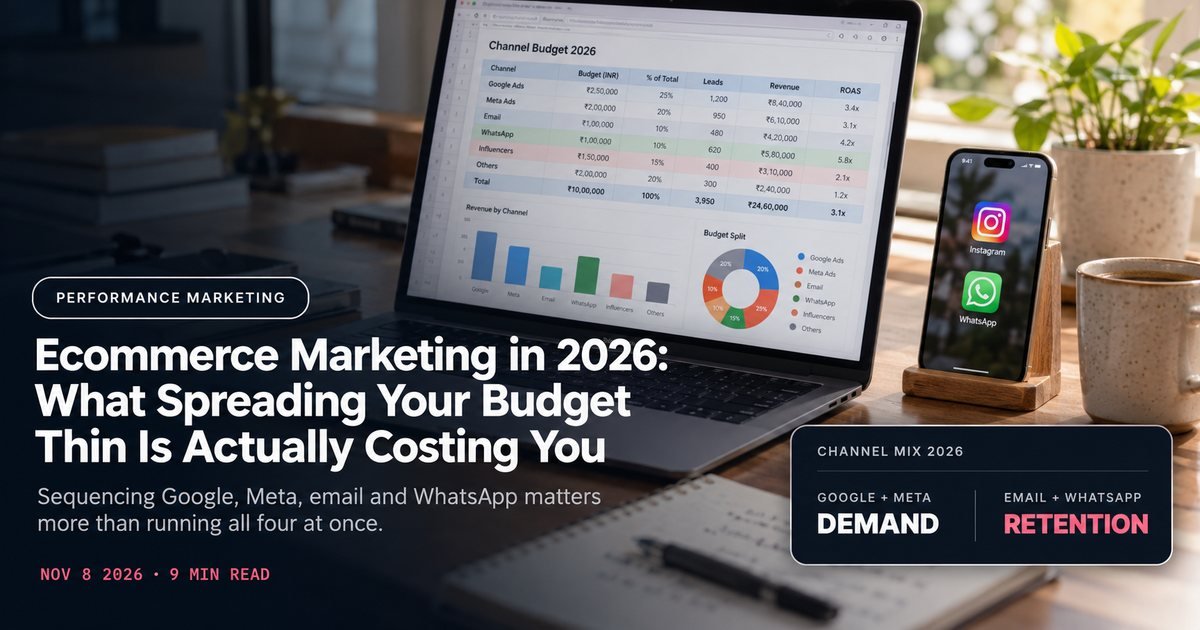
A skincare brand we spoke with last quarter was running Google Search, Meta Reels, email flows, and a WhatsApp broadcast list all at once. The budget could realistically support two of those well.
Nothing was broken exactly. Everything was just thin.
That's the most common failure mode in digital ecommerce marketing right now. Not picking the wrong channel, but refusing to sequence the right ones.
Google, Meta, email and WhatsApp each do a genuinely different job in the funnel. They are not interchangeable. Running all four at mediocre intensity rarely beats running two of them properly.
This piece lays out what each channel is actually built to do, and a practical way to decide which one deserves your next rupee based on where your traffic and revenue mix stands today.
Google Search captures demand that already exists
Google Search ads show up when someone has already decided they want something like your product and is actively looking. That's the core job: capturing existing demand. Creating demand is a different channel's job entirely.
A shopper searching "organic vitamin C serum India" already knows roughly what they want. Your ad's job is to be there, with a clear price and a fast-loading page, when they search.
This is why Search tends to convert at a higher rate than discovery channels, often 3-6% for well-optimized D2C categories against Meta's typical 1-2%. It can't manufacture demand that doesn't exist yet, though. That's the tradeoff.
Google Shopping and Performance Max extend this by surfacing your product directly in search and across Google's network using your catalog feed, which matters more as your SKU count grows past 15-20 products.
If your category has real, searched-for demand, Search should usually be funded before Meta, not after. Too many D2C brands pour budget into Meta discovery while underfunding the Search campaigns that would have converted a buyer already looking for them, at a lower cost per acquisition.

Meta and Instagram generate demand that doesn't exist yet
Meta Ads and Instagram work on the opposite principle. Most people scrolling Reels weren't looking for a new mattress or a probiotic supplement. Your ad has to create the want, then make the case for buying now.
This is why creative matters so much more here than on Search. A strong UGC-style video showing a real use case can outperform a polished studio ad by 2-3x on CAC, because it interrupts a scroll with something that reads as a recommendation rather than an ad.
Meta Ads are also where most new-customer acquisition for D2C brands in India happens at scale, since the platform's targeting and placement options (feed, Reels, Stories) let you test audiences faster and cheaper than most other channels.
The tradeoff is cost efficiency per conversion. Meta is built to generate volume and new-customer reach; a tight CAC on Search doesn't carry over. Expect to pay more to acquire through Meta than through Search, and budget for that difference rather than treating a rising Meta CAC as a sign something's broken.
Email and SMS retain and drive repeat purchase
Once someone's bought, Google and Meta mostly stop being the efficient channel. Email and SMS take over, and they're dramatically cheaper per order than paid acquisition.
A well-built post-purchase flow (order confirmation, shipping updates, a review request, a replenishment nudge for consumable categories) can drive 15-25% of total revenue for a mature D2C brand, at a fraction of the cost of acquiring the same revenue through ads.
The mechanics matter here. Abandoned cart flows, win-back campaigns for customers who haven't ordered in 60-90 days, and post-purchase cross-sell sequences are the builds that actually move revenue for ecommerce, as opposed to generic newsletter content that most brands default to and that drives comparatively little.
Retention through email and SMS is the cheapest revenue you'll generate all year, and it's also the channel most D2C brands underinvest in relative to its return, because it doesn't have the obvious "spend more, get more reach" dial that paid media has.

WhatsApp handles conversion assistance and COD confirmation
WhatsApp occupies a specific, India-specific role that doesn't map cleanly onto any Western ecommerce playbook: conversion assistance and cash-on-delivery confirmation.
A huge share of Indian D2C orders, especially outside metro cities, still come in as COD. Cash on delivery remains a meaningful share of order volume for most brands selling outside the top eight cities, and COD orders have a materially higher cancellation and return-to-origin rate than prepaid.
A WhatsApp confirmation message sent within minutes of checkout, confirming the order and address before it ships, can cut COD cancellation rates meaningfully, often by double digits, because it catches mistyped addresses and impulse cancellations before the product leaves the warehouse.
WhatsApp also works earlier in the funnel for high-consideration categories: a shopper with a sizing question on a ₹3,000 kurta is far more likely to message on WhatsApp than fill out a contact form, and a fast human (or well-built bot) reply there converts at a rate that a static FAQ page never will.
Where organic and paid actually overlap
None of these four channels run in isolation, and treating them as four separate budgets is its own kind of mistake. Organic search traffic and Google Search ads compete for the same real estate on a results page, and a brand with strong organic rankings for its core product terms can often cut Search ad spend on those exact keywords without losing visibility.
The same overlap shows up between Meta ads and organic Instagram content. A Reel that performs well organically is frequently the strongest-performing ad creative too, since the signal that made it resonate organically (a genuine hook, a real use case, a face people trust) is the same signal that stops a scroll in a paid placement. Brands that treat organic content and paid creative as separate workstreams usually waste the one asset, a proven organic winner, that would have made their next ad campaign cheaper to run.
Email list growth has a similar paid-organic relationship. Every Meta or Google ad that sends traffic to a product page without a visible email capture is leaving a retention asset on the table, built at acquisition cost and then thrown away the moment the session ends. A simple on-site popup or post-purchase opt-in turns a chunk of that paid traffic into an owned audience that email and WhatsApp can remarket to for free, which is part of why the retention math in the earlier section looks as favorable as it does.
Budgeting for seasonality, not just steady state
Everything above describes a steady-state month. Festive season breaks the framework in a predictable way: demand spikes across all four channels at once, and the brand that's been running one channel well for a quarter usually has the operational muscle to scale that channel fast when the spike hits, rather than scrambling to stand up a new one under pressure.
Google Search volume for gifting and seasonal categories climbs sharply in the weeks before Diwali and other festive periods, which means Search budgets that felt adequate in August can underfund real demand in October. Meta CPMs climb at the same time as every other advertiser bids up the same inventory, so the cost-efficiency gap between Search and Meta narrows during peak season even as both get more expensive in absolute terms.
WhatsApp's role also shifts during high-COD-volume periods like festive season, when order volume (and the cancellation risk that comes with it) both increase. A confirmation flow that was optional in a normal month becomes closer to essential when a spike in COD orders means a spike in the absolute number of cancellations if nothing catches them. Building and testing that flow in a quiet month, rather than during the highest-pressure weeks of the year, is the kind of unglamorous prep work that separates brands with a smooth festive season from ones firefighting through it.
A framework for sequencing your next rupee
The right next channel depends on where your current traffic and revenue mix sits, not on what's trending.
If most of your traffic is unbranded and you have no meaningful organic search presence, fund Search first; you're leaving the cheapest, highest-intent conversions on the table.
If you have decent Search coverage but your monthly new-customer count has plateaued, Meta is your next dollar; you need top-of-funnel volume that Search can't generate on its own.
If your repeat purchase rate is under 20% and you have no post-purchase email flows live, stop adding acquisition budget and build the retention flows first. New-customer CAC becomes a much better investment once a meaningful share of those customers buy again.
If COD represents more than a third of your order volume and you have no confirmation flow, a basic WhatsApp ads and messaging setup for D2C brands pays for itself quickly just from reduced cancellations, before you even count it as a marketing channel.
Sequencing beats spreading. That's the whole argument here.
A brand running one channel well for a quarter learns more than a brand running four channels thinly for the same period, and the data from that one channel usually tells you exactly which one to fund next.
What to actually do this quarter
- 1Pull your current channel mix and revenue split; most brands discover they're running four channels at 25% intensity each instead of two well.
- 2If Search spend is under 20% of your total budget and your category has real search volume, reallocate toward it before adding more Meta spend.
- 3Audit whether post-purchase email flows exist at all; if not, this is usually a two-week build with outsized return relative to the cost.
- 4If COD orders exceed 30% of volume, set up a WhatsApp order-confirmation flow before your next festive push.
- 5Review this mix every quarter, not once a year; channel efficiency shifts with iOS tracking changes, platform CPM trends, and your own repeat-purchase curve as the brand matures.
If you want help figuring out which of these actually applies to your numbers, a free strategy call is a quick way to get a second opinion before you shift next month's budget.
Book a call