Facebook & Instagram Ads on One Account: What You're Losing by Not Splitting the Budget
Facebook and Instagram ads run from one account but reach different people. Here's how to read placement-level data before it misleads you.
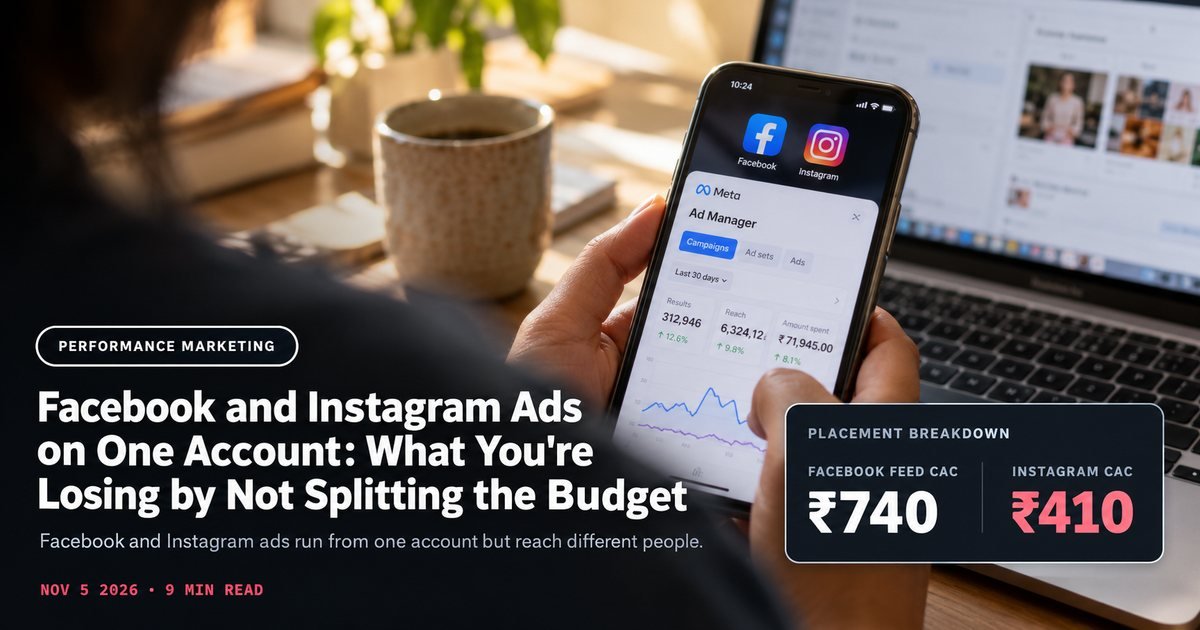
A single Meta campaign with automatic placements will happily spend your budget across Facebook feed, Instagram feed, Instagram Reels, and Facebook Reels at once. It reports one blended set of facebook and instagram ads numbers at the campaign level.
That blended number can hide a real problem. One platform might be carrying the whole campaign while the other quietly burns budget with nothing to show for it.
We've pulled placement breakdowns on dozens of Indian D2C accounts where the campaign-level ROAS looked fine, 2.8x, solid enough to scale. The placement-level data underneath told a completely different story: Instagram at 4.1x, Facebook at 1.3x.
Scaling that campaign without knowing that would have poured more money into the weaker platform. If you want someone to pull this breakdown on your own account, our performance marketing team runs this exact audit for new clients.

Facebook and Instagram users in India aren't the same audience
Even inside one household, the person using Facebook and the person using Instagram often behave differently. Sometimes it's genuinely two different age groups entirely.
Facebook in India skews older and more price-sensitive on average. Users in their late 30s to 50s still make up a large share of active Facebook usage. Purchase behavior there tends to respond more to clear pricing, reviews, and straightforward product benefit claims.
Discount-led messaging and social proof, ratings, review counts, tend to outperform aspirational or trend-driven creative on Facebook feed.
Instagram skews younger and more visually driven. The 18-34 bracket dominates usage. This audience responds more to aesthetic, trend relevance, and creator-style content than to a hard discount push, a pattern our Instagram algorithm 2026 breakdown covers from the organic side too. A UGC-style Reel that underperforms on Facebook can be the top-performing asset on Instagram Reels in the same account.
Not every brand or category follows this split exactly. But it holds often enough that treating "Meta ads" as one undifferentiated audience is the real mistake.
A skincare brand running the exact same static ad across both placements is, in effect, running one creative against two audiences with different expectations. The result: an average outcome instead of a strong one on either.
Why a blended campaign number can mislead you
When you run automatic placements, the correct default for most accounts, Meta's delivery system decides how much budget each placement gets based on where it predicts the best results. Genuinely useful. Real-time optimization you can't match manually.
The real problem is the campaign-level report, rolling everything into one ROAS, one CPA, one number. A 2.8x blended ROAS could mean both platforms are performing evenly, or it could mean one platform is doing almost all the work while the other drags the average down. You can't tell which without going one level deeper.
This matters most at the moment you're deciding whether to scale. Say a campaign is secretly 80% dependent on Instagram performance, while Facebook limps along at break-even. Doubling budget there pours fresh money into the weak half too, since increases get distributed by that same automatic logic.
How to read placement-level reporting correctly
Inside Ads Manager, go to your campaign, open the Breakdown menu above the results table, and select Placement. This splits your blended numbers into Facebook feed, Instagram feed, Instagram Reels, Facebook Reels, and any other active placement, each with its own spend, results, and cost per result.
Do this check before every scaling decision, not after a campaign has already run for a month. Look specifically for:
- A placement with spend share meaningfully higher than its result share. That's the one quietly dragging the average down.
- A placement with disproportionately strong CPA relative to its spend share. That's where additional budget would likely do the most good if you shifted it there.
- Big swings week to week on one placement specifically, which often means creative fatigue hitting that audience faster than the other.
Run this breakdown weekly for the first month of any new campaign, then at minimum before any budget increase after that. It takes under five minutes and it's the single most common blind spot we find auditing new client accounts.
A real example of what this looks like in practice
A home fragrance brand we audited last quarter was running one campaign at a blended 2.4x ROAS, decent enough that nobody had looked closer in months. The placement breakdown showed Instagram Reels at 3.6x and Facebook feed at 0.9x, essentially losing money on nearly a third of the budget.
The fix wasn't complicated. We kept the campaign structure as-is but briefed two Facebook-specific static ads leading with a review count and a direct price comparison against the category average, the kind of proof-based creative that Facebook's older, more price-sensitive audience responds to.
Within three weeks, Facebook feed climbed to 1.8x. Blended ROAS moved from 2.4x to 3.1x without a single rupee of extra spend, just by fixing what was actually broken instead of scaling a number that looked fine on the surface.
That's the pattern worth internalizing: the campaign-level metric told us nothing was urgently wrong. The placement breakdown told us exactly where to look. Our digital marketing strategy playbook walks through where this kind of channel-level diagnosis fits into a broader plan.
When to split placements vs let automatic optimize
Automatic placement is the right default for 80-90% of D2C accounts, especially newer ones still building conversion volume, because it needs flexibility to find where your buyers actually are. Splitting too early, before you have enough data, usually just creates two underfunded campaigns competing against each other for the same audience pool.
Split placements deliberately when you've identified a real, consistent gap through the breakdown above, not as a default strategy.
If Instagram Reels has outperformed Facebook feed by 2x or more for three straight weeks, and you have a large enough budget to fund two separate campaigns properly (generally ₹2,000+ daily per campaign minimum), splitting lets you control budget allocation directly instead of hoping Meta's automatic logic keeps favoring the stronger placement as you scale.
Splitting also makes sense when you want platform-specific creative that genuinely differs rather than a resized version of the same ad.
A founder-led talking-head video that performs on Instagram might need a different structure, tighter hook, more direct pricing callout, to work on Facebook's older audience. Running separate campaigns lets you brief and test that difference cleanly, something our meta ads for D2C brands guide covers in more depth if you're rebuilding account structure from scratch.

The practical middle ground most accounts should use
For most mid-size D2C accounts, the right approach sits between full automatic and a full manual split. Keep automatic placement running. Build a standing habit of checking the placement breakdown weekly, and adjust creative, not campaign structure, based on what you find.
If Facebook consistently underperforms within a blended campaign, the fix is usually creative. A more price-forward, review-led variant, aimed at that audience, added into the same creative rotation. Leave the automatic system to keep allocating budget efficiently. Just feed it creative that actually fits both audiences, not one audience with a second placement bolted on.
Stories and Reels need their own placement check too
Placement breakdown isn't just Facebook versus Instagram. Within Instagram alone, feed, Stories, Reels, and Explore behave as different sub-placements with their own creative expectations.
A static product shot that performs in feed often falls flat in Stories, where the format rewards something that feels native to a quick, full-screen swipe. Reels rewards motion and a hook in the first two seconds, closer to organic content than a polished ad.
Run the same breakdown logic one level deeper when a campaign includes Stories or Reels specifically. If Reels is pulling a disproportionate share of spend relative to results, the fix is rarely the bid or the budget. It's usually that the creative was built for feed and resized down, rather than built for the format it's running in.
Age and gender splits inside the same placement
Placement isn't the only lens worth checking. Within a single Facebook feed placement, performance can still split sharply by age and gender, especially for categories like skincare, supplements, or apparel where the buyer skews heavily toward one demographic.
Open the Breakdown menu again, this time selecting Age or Gender instead of Placement. A campaign that looks fine in aggregate can be carried almost entirely by women 25-34, while every other segment loses money quietly underneath it.
This matters for creative decisions as much as budget ones. If one age bracket is driving most of the result, the messaging, pricing callout, and visual style probably already resonates with that group.
The question becomes whether to double down on serving that segment better, or to test a second creative variant aimed specifically at the underperforming ones. Worth asking either way. If this kind of granular reporting feels like more than your team can realistically keep up with in-house, our breakdown of social media marketing agency vs in-house walks through that tradeoff honestly.
Takeaways
- 1Facebook and Instagram audiences in India differ meaningfully in age and purchase behavior; the same creative often doesn't work equally well on both.
- 2A blended campaign ROAS can hide one placement carrying the whole result while the other barely breaks even.
- 3Check the Placement breakdown in Ads Manager weekly, especially before any scaling decision.
- 4Keep automatic placement as your default; split into separate campaigns only after you've confirmed a consistent gap over several weeks.
- 5When one placement underperforms, try fixing it with audience-specific creative before restructuring the campaign itself.
If you want a placement-level audit of your current account to see exactly where your budget is actually working, book a free strategy call and we'll pull the breakdown live on the call.
Book a call