Digital Marketing Strategy for D2C Brands: Building the 2026 Playbook
A digital marketing strategy for D2C brands that sequences paid, content, organic social, and influencer into one growth system, not four disconnected teams.
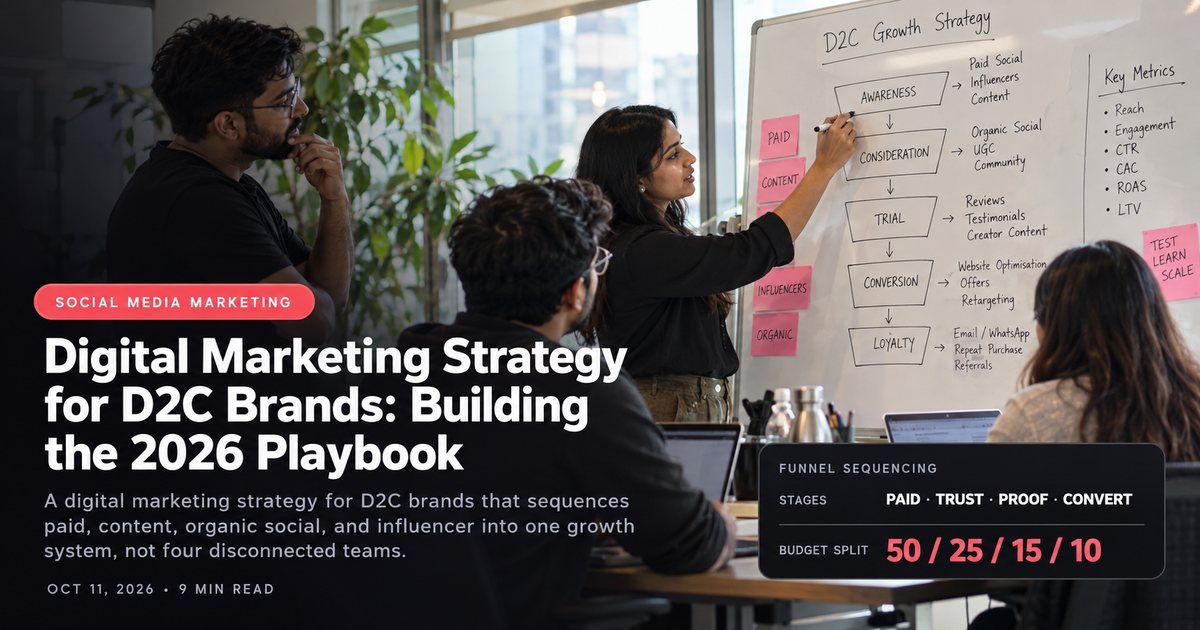
Most D2C founders don't have a digital marketing strategy. They have four separate ones running in parallel, each reporting to a different dashboard.
Paid media chases CAC. The social team chases followers and reach. Content chases traffic. Influencer chases reach and vanity screenshots. Nobody owns the sequence between them, so the brand spends four budgets to get the output of one.
A real digital marketing strategy treats these as stages of a single system. Paid buys attention. Content and organic social build the trust that makes attention convert. Influencer supplies proof at scale.
Each stage feeds the next. Skip the sequencing and you're just buying reach with no compounding effect behind it.
This is the 2026 playbook we use with Creator City clients. It covers how to sequence channels, size budgets across them, and know which stage is actually broken when growth stalls.
If you're looking for the execution layer, things like content pillars, posting cadence, and community response, our tactical social media playbook covers that in depth. This piece stays one level up. It's the cross-channel strategy that decides how much budget and attention each channel gets, and in what order.
Why channel-by-channel thinking caps your growth
A brand running Meta ads, Instagram content, and two influencer campaigns a month usually thinks it's running an integrated strategy. Really, it's running three campaigns that happen to target the same customer.
You can tell because the numbers don't add up cleanly. Paid CAC looks fine in isolation. Organic reach looks fine in isolation.
But blended CAC, the number that actually decides if the business survives, keeps drifting up every quarter. That's the tell of unsequenced spend.
Each channel is optimizing for its own metric instead of the next stage in the funnel. A Reel that gets 40,000 views but zero saves isn't feeding your retargeting pool. An influencer post with a great engagement rate but no product-in-use footage gives your ad account nothing to repurpose.
Fix the sequencing first. Budget allocation comes second.
The four stages, in the right order
Think of the D2C funnel as four handoffs, not four departments.
Stage 1 is paid, and its job is to buy the first look. Performance marketing is the fastest lever to put your brand in front of a cold audience at a known cost. Nothing else scales attention on a schedule the way paid does.
Its job here is to get eyes on the brand and start collecting signal, who clicks, who adds to cart, who bounces, not to close the sale on the first click.
Stage 2 is content and organic social, and they build the trust paid can't buy on its own. Someone who saw your ad twice searches your Instagram before they buy. If that grid is dead, thin, or purely promotional, you lose the sale you already paid to win.
Organic social and blog content answer the questions a cold click doesn't answer: does this actually work, is this a real brand, what do other buyers say.
Stage 3 is influencer, and it supplies proof at a scale you can't fake internally. One founder testimonial convinces nobody. Fifteen creators using the product in their own voice, across different follower tiers, convinces a lot of people.
This is also where your best ad creative usually comes from. Whitelisted or spark-ads versions of influencer content routinely outperform in-house creative on cost per result.
Stage 4 is the store, and it closes what the first three stages opened. All of that upstream work dies at checkout if load times are slow or the product page doesn't answer the last objection. Conversion-focused ecommerce development is the stage most D2C brands underinvest in, because it's the least glamorous.
In practice, the stages blur together. A customer might see an influencer post before an ad, or land on the site first and check Instagram after.
Budgeting and content planning should still respect this order, though. Each stage's output becomes the next stage's raw material.
Budgeting across the four stages, not within one
Once you accept the stages feed each other, budget splits look different. Here's a starting allocation we use for D2C brands doing ₹15-60 lakh a month in revenue, before any brand-specific tuning:
- 45-55% performance marketing, the always-on engine, split roughly 60/40 between Meta and Google depending on category
- 20-25% influencer marketing, a mix of paid collaborations and gifting, weighted toward creators whose content will double as ad creative
- 15-20% content and organic social production, filming, editing, scripting, community management
- 10% ecommerce and CRO, landing page tests, speed fixes, checkout friction removal
These ratios shift as the brand matures. A brand under ₹10 lakh a month usually needs to over-invest in content and organic first, because paid has nothing credible to point traffic at yet.
A brand past ₹1 crore a month can often trim performance marketing's share slightly. Organic reach from creators starts compounding brand search volume on its own by that point, so influencer takes on a bigger job.
The mistake we see most is brands funding stage 1 heavily and starving stages 2 and 3, then wondering why paid CAC keeps climbing. Cold traffic with no social proof to land on converts worse every month as the algorithm's early novelty wears off.
Diagnosing which stage is actually broken
When blended CAC creeps up, most teams add more paid budget. That's usually the wrong fix, because it treats a sequencing problem as a spend problem.
Work backward through the four stages before touching the ad budget:
- 1Check the store first. If checkout conversion rate is under 1.5%, no amount of upstream traffic fixes the leak. Fix page speed and checkout friction before anything else.
- 2Check the proof layer next. Pull up your product page and ask honestly: would a stranger trust this? If there's no UGC, no reviews, no creator content, that's your fix, not more ad spend.
- 3Check organic social. Look at your last 10 posts. If saves and shares are near zero, that content is just occupying a feed slot, doing nothing to build trust.
- 4Only then look at paid. If the first three stages check out and CAC is still climbing, the issue is creative fatigue or audience saturation, both fixable inside the ad account.
Running this diagnostic quarterly catches problems before they show up as a bad month of revenue. Most brands only run it after the damage is visible.
Content marketing's role in the sequence
Content marketing sits underneath all four stages, not beside them. Blog content and SEO-driven pages capture the search demand your paid and influencer work creates: someone who saw a Reel about your product often googles the brand name before buying. A content marketing engine built for this exact handoff gives that searcher an answer instead of a blank SERP.
This matters more every year because brand search volume, not just paid impressions, has become a leading indicator of which brands are winning in a category. If your organic search presence is thin, you're leaking demand you already paid to generate.
What actually breaks a sequenced strategy
Two things kill this system even when the plan on paper looks right.
First, disconnected teams. If your performance marketer never talks to whoever runs Instagram, nobody is deciding which content becomes ad creative. Nobody decides which ad learnings should shape the next content brief either.
This is an org problem more than a budget problem. It's the single biggest reason agencies exist: someone has to own the handoffs.
Second, no shared measurement. If paid reports on CAC, social reports on reach, and influencer reports on impressions, you can't tell which stage is actually underperforming.
Put everything against one shared number instead, contribution to blended CAC or revenue, even if each channel also tracks its own operational metrics.
A numbered takeaway for building your 2026 plan
- 1Map your funnel into the four stages (paid, trust-building, proof, conversion) before allocating a single rupee of budget.
- 2Start budget splits around 50% paid, 20-25% influencer, 15-20% content and social, 10% ecommerce/CRO, and adjust based on brand maturity.
- 3Diagnose CAC problems backward through the funnel: store first, then proof, then organic, then paid, instead of defaulting to "add more ad spend."
- 4Treat influencer content as a creative pipeline for paid, not a standalone campaign that ends when the post goes live.
- 5Put one shared metric over all four channels so you can actually tell which stage is underperforming.
- 6If you want the execution details for organic social once the strategy is set, the social-specific tactical companion to this cross-channel strategy covers posting cadence and content pillars in depth.
If you'd rather have someone map this against your own numbers, book a free strategy call and we'll walk through where your funnel is actually leaking.
Book a call