Social Media Marketing Strategy for D2C Brands: What Actually Works in 2026
A social media marketing strategy for D2C brands in 2026: content pillars, posting cadence by platform, community management, and paid amplification.
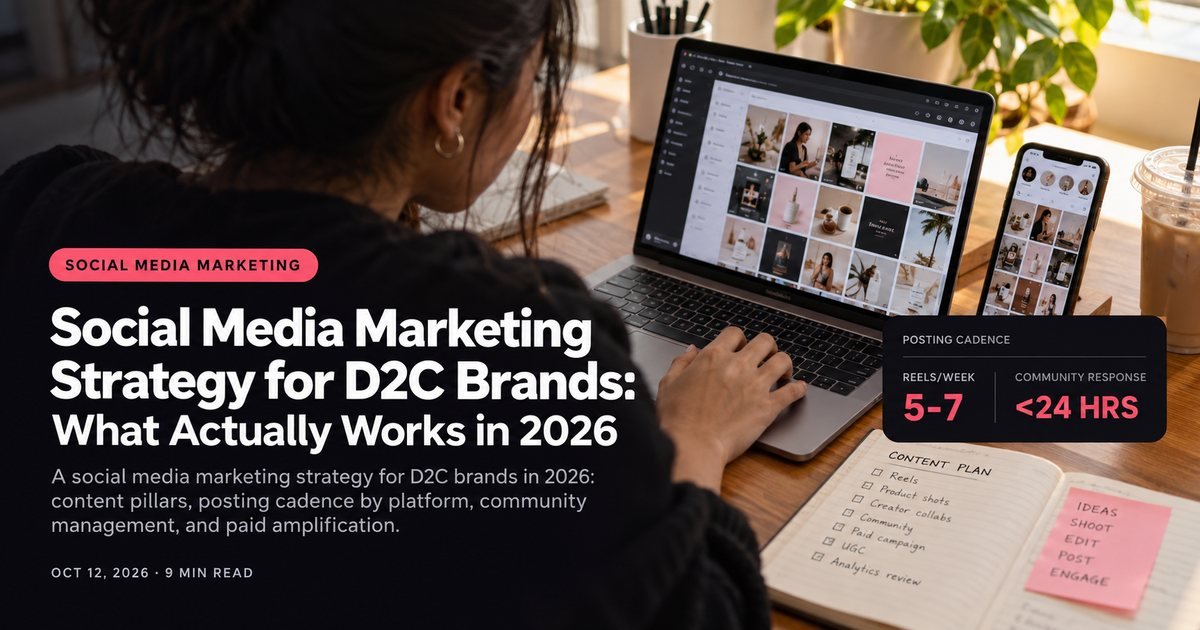
Most D2C brands don't have a social media marketing strategy. They have a posting habit. Someone on the team uploads a Reel when they remember to, replies to comments when they see them, and calls it content.
A real strategy tells you what to post, when to post it, who replies to what, and how much you spend to push the winners further. Skip any of those four pieces and you're guessing on a schedule, hoping something lands.
No plan, no traction.
This piece stays inside the app: content pillars, cadence, community management, and paid social amplification. Figuring out how social fits alongside performance marketing, influencer campaigns, and content in a full channel sequence is a different question. The broader cross-channel companion to this social-specific playbook covers that side of it.
Content pillars: the four buckets that actually work for D2C
Pillars work as a production shortcut, not a branding exercise. Once you know your four buckets, you stop staring at a blank content calendar every Monday.
For most D2C brands, these four buckets cover 90% of what should get posted:
- 1Product-in-use content: the item actually being applied, worn, or used, not sitting on a table
- 2Founder or team POV: a face talking about why the product exists, a sourcing decision, a mistake you fixed
- 3Customer proof: screenshots of reviews, UGC reposts, before/after where relevant
- 4Trend or culture response: a format or audio trending that week, adapted to your product in under two hours
Most brands skip bucket four because it feels unplanned, and that's the mistake. Trend response is the highest-reach bucket per unit of effort. It only works if someone on the team watches the feed daily instead of planning content three weeks out on a calendar template.

Split your weekly output roughly 40% product-in-use, 25% founder/team, 20% customer proof, 15% trend response. Adjust once you have six weeks of data.
Start there. Skip the meeting about ratios.
Posting cadence by platform
Cadence advice online is mostly generic. Here's what's realistic for a D2C team with one or two people on content, based on what we run for clients.
On Instagram, post 4-5 Reels a week, 2-3 static or carousel posts, and Stories daily. Reels drive discovery through non-followers.
Stories keep existing followers warm. Skip them to save time and you cut off the one place your community actually talks back.
YouTube works differently. Run 1-2 long-form videos a month if you're in a considered-purchase category like skincare science or appliance reviews, plus 3-4 Shorts a week repurposed from your Reels.
Most D2C brands under-invest here because it feels slow. But it's the only platform where a two-year-old video keeps bringing in traffic, no ad spend required.
Facebook is mostly maintenance at this point. Cross-post your Instagram Reels there, keep the page active for ad account health and older-demographic reach. Original Facebook copy is rarely worth the time unless your audience genuinely skews 35 and up.
If you're weighing whether posting frequency itself moves the needle, the research on Reels output and reach is worth reading before you commit a team member's whole week to volume over quality.
Community management is a growth lever, not a support ticket queue
Most brands treat replying to comments and DMs as an afterthought. That's a mistake, because comment replies are a ranking signal on Instagram. A fast, personal DM reply on a product question also closes sales that would otherwise bounce straight to a competitor's site.
Set a rule: every comment gets a reply within 4 hours during business hours, every DM within 2. Make it a real reply, not a bot script, even if it's just two lines.
Assign this to a specific person by name, never "the team." Spread ownership across everyone and it belongs to no one.
Replies slip for days. Then a customer complains publicly about being ignored.
Three numbers are worth tracking monthly here. Average reply time tells you if the SLA is holding.
DM-to-sale conversion on product-question threads tells you whether replies close revenue. Repeat-commenter rate, meaning the same people showing up post after post, tells you if a real community is forming.
Paid social amplification: spend behind winners, not everything
Organic posting builds the library. Paid social decides which pieces get seen beyond your existing followers. Most brands get this backwards and boost everything a little instead of concentrating spend where it works.
The rule that actually holds up: let a post run organically for 48 hours first. If it beats your account's average watch-through rate or save rate, put ₹3,000 to ₹8,000 behind it as a whitelisted or spark ad for 5-7 days.
If it doesn't beat the average, skip it. No spend, no matter how much the team likes it creatively.
This turns your content calendar into a testing ground instead of a broadcast schedule. You stop guessing what to boost, because the organic numbers already told you.
A few boundaries keep this from getting messy. Cap any single post's amplification budget so one lucky Reel doesn't eat the whole month's spend.
Route amplified posts to a landing page or bio link built for that specific offer, never your generic homepage. Review amplification spend weekly alongside your performance marketing numbers too. Otherwise social spend sits in a silo, cut off from your actual CAC.
If you're deciding whether this whole function should sit in-house or with a team that already runs it across accounts, the case for and against building it internally breaks down the real cost comparison.
Reach still depends on the algorithm, not just effort
None of the cadence or paid tactics above matter if the content itself doesn't clear the algorithm's bar for distribution. Instagram in 2026 weights watch-through and shares far more than likes, and what actually earns reach right now has shifted meaningfully from even a year ago.
Build your hooks for the first three seconds, not the caption. Most scroll-past decisions happen before anyone reads a word you wrote.

Where user-generated content fits into all this
Your community and your paid budget both get cheaper when real customers are making content for you. A social media content strategy that leans entirely on brand-shot footage burns out fast, and it ends up looking like every other feed in the category.
Build a simple system instead. Ask happy customers for a video in exchange for a discount code. Repost the best ones with credit, and rotate two or three into your paid rotation each month. Set it up once and it mostly runs itself after that. A full sourcing-to-reposting framework walks through the details if you're building this from scratch.
Most brands that try UGC once and quit made the ask too complicated. Keep it simple. A DM with a clear discount code beats a formal brief nobody reads.
Test it on your ten most active repeat customers first. Their response rate tells you if the incentive is right.
Your first 30 days: a numbered takeaway
If you're rebuilding your social function from scratch, do these in order:
- 1Write your four content pillars and the weekly ratio, based on your category and audience
- 2Set platform cadence: 4-5 Reels a week on Instagram, Stories daily, 3-4 YouTube Shorts a week
- 3Assign community management to one named person with a 4-hour reply SLA
- 4Run the 48-hour organic test before spending any paid budget on a post
- 5Review numbers monthly: reply time, save rate, amplification ROAS, and repeat-commenter rate
None of this needs a bigger budget. It needs someone actually owning each piece instead of everyone loosely owning all of it at once, which in practice means nobody owns it.
Most brands we work with already do two or three of these five reasonably well. The gap is usually the paid amplification rule. Waiting 48 hours before spending feels like losing momentum. Really it's just the difference between spending on data and spending on a hunch.
If you'd rather have a team already running this cadence for other D2C brands than build it from zero, book a free strategy call and we'll walk through what your first 60 days would look like.
Book a call