The Google Ads Settings Most Agencies Never Touch After Month One: What That Neglect Is Costing You
Most agencies set up Google Ads once and leave it running. Here's what gets stale: negatives, bidding, audience signals, search terms, schedules.
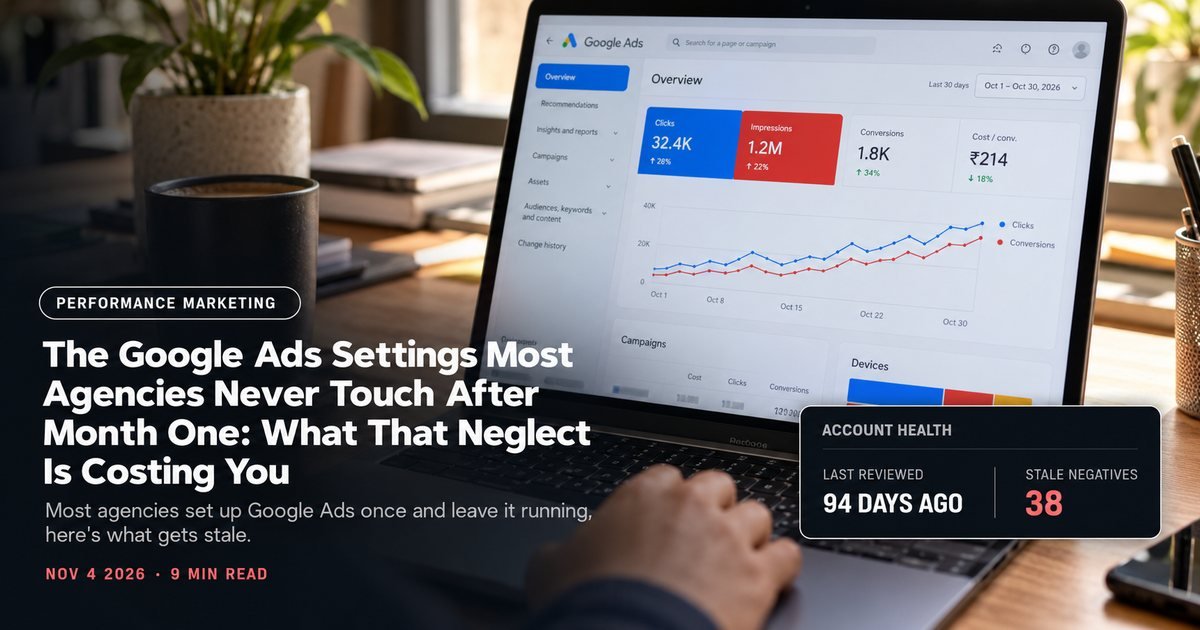
Open your Google Ads account right now and check the date on your last negative keyword list update. If you can't remember, or if it's been more than six weeks, you're not alone. Most agencies build a Google Ads account properly in the first thirty days, then shift attention to whichever client is shouting loudest that month. The account keeps running. Nobody goes back in to tune it.
Usually this comes down to math, not laziness. An agency managing fifteen accounts has maybe four hours a week per client. Almost all of that goes to reporting calls and creative requests.
The unglamorous maintenance work gets skipped first, because none of it shows up on a slide. If you want to know whether this is happening to you, here are five places to search Google Ads settings that quietly go stale. Each one starts costing you money within weeks of being ignored.

Negative Keyword Lists That Haven't Moved Since Launch
Every account starts with a negative list built from assumptions: competitor names, obviously irrelevant terms, maybe a few job-seeker queries if you sell a product people might confuse with a career. That list is a snapshot of day one. It is not a living document unless someone makes it one.
Six months in, the terms triggering your ads have shifted. New competitors enter the market. Your product catalog grows, and new search terms start matching your existing keywords in ways nobody predicted.
A skincare brand we picked up mid-contract had been running "vitamin c serum" as a broad match phrase for eight months. Nobody had checked the search terms report since month two. It was burning roughly ₹14,000 a month on queries containing the word "recipe," because an unrelated food blog had started ranking for similar terms and Google's broad match kept widening the net.
The fix takes twenty minutes a week, not a quarterly audit. Pull the search terms report, sort by cost, scan the top fifty queries for anything that shouldn't be spending your money, add negatives, done. If your current setup involves performance marketing being run by someone else, ask them directly when they last reviewed this. The answer tells you a lot.
Bidding Strategy That Never Graduated
Most accounts launch on Maximize Conversions or a manual CPC while the algorithm learns your account's behavior. That's correct for month one. It's often wrong for month six.
Once you've got consistent conversion volume, usually 30+ conversions a month at the campaign level, Target CPA or Target ROAS almost always outperforms the launch-phase bidding strategy. Google's machine learning has enough signal by then to optimize properly. Agencies that set and forget leave accounts on Maximize Conversions indefinitely, chasing volume without regard for efficiency once a real CAC target exists.
We took over an account for a home goods brand stuck on Maximize Conversions for eleven months, despite averaging 80+ monthly conversions. Switching to Target CPA, set conservatively at their historical blended average, cut cost per acquisition by roughly 22% within three weeks. Volume held steady.
Nobody had made the switch because nobody was comparing conversion volume against bidding strategy fit. The team was reading the top-line CAC number on a monthly report and calling it stable.
Audience Signals Frozen at Launch
Audience signals tell Google's automated bidding who to prioritize within your broad targeting. Most accounts get seeded once, usually with a customer list upload and maybe a lookalike audience, and then that signal sits untouched for the life of the account.
Your customer base changes. Repeat buyers look different from your first 500 customers, and high-LTV segments emerge that didn't exist at launch. If your CRM or Shopify data isn't being re-uploaded as a refreshed signal every quarter, you're feeding the algorithm an outdated picture of who actually buys from you.
This matters most for Performance Max and Advantage+ style campaigns, which lean almost entirely on signal quality to decide where your budget goes.
A refreshed audience upload takes maybe thirty minutes a quarter for someone with CRM access. It falls through the cracks precisely because it's small and produces no immediate visible change in dashboards. The effect still compounds over months.

Search Term Reports Nobody Reads
This one overlaps with negatives but deserves its own mention because it's the single most skipped recurring task in Google Ads management. The search terms report shows you exactly what people typed before your ad showed up. It is the clearest signal in the entire platform for both wasted spend and hidden opportunity.
Agencies that review this weekly catch problems in days. Agencies that only check it "when something looks off" catch the same problems months later.
They also miss the opportunity side entirely. High-converting search terms that haven't been added as their own keywords stay dependent on broad match to keep finding them, instead of being bid on directly with proper control over match type, bid, and ad copy relevance.
If you want a gut check on whether your own agency does this, ask for the last search terms report pulled on your account along with the date it was reviewed. A properly run account should have this as a standing weekly task, not an ad hoc investigation triggered by a client complaint about rising CAC.
Ad Schedules Set Once and Left Alone
Ad scheduling, which hours and days your ads actually run, gets configured once during setup based on a guess about when your customers are online. Then it sits there, often for the life of the account, even as actual conversion-by-hour data accumulates that could tell you something completely different.
We've seen D2C accounts running full budget at 3am with conversion rates near zero, simply because nobody pulled the hour-of-day report and adjusted dayparting to match. On a ₹50,000 monthly budget, even a modest reallocation into actual peak conversion windows, typically 7pm to 11pm for D2C in India, can lift account efficiency by 8-12%. No extra rupee required.
This is the kind of optimization that's invisible unless you go looking for it specifically. It won't show up as a problem in a monthly report because nothing is "broken." The budget is just being spent less efficiently than it could be, quietly, every single day.
What to Actually Ask Your Agency
If any of this sounds like your account, the conversation with your current agency doesn't need to be confrontational. Ask four specific questions: when was the negative keyword list last updated, is the bidding strategy still right for current conversion volume, when was the audience signal last refreshed, and how often is the search terms report actually reviewed versus just available.
Vague answers tell you plenty. A team actively managing these should have dates and specifics rather than a line about "always optimizing in the background."
If you're weighing whether to bring this in-house or switch providers entirely, our guide on how to choose a marketing agency walks through the right diligence questions before you sign anything new. And if you're unsure what a well-run account should even cost you monthly, the breakdown in what a performance marketing agency actually charges is worth reading before any renewal conversation.
Google's own documentation won't flag any of this for you. The platform doesn't warn you that your negative list is stale or that your bidding strategy has outgrown your account. It just keeps spending according to whatever was last configured, which is exactly why these settings are the ones that rot first.
Takeaways
- 1Review the search terms report weekly, not quarterly. It's the fastest-decaying signal in the account.
- 2Revisit bidding strategy once you consistently clear 30+ monthly conversions at the campaign level.
- 3Refresh audience signals from your CRM or Shopify data every quarter, not just at launch.
- 4Pull an hour-of-day and day-of-week report twice a year and adjust ad scheduling to match real conversion patterns.
- 5Ask your agency for dates, not reassurances, on when each of these was last touched.
Most accounts we audit have at least two of these five problems sitting untouched since launch.
If your account hasn't had a real settings review in months, book a free strategy call and we'll walk through what's actually configured versus what should be.
Book a call