How to Choose a Marketing Agency for Your D2C Brand: A 2026 Buyer's Checklist
Agency for marketing? Here's the 2026 buyer's checklist Indian D2C founders use to vet fit, pricing, and contracts before signing.
Picking an agency for marketing your D2C brand is a six-figure decision most founders make in about two calls. That's backwards.
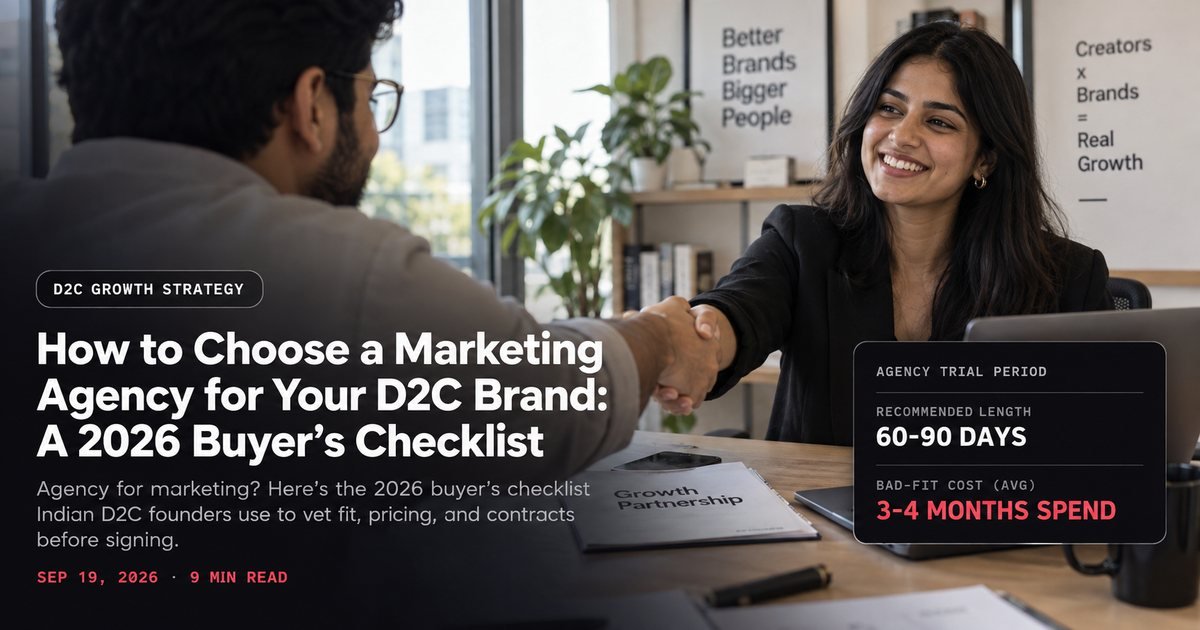
You'll hand this agency your ad account, your brand voice, and a chunk of your monthly burn. A bad fit costs you three to four months of wasted spend before you even notice something's wrong, because early-stage CAC numbers are noisy enough to hide a mediocre team.
This checklist is built from what actually separates a good agency partnership from a bad one, not generic "look for experience" advice. Every claim below has a number or a timeframe attached, because that's the only way to make this decision testable.
Start With What You Actually Need
Most founders search for "the best marketing agency" when they really need one of four narrower things: performance media buying, influencer casting, always-on social content, or ecommerce/CRO development. Some agencies do all four well. Most do one or two well and outsource or fumble the rest.
Write down your actual bottleneck before you take a single pitch call. Say your Meta CAC has crept up 40% in two months; you need a performance specialist there, not a full-service shop pitching a content calendar.
Or say your site converts at 0.8% against a category average of 1.5-2%. Your problem is the store, and no amount of extra ad spend fixes that.
Match the agency to your actual bottleneck. A generalist agency will happily take a performance-marketing retainer even if their real strength is content. You won't find that out until month three, usually from a flat CAC trend line.

Red Flags in the Pitch Deck
A pitch deck tells you almost as much from what it omits as what it includes. Watch for these five patterns.
- Case studies with no baseline. "We grew this brand's revenue 3x" means nothing without the starting number, the timeframe, and the ad spend behind it. Ask for before-after in absolute rupees, not a multiplier.
- Vanity-metric dashboards. Sample reporting that shows reach and engagement rate front and center, with CAC buried on slide nine, tells you the order they'll report to you too.
- Guaranteed results language is a sales tactic, not a forecast. No agency can promise a specific ROAS or CAC before touching your account. The auction, your margins, and your creative all move that number.
- No questions about your unit economics. A team that skips your AOV or contribution margin in the first call will optimize for cheap clicks instead of profitable orders.
- Retainer pricing with no floor on deliverables. A flat monthly fee means little without a defined scope: creatives tested per month, platforms covered, whether landing pages are included.
Evaluating Fit Across Channels
If you're hiring beyond one channel, evaluate each discipline on its own terms; a strong performance team and a strong content team need different proof points.
Performance marketing fit
If your bottleneck is running Google and Meta Ads as one blended account against a CAC target, start by asking for their blended CAC-to-AOV ratio benchmarks by category. A skincare brand with a ₹900 AOV should see a very different target CAC than a mattress brand at ₹18,000 AOV.
An agency quoting one flat CAC number across categories hasn't run enough accounts. Good performance partners also run structured creative testing, typically 6-10 new ad variants weekly in the first two months. That's how fast Meta's algorithm needs fresh signal to hold CAC steady.
Influencer and creator fit
Check whether they cast off conversion data (swipe-ups, code redemptions, spark-ad performance) or off follower count and vibes. Rates in India run ₹8,000-₹40,000 per Reel for mid-tier creators (50K-500K followers), depending on category and usage rights.
An agency quoting a flat rate "per influencer" regardless of niche hasn't negotiated a real deck of creators.
Ecommerce and CRO fit
Ask what their last three stores scored on Core Web Vitals and what their average conversion-rate lift was post-launch. A competent dev partner can usually show a 20-35% lift in add-to-cart rate from checkout and PDP fixes alone, within 60 days of a relaunch.
Social and content fit
Look at whether their content calendar is reactive to trends within 24-48 hours or planned a month out with no room to move. D2C categories like beauty and food move fast on Instagram and YouTube Shorts; a static monthly calendar is a sign the team isn't actually watching the feed.
Structuring a Real Trial Period
Never sign a 12-month retainer on the first conversation. A 60-90 day trial period, with a defined exit clause, is standard and any serious agency will agree to it.
During the trial, set two or three specific, measurable goals up front: a target CAC range, a minimum number of creative tests run, a defined reporting cadence. Put these in writing in the SOW, not just discussed on a call.
Expect a 30-day ramp before performance stabilizes. New account structures, pixel data, and creative angles all need time to season; judging an agency on week two numbers is how founders fire good teams too early and keep bad ones too long by accident.
By day 60, you should have enough signal (spend volume, creative iteration count, actual CAC trend) to make a real call. If the agency resists a structured trial and pushes for a long lock-in instead, that itself is diagnostic.

What Real Reporting Looks Like
Good reporting starts with business outcomes and works backward to platform metrics, not the reverse.
A useful weekly or biweekly report leads with blended CAC, ROAS, and contribution margin after ad spend, then breaks down by channel and campaign. It should flag what changed and why: a creative that fatigued, a bid strategy shift, a competitor's spend spike pushing CPMs up.
Vanity-metric-first reporting, reach and impressions on top with CAC as a footnote, is the clearest sign an agency is managing your perception of the account rather than the account itself.
If you can't answer "what did we spend to acquire a customer this month, and was that profitable" from the report in under two minutes, the report has failed its one job.
Ask upfront how often you get raw account access. You should always have view or admin access to your own ad accounts and analytics; an agency that resists sharing this is trying to make itself hard to replace.
Pricing Models: Retainer vs Performance vs Project
The three common structures each fit a different stage and risk appetite.
- 1Flat retainer. Typically ₹40,000-₹1,50,000+/month for performance or social depending on scope and ad spend managed. Predictable cost, but you're paying the same whether results are strong or weak, so scope clarity matters more here than anywhere else.
- 2Performance-based (percentage of spend or revenue). Usually 10-20% of managed ad spend, or occasionally a share of incremental revenue. This aligns incentives well for brands already spending ₹5 lakh+/month, but is a poor fit below that, since the fee floor often exceeds what a flat retainer would cost.
- 3Project-based. Fixed-scope work like a Shopify rebuild or a one-off influencer campaign, typically ₹1-8 lakh depending on complexity. Best when the deliverable is finite and clearly specced; worst when scope creeps and there's no retainer relationship to absorb it.
Most D2C brands under ₹50 lakh/month in revenue do best starting on a flat retainer with a tight trial. Renegotiate toward performance-based pricing once volume justifies it.
Want the full breakdown of what each channel actually costs by category? The full agency pricing guide covers benchmarks brand by brand.
If a chunk of your evaluation is specifically about creator partnerships, it's worth reading our deeper breakdown on choosing an influencer marketing agency before you sign anything there, since casting and contract terms differ a lot from performance media.
Agency vs In-House: A Quick Gut Check
Before you finalize any agency, it's worth stress-testing whether you need one at all for a given channel. Founders with a strong existing team and volume above ₹1 crore/month sometimes get more value building certain functions in-house.
That tradeoff plays out differently channel by channel, and it's worth weighing on its own terms rather than as a blanket rule.
For most brands under that scale, though, a specialist agency for marketing outpaces an in-house hire on speed to competence, since you're buying a team that has already run 20-30 similar accounts instead of training one person from scratch.

Contract Terms Worth Reading Twice
Two clauses cause most of the founder complaints we hear about agency relationships.
Notice period and exit terms. A 30-day notice window is reasonable; 90 days or more locks you in past the point where a bad fit is already obvious. Check who owns creative assets and ad account access after termination, since some agencies build campaigns in a way that's painful to unwind.
Ownership of ad accounts and pixels matters more than founders expect. Your Meta Business Manager and Google Ads account should sit under your business entity, with the agency added as a partner.
Some agencies insist on running your ads from their own top-level account instead. Do that, and you lose your full campaign and audience history the day you leave.
The 2026 Buyer's Checklist: Ten Things to Confirm
- 1The agency's core strength matches your actual bottleneck, not a generic full-service pitch.
- 2Case studies include baseline numbers, timeframe, and spend, not just a growth multiplier.
- 3Reporting leads with CAC, ROAS, and contribution margin, not reach and impressions.
- 4You retain ownership of ad accounts, pixels, and creative assets at all times.
- 5Pricing model (retainer, performance, or project) matches your current revenue stage.
- 6A 60-90 day trial period with written, measurable goals is in the SOW.
- 7Notice period is 30 days or less, with a clear exit and handover process.
- 8Creative testing cadence is specified in writing, not left vague.
- 9You get direct account access, not agency-only visibility.
- 10Someone on the team asked about your margins and AOV before pitching a strategy.
If an agency clears eight or more of these before you sign, you're in reasonable shape.
Want a second opinion on your specific numbers? Book a free strategy call and we'll tell you honestly whether your current setup needs a new agency, or just a fix to the one you have.
Book a call