Influencer Marketing Agency Guide: What They Do and What It Costs
influencer marketing agency work explained: casting, briefing, whitelisting and the real ₹ fee ranges Indian D2C brands actually pay in 2026.
If you have typed "influencer marketing agency" into Google at 11pm trying to figure out whether you actually need one, you are not alone. Most D2C founders reach this question after a barter collab flopped or a creator ghosted them mid-campaign.
Here is the honest answer: an influencer marketing agency does five specific jobs, and each one has a real price tag in the Indian market. This guide breaks down what you are actually paying for, the fee structures agencies use, and when doing it yourself still makes more sense.
What an Influencer Marketing Agency Actually Does
Strip away the pitch decks and an agency's day-to-day work sits in five buckets. Skip even one and campaigns underperform, no matter how good the creators look on paper.
Casting
Agencies maintain databases of thousands of creators tagged by niche, engagement rate, audience geography, and past brand fit. A good casting process filters out bought followers and engagement pods before a single rupee is spent.
For a mid-size skincare brand, that usually means shortlisting 40-60 creators to land on 8-12 who actually convert. Doing this manually eats a founder's week; a dedicated influencer marketing team does it in two to three days because the shortlist already exists.
Briefing and creative direction
A brief that just says "post about our product" produces content nobody watches. Agencies write briefs with hooks, do's and don'ts, mandatory product shots, and a rough script structure, while leaving room for the creator's own voice.
This matters more than most brands expect. Briefing quality is the single biggest lever on whether a Reel converts, and it costs nothing extra once the agency has a template system.
Negotiation
Creator rate cards are opening offers, not fixed prices. Agencies that book hundreds of creators a year know which mid-tier fashion creator will take ₹15,000 instead of the ₹25,000 they quoted, and which food creator's ₹8,000 Reel rate is already rock bottom.
That negotiating power alone can save 20-30% off list-price rates across a campaign. It usually covers a good chunk of the agency's own fee.
Whitelisting and spark ads setup
This is the technical part most brands skip entirely. Whitelisting means the creator grants the brand's ad account permission to run paid media through their handle, so ads show up as if the creator posted them organically.
Setting this up on Meta (via Creator Marketplace/Business Manager partnership) or as a TikTok-style Spark Ad equivalent on Instagram takes creator cooperation, correct permission scopes, and testing before spend goes live. An agency that runs this weekly does it in under an hour per creator; a brand doing it for the first time can burn half a day per handle.
Reporting
Reach and likes are vanity numbers. What a brand actually needs is cost per click, cost per acquisition by creator, and which content format (Reel vs static vs carousel) is pulling its weight.
Agencies pull this from ad manager and affiliate link data weekly, then flag underperforming creators before the brand has sunk the full budget into them.

How Influencer Marketing Agencies Charge in India
There are three common fee structures, and each suits a different stage of brand.
1. Project fee
A flat fee for a defined campaign: a set number of creators, a set deliverable count, over a fixed timeline. Indian agencies typically charge ₹75,000 to ₹3,00,000 per project depending on creator count and tier, on top of the actual creator payments.
This works best for a one-off launch or a festive push where the brand wants a clear start and end date, no ongoing commitment.
2. Monthly retainer
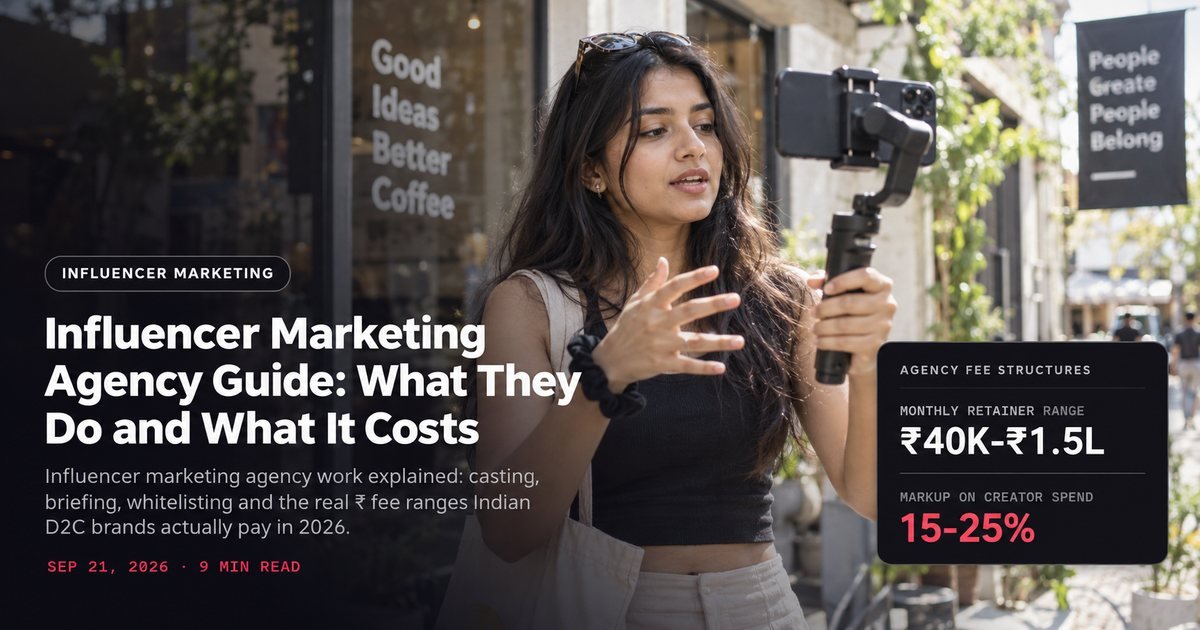
A recurring fee that covers ongoing casting, briefing, and reporting, usually paired with a monthly creator budget the brand sets separately. Retainers for a mid-size D2C brand generally land between ₹40,000 and ₹1,50,000 a month, scaling with the number of creators managed and whether whitelisting/spark ads are included.
Retainers suit brands running influencer marketing as an always-on channel rather than a campaign spike, since the agency builds creator relationships over time that get cheaper and better with each repeat booking.
3. Percentage markup on creator spend
Some agencies charge a 15-25% markup on total creator payments instead of, or blended with, a flat fee. A brand spending ₹5,00,000 on creators in a quarter would pay roughly ₹75,000 to ₹1,25,000 on top.
This model aligns agency incentive with spend, which sounds good until you notice it can also push agencies toward recommending more creators than a campaign needs. Ask directly whether the agency's recommendations change if you cap the budget lower.
When to Hire an Agency vs Run It In-House
Plenty of brands don't need an agency on day one. Working out whether yours does comes down to three questions.
How many creators are you managing at once? Below 5-8 creators a month, a founder or a junior marketer can run this manually with a spreadsheet and a WhatsApp group.
Past that, coordination overhead alone justifies outside help. Coordination, not creativity, is what breaks first once a brand scales past a handful of active creators.
Do you need whitelisting and spark ads? If influencer content is purely organic, in-house stays viable longer.
The moment you want to run paid media through creator handles, the setup gets fiddly fast. This is where most in-house attempts stall out.
What's your time actually worth? A founder spending 15 hours a week chasing creator briefs and payment confirmations loses those hours to admin instead of product or performance media. Run the math on your own hourly value before assuming in-house is cheaper.
A hybrid model also works well for many brands: keep casting and relationship management in-house, since founders often know their community best, and bring in an agency purely for whitelisting, spark ads, and reporting. Some Creator City clients start here before handing over the full funnel.
If you are earlier in the decision and still comparing agencies against freelancers or a fully DIY approach, this breakdown of what influencer marketing actually costs in India is a useful companion read on the numbers side.

Red Flags When Choosing an Agency
A few warning signs show up repeatedly in bad agency fits.
- No transparent rate card breakdown. Opacity here usually hides a bigger markup than they'd admit to.
- No whitelisting experience. Vague answers about their Meta Business Manager process mean they haven't run it at scale.
- Vanity-metric-only reporting. A sample report that leads with reach instead of cost per acquisition is a bad sign.
- No written creator agreements. Usage rights and exclusivity terms belong in writing every time; see our guide on what needs to go into an influencer contract.
If you'd rather build your own shortlist of creators before bringing an agency in, start by mapping creators by category and tier, then vet each one for audience quality before you spend.
And if the agency decision itself feels bigger than just influencer marketing, our broader checklist for choosing a marketing agency as a D2C brand walks through the same red flags across every channel.

What to Take Away From This
Here is the short version if you're deciding this week.
- 1Expect ₹75,000-₹3,00,000 per project, or ₹40,000-₹1,50,000 a month on retainer, plus creator payments.
- 2Percentage markup models run 15-25% on creator spend; ask what happens to recommendations if you cap the budget.
- 3Casting, briefing, negotiation, whitelisting, and reporting are the five jobs you're paying for.
- 4Below 5-8 creators a month, in-house is usually viable.
- 5Ask for a sample report before signing anything.
The brands that get the most out of an agency treat it like a specialist hire, not an outsourced headache. Know what you're buying and ask for the numbers upfront.
If you want a second opinion on whether your current setup needs one, book a free strategy call and we'll tell you straight, even if the answer is "not yet."
Book a call