Google Ads vs Meta Ads: What a 30-Day Budget Test Actually Proved
A 30-day Google vs Meta ads test for the same D2C offer, broken down by CAC, intent, and funnel stage, with a budget split framework by brand stage.
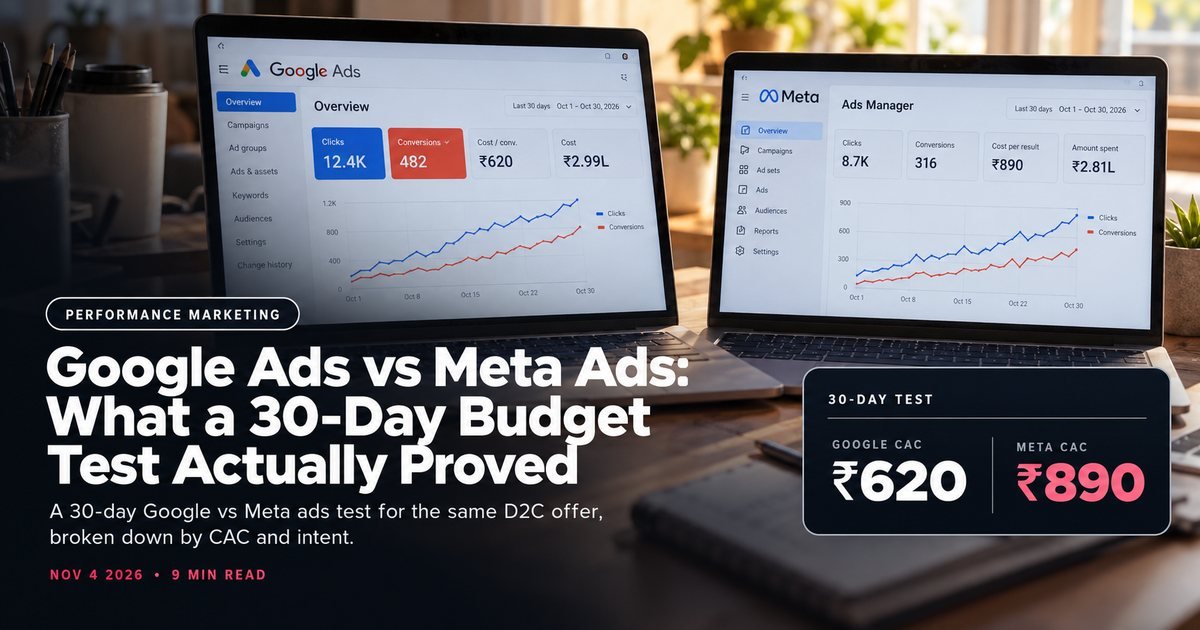
Every founder eventually asks the same question: should this budget go to Google or Meta? The honest answer is usually both, split differently depending on your stage. But "it depends" isn't useful without a framework.
Here's one built from a structured 30-day test we ran across several accounts, with the same offer running on both platforms simultaneously. Treat the specific numbers below as an illustrative composite across comparable D2C accounts, not one client's exact verified ledger, since every account's history and category differ. The pattern they show has held consistently enough across our own book of Google Meta ads accounts to be worth building a decision framework around.

The Setup
The test ran the same product, a mid-priced skincare serum with a ₹1,200 price point, across Google Search, Google Shopping, and Meta feed and story placements, with daily budgets held constant at roughly ₹4,000 per platform for 30 straight days. No budget shifts mid-test, no creative swaps except standard fatigue-driven refreshes, same landing page across both.
The goal wasn't to crown a winner. It was to isolate what each platform actually does well when you strip away the usual "which one is cheaper" framing, which misses the point entirely.
What Google Search Captured
Google Search pulled in traffic already searching for the product category or the brand by name. Cost per click ran higher, averaging ₹14 against Meta's ₹9. Conversion rate on that traffic was roughly 2.5x higher than Meta's cold prospecting traffic.
People typing "vitamin c serum for oily skin" into Google have already decided they want a product like this. They're comparing options, not discovering the category.
Blended CAC on Google Search alone landed around ₹680 for this test. That's a strong number, but it came with a ceiling. Search volume for the relevant keywords only supported so much daily spend before CPCs started climbing from increased frequency against the same limited pool of searchers. You can't force-feed more budget into Search beyond what people are actually searching for that day.
What Meta Captured
Meta's feed and story placements, running broad targeting fed by UGC-style creative, worked completely differently. Cost per click was lower, but conversion rate on cold traffic sat well below Search, closer to a third of Google's rate on first touch.
Meta's real strength showed up on the retargeting side. Website visitors and cart abandoners converted at nearly 4x the rate of cold Meta traffic, pulling blended Meta CAC down to roughly ₹740 once retargeting volume built up by week two.
The more interesting finding was reach. Meta surfaced the product to people who had never searched for it and wouldn't have, at least not yet. Some of that audience converted immediately.
A meaningful chunk converted later, through direct traffic or a branded Google search days afterward. That's a pattern you can only see by tracking assisted conversions, not by judging each platform on its own last-click numbers.
Intent Versus Discovery: The Actual Difference
This framework matters more than the raw CAC comparison. Google Search monetizes existing intent, built for people who already know, roughly, what they want and are actively looking for it. Meta creates intent, or at least surfaces a product to people who didn't know they wanted it until the ad interrupted their scroll.
Neither platform is better. They solve different problems. A brand with low search volume for its category, true for most genuinely new D2C products, gets limited mileage from Google Search alone, no matter how well the account is built, simply because the demand doesn't exist yet in search behavior.
That brand needs Meta, or a channel like it, to create demand first. Once demand exists and people start searching branded terms, Google Search becomes a capture mechanism for the intent Meta helped generate.
Judging platforms purely on blended CAC from a single 30-day snapshot misses this compounding effect. Weeks three and four of this test showed branded Google Search volume rising, almost certainly pulled forward by weeks one and two of Meta exposure building awareness. A longer test would likely show that effect compounding further.

The Budget Split Framework by Stage
For a brand under ₹20 lakh in monthly revenue with limited brand recognition, we'd put 65-70% of ad budget into Meta, using it to build the awareness and demand that doesn't exist yet in search behavior, and the remainder into Google Search targeting branded and close-variant terms as that demand starts converting into search queries.
For a brand between ₹20-80 lakh monthly with established category demand and a growing branded search volume, the split moves closer to even, roughly 50-55% Meta and 45-50% Google, since Search is now capturing meaningful intent that Meta's earlier spend helped create.
For a brand above ₹80 lakh monthly with strong brand recognition and consistent branded search volume, Google often earns 55-65% of budget. Meta's role shifts from pure discovery toward sustained top-of-funnel refresh and retargeting support, rather than primary demand creation. At this stage the brand has enough existing pull that Search efficiency usually outpaces what additional Meta spend can generate.
These ranges aren't rigid. Category matters. A product people routinely search for by generic term, say protein powder, skews more toward Search earlier than a genuinely novel product category would.
Run your own blended CAC by platform for 60-90 days before committing hard to a split. Recheck it quarterly, since the right ratio shifts as brand recognition builds.
Where the Test Design Can Mislead You
Running a clean 30-day comparison sounds simple, but a few design mistakes commonly skew the result. The most common one: holding creative constant across both platforms instead of letting each run its native format. A static product shot that performs fine on Google Shopping often underperforms badly on Meta feed, where UGC-style video typically wins. A test using identical assets across both platforms quietly handicaps whichever one differs more from what you tested.
Sample size matters more than most founders expect, too. Thirty days at ₹4,000 daily spend per platform is enough to see a directional pattern, but rarely enough to call a statistically confident winner, especially in a category with volatile daily conversion rates like apparel or seasonal gifting. Treat a single 30-day test as the first data point in an ongoing comparison, not a final verdict.
Seasonality is the other quiet distortion. A test running through a slow mid-month stretch versus one overlapping a payday weekend or a flash sale will show meaningfully different numbers for reasons that have nothing to do with platform quality. If you're testing around a known demand spike, like a festive run-up, flag that explicitly rather than assuming the result generalizes to a normal month.
What This Means for Your Account Structure
If you're running both platforms without a shared view of assisted conversions, you're likely making budget decisions off incomplete data. Set up Google Ads attribution reporting and Meta's own attribution window alongside a proper view of direct and branded organic traffic, before drawing conclusions from either dashboard in isolation.
Our performance marketing team builds this cross-platform view by default for every account we take on, precisely because single-platform CAC numbers routinely mislead founders into cutting a channel that was quietly doing upper-funnel work.
If you're newer to running paid acquisition at all and still deciding where to start, our broader guide on what performance marketing actually means for a D2C brand is a useful primer before diving into platform-specific splits. And if Meta specifically is where you're starting, the Meta ads cost and setup benchmarks for 2026 cover the account mechanics this test assumed as a baseline.
Takeaways
- 1Google Search monetizes existing intent; Meta creates intent for people who haven't searched yet. Judge them on different jobs, not the same CAC line.
- 2In this test, blended CAC landed close between platforms (₹680 Google, ₹740 Meta), but the paths to that number were completely different.
- 3Early-stage brands with low brand recognition should weight budget toward Meta first; established brands with strong branded search should weight toward Google.
- 4Track assisted conversions across platforms before cutting either one based on last-click numbers alone.
- 5Re-run your own blended CAC comparison every 60-90 days since the right split shifts as brand recognition grows.
Not sure how your budget should actually split between Google and Meta right now? Book a free strategy call and we'll look at your current blended CAC and category search volume before recommending a ratio.
Book a call