Instagram Ads Cost in India 2026: What You're Actually Paying Per Result
A real breakdown of instagram ads cost in India by category, placement and format, with current CPC and CPM ranges you can benchmark against.
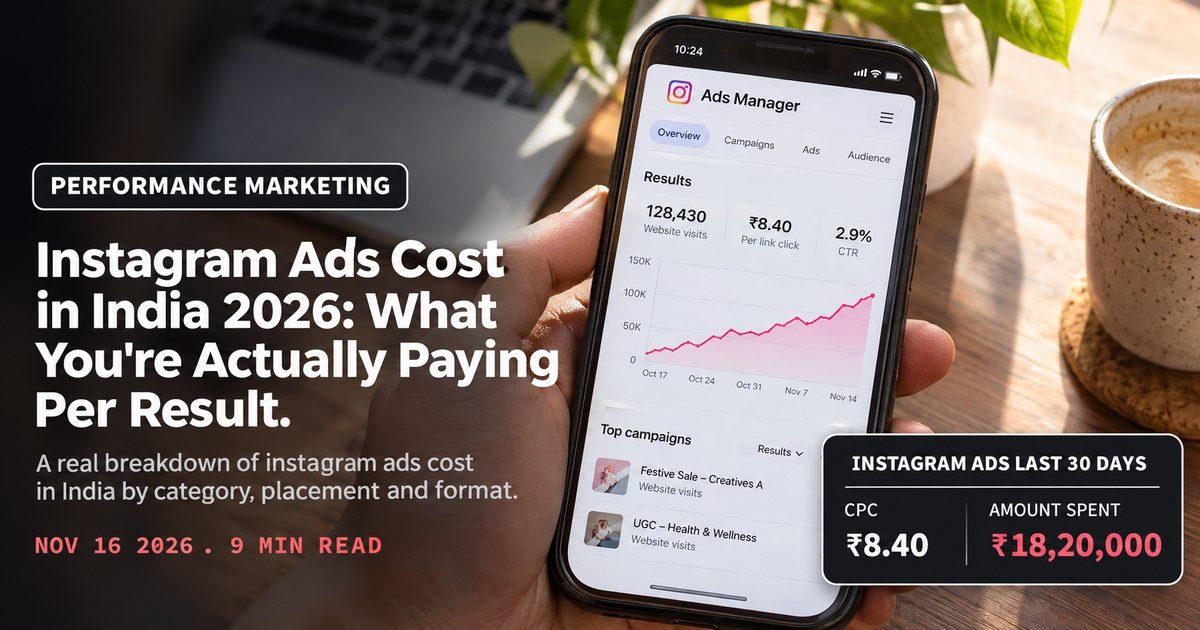
A beauty brand we started working with this year had been told by their previous agency that ₹40 CPM was "just how Instagram is now." It wasn't.
Their catalog feed was broken. Half their ad set was running the same three creatives since March. And they were bidding into Feed placements exclusively because nobody had turned on Advantage+ placements. Once we fixed those three things, blended CPM dropped to ₹26. Same budget, same product, same month.
That gap between what people assume Instagram ads cost and what they're actually paying once the account is clean is enormous. Most founders never get a straight number to compare against. They get a vendor quote, a WhatsApp forward from another founder, or a vague "it's gotten expensive" shrug.
So here's the actual number set. Instagram ads cost varies by category, placement, format, and funnel stage, often by 2-3x within the same account. This piece lays out the current CPC and CPM ranges by category, how placement changes the math, and how creative format shifts cost.
We'll also cover what's genuinely driving the trend upward in 2026 versus what's just excuse-making. If you want the deeper "why is this rising" analysis rather than the number set, our piece on why Instagram ads keep getting more expensive covers that separately. This one is the reference sheet.
What Instagram ads actually cost right now, by category
CPM and CPC vary more by category than most advertisers expect, because competitive density and average order value both shift the auction price.
Fashion and apparel. CPM typically runs ₹18-32, CPC ₹8-18. This is one of the most contested categories on the platform. D2C fashion brands and marketplaces are all bidding into the same 18-34 age bracket, especially during festive months. Expect the upper end of that range from October through January.
Beauty and personal care. CPM runs ₹20-38, CPC ₹10-22. Beauty has the fastest creative fatigue of any category we track. That pushes effective cost per result higher even when raw CPM looks moderate. A brand running the same five creatives for six weeks will see cost per purchase climb well past these ranges regardless of category benchmarks.
Food and beverage, including D2C snacks and supplements. CPM runs ₹15-28, CPC ₹7-16. Lower average order values here mean the category is more CPC-sensitive than CPM-sensitive. A brand selling a ₹399 snack box needs a tighter CPC to stay profitable than a brand selling a ₹2,500 skincare set at the same CPM.
Electronics and gadgets. CPM runs ₹22-40, CPC ₹14-30. Higher consideration purchases mean more scroll-stopping is needed before a click happens. The audience, often 25-40 and higher intent, costs more to reach precisely. This category also sees heavier competition from marketplaces running their own Meta ads alongside the brand's.

These ranges assume a reasonably healthy account: working Pixel, clean catalog feed, Advantage+ campaigns switched on where relevant. A broken setup can push any of these numbers 40-60% higher without anyone noticing why.
How placement changes what you pay
Instagram sells four distinct inventory types through the same auction, and they price very differently.
Feed is the most expensive placement per impression, typically 10-20% above the account's blended CPM, because it's the most scrolled-through, highest-attention real estate. It also converts best for considered purchases where a clear product shot and price point do the selling.
Reels run cheaper, usually 15-30% below Feed CPM, because Instagram is still pushing Reels inventory to build its video ad business. Cheaper impressions don't automatically mean cheaper purchases though; Reels skews toward top-of-funnel discovery rather than immediate conversion.
Stories sit in between, often close to Feed pricing but with lower average engagement per impression for static creative. Stories work best with motion or a clear swipe-up cue, not a repurposed Feed static.
Explore is the least predictable placement cost-wise. It can be the cheapest inventory on a given day or spike unpredictably depending on how much content Instagram is pushing there that week. We generally recommend leaving it inside automatic placement rather than bidding it manually, since isolating it rarely pays off at typical D2C budget levels.
How creative format moves the number
Format has quietly become a pricing decision, not just a creative one, because Meta's delivery system rewards formats that hold attention longer.
Static images are the cheapest to produce but often the most expensive to run per result, because average watch time is near zero and relevance scores tend to sit lower than video. They still work well for retargeting warm audiences who already know the product.
UGC-style video, 15-30 seconds, consistently pulls the lowest cost per result across most categories we manage. It typically runs 20-35% cheaper per purchase than a static-only campaign at the same spend.
This is the format Instagram's delivery system currently favors most for cold-audience prospecting. If producing fresh UGC weekly isn't realistic for your team, AI-generated UGC ads have become a genuinely viable way to maintain that volume without a shoot schedule.
Carousel ads land in between, useful for catalog-style products with multiple SKUs, but they need a strong first frame or the cost advantage disappears since most users never swipe past slide one.
Founder-led or talking-head video performs unusually well in categories where trust is the blocker, supplements, skincare, financial products, often beating UGC on cost per result once an audience has seen a few rounds of generic UGC from competitors.
What's actually driving the 2026 cost trend
The honest answer: more advertisers, less targeting precision, faster fatigue. We've written about this in more depth in our piece on why Instagram costs keep climbing, but the short version for this reference piece is that none of it is a platform conspiracy. It's auction economics responding to more bidders and weaker signal per bidder.
What that means practically for your 2026 budget: plan for CPMs to sit 10-15% above where they were a year ago in most categories, and build creative refresh into your monthly plan rather than treating it as a crisis response. Meta ads for D2C brands covers the account setup that keeps targeting signal strong enough to resist some of this drift.
Budgeting against these numbers: a worked example
Take a mid-size D2C fashion brand spending ₹4 lakh/month. At a blended CPM of ₹25 across Feed, Reels, and Stories, that's roughly 1.6 crore impressions a month. At a 1.2% average click-through rate, that's about 192,000 clicks, landing CPC around ₹20.80.
If the funnel converts at 2%, that's roughly 3,840 purchases a month, or a cost per purchase near ₹104 before accounting for creative fatigue drag over the month.
That number holds only if the account keeps 15-20 active creative variants rotating. A stale account running the same four ads for eight weeks will see that cost per purchase drift up 25-40% by month's end, same spend, same targeting.
Run that same math against your own account's actual CPM and CTR rather than these averages. Category benchmarks tell you whether you're in a reasonable range; they don't replace your own funnel numbers. If you're also running Google and WhatsApp spend alongside Meta, our breakdown of Google, Meta and WhatsApp ad costs in India for 2026 is worth cross-checking your blended CAC against.

When a low CPM is actually a warning sign
Founders sometimes get excited about an unusually cheap CPM and miss that it's cheap for the wrong reason. A CPM that's dropped sharply month over month without a corresponding creative refresh or targeting change usually means Meta has shifted delivery toward a lower-quality, lower-intent slice of the audience, not that the brand suddenly got more efficient.
Check conversion rate alongside CPM before celebrating a drop. A CPM that falls 20% while conversion rate falls 30% is a worse outcome than a flat CPM with a stable conversion rate, even though the first scenario looks better on a top-line cost report.
What to actually do this quarter
- 1Pull your last 90 days of CPM and CPC by placement, not blended account numbers, and compare each against the category ranges above.
- 2Check creative age. Anything unchanged for more than three weeks likely drives rising cost per result, regardless of category.
- 3Confirm Advantage+ placements are switched on unless you have a tested reason to isolate one placement.
- 4Match format to funnel stage: UGC and video for cold prospecting, static and carousel for retargeting.
- 5Rebuild your cost-per-purchase model on your account's real CPM and CTR, not category averages.
- 6Re-check this benchmark set quarterly. Auction dynamics in 2026 shift fast enough that a six-month-old number is already stale.
If you want someone to pull your actual account data against these benchmarks and tell you exactly where the money's leaking, book a free strategy call and bring your last 90 days of Ads Manager data.
Book a call