Why Instagram Ads Keep Getting More Expensive: What's Driving the Cost Up, and What Isn't
Instagram advertisement costs keep climbing. Here's what's actually driving it and the concrete fixes that bring your CPMs back down.
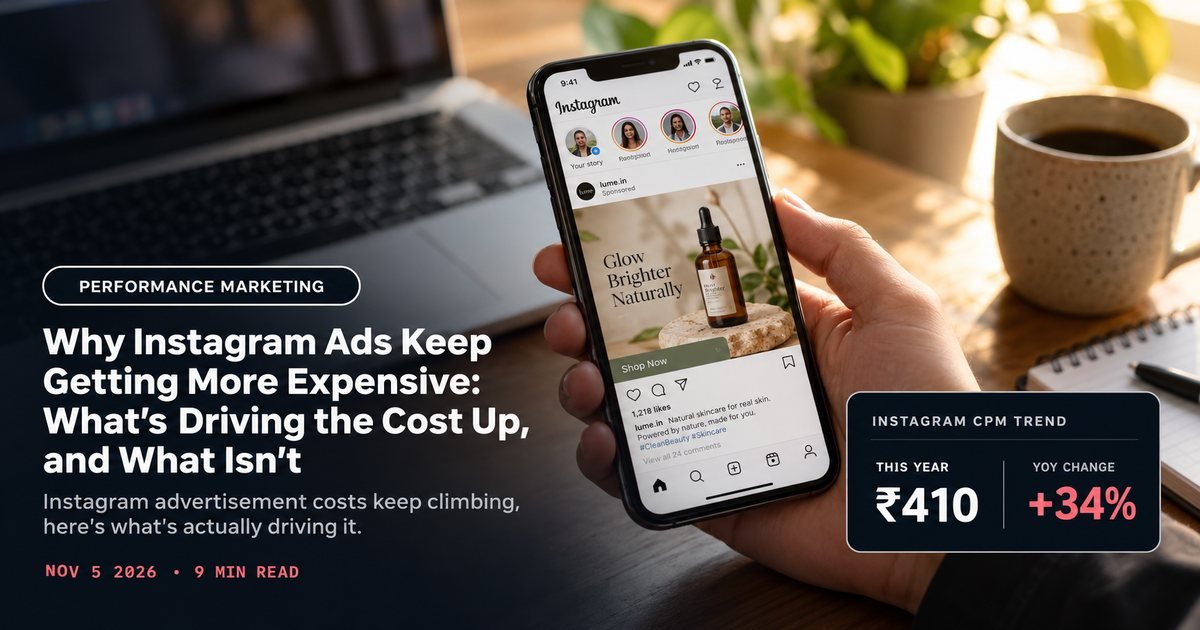
Every founder running an instagram advertisement account has had the same conversation with their team this year. The budget didn't change. The product didn't change. But the cost per result crept up, month after month. The auction itself is shifting under you, not bad luck on your part.
Three real forces are driving this. This piece breaks each one down, then gets into the fixes that actually move the needle on cost: creative refresh cadence, broader targeting, Reels vs feed, and first-party data. No "post more" filler. If you'd rather have someone audit your account directly, our performance marketing team runs this exact diagnostic for new clients.

Why Instagram ads cost more today than two years ago
Three things are happening at once. They compound rather than add up.
More advertisers are bidding for the same feed real estate. Instagram's ad inventory hasn't grown as fast as the number of brands spending on it. Every D2C category we track, beauty, fashion, food, wellness, has seen the number of active advertisers in India roughly double since 2023, a shift our online marketing channel budget breakdown covers in more depth.
More bidders chasing the same impressions pushes the auction price up. Simple supply and demand, not a platform charging more out of nowhere.
iOS privacy changes cut targeting precision, which cuts efficiency. Since Apple's App Tracking Transparency rollout, a large share of iOS users opt out of cross-app tracking. Meta's algorithm sees less signal about who actually converts. So it spends more impressions testing and learning before it finds your buyers.
Less precision per impression means you need more impressions for the same result. That shows up as a higher effective cost per purchase, even when the raw CPM looks flat.
Ad fatigue sets in faster in crowded niches. Beauty and supplements get hit hardest here. When five competitors run similar UGC-style ads to similar audiences, the same user sees comparable creative from multiple brands in one scroll session. Relevance scores drop across the board. Meta's delivery system then charges more to show an ad it predicts will get skipped.
More bidders. Less certainty about who to show the ad to. Audiences tired of seeing ads like yours. That's the real story behind rising cost for instagram ads, not a single algorithm update.
What actually brings cost down: creative refresh cadence
Creative volume and freshness, not budget cuts, is the single most effective fix available.
Run a fixed refresh cadence, not a reactive one. Most accounts we take over refresh creative only after performance drops. Too late by then. Set a standing weekly or biweekly briefing cycle instead: 3-5 new ad variants land in the account every two weeks, regardless of how last week performed. By the time one batch fatigues, the next is already warming up.
A realistic cadence for a mid-size D2C account running ₹3-8 lakh a month looks like this. Keep 15-20 active variants at any time. Rotate out the bottom 20-30% by relevance score every two weeks. Mix formats on purpose: static product shots, UGC-style video, founder-led talking-head clips.
If shooting fresh UGC that often isn't realistic for your team, AI-generated UGC ads are a genuinely useful shortcut to hit that refresh volume without a weekly shoot schedule.

Broaden targeting instead of narrowing it
This feels backwards if you learned Meta ads before 2023. But it's the correct move now. Advantage+ style automated targeting consistently beats manually narrowed audiences once your account has enough conversion volume to train on.
The old instinct was carving out a tight interest-based audience to avoid "wasting" spend. Under today's delivery system, that instinct backfires. Narrow audiences starve the algorithm of signal. They get more expensive over time because Meta has fewer people to test creative against.
Broad targeting fed by strong creative, plus a clean Pixel and Conversions API setup, gives the algorithm room to find your actual buyers, wherever they sit demographically. We cover the full setup sequence in our Meta ads for D2C brands guide if your account structure hasn't caught up yet.
Reels vs feed: the cost gap that's still there
Reels placements generally run cheaper CPMs than feed, often by 15-30%, because Instagram is actively pushing Reels inventory. But cheaper impressions don't automatically mean cheaper conversions.
Feed placements still convert better for considered purchases, where a static product shot with clear pricing and a review count does the selling. Reels work better for discovery and top-of-funnel awareness, where motion and sound carry the message.
If your funnel skews toward impulse buys under ₹1,500, lean Reels-heavy. Selling a ₹3,000+ skincare set that needs explanation? Keep feed in the mix; don't abandon it just because the CPM looks worse on paper.
Letting automatic placement optimize across both, rather than manually forcing one, usually gives the best blended result once your account has enough spend and conversion history.
Use first-party data to cut reliance on the open auction
First-party data is the fourth lever, and the one most founders underuse. Every purchase, email signup, and repeat customer in your CRM or Shopify database is a signal you own outright. iOS opt-outs can't touch it.
Upload your customer list as a custom audience. Build lookalikes from your actual buyers rather than Meta's best guess at "interested" users. Retarget past purchasers with a different offer than cold prospects. A properly configured Meta Business Suite setup makes this far easier to maintain. Feed Conversions API events server-side so you're not solely dependent on browser-level Pixel data that iOS quietly degrades.
Brands with clean first-party data pipelines consistently see 15-25% better efficiency than brands relying purely on Meta's own targeting signals.

A quick benchmark check before you panic
Compare your CPM trend against your category, rather than against your own numbers from a year ago. A beauty brand seeing CPMs climb from ₹28 to ₹42 over six months is roughly tracking the category average, a sign of competition and seasonality rather than a tracking failure.
What should actually worry you: a CPM rising faster than relevance score is falling, or a cost increase with no change in competitive density or creative age. That pattern usually points to a setup problem. A Pixel that stopped firing cleanly. A catalog field gone missing. A campaign still running untouched since the learning phase, creative nobody's looked at in months. Pull your Events Manager diagnostics before you touch budget.
What this means for your budget this quarter
The easy wins from 2021 are gone. The gap between accounts investing in creative and data infrastructure and accounts that aren't has only gotten wider.
Strong-performing brands rarely have bigger budgets. They treat creative like a content pipeline instead of a one-time asset. They feed the algorithm clean first-party signal. They check placement and relevance data often enough to catch fatigue before it becomes a spend problem. A process change, cheaper than either default move founders reach for: cutting spend, or throwing more money at the same stale setup.
Running the same five creatives from last quarter, on a narrowly targeted audience, with no server-side tracking? That's your rising CAC explained right there. Fix those three things before blaming the platform, and if budgeting across channels is the bigger open question, our guide on performance marketing agency costs in India breaks down what fair pricing actually looks like for this scope of work.
Takeaways
- 1Rising Instagram ad costs come from more advertisers bidding, weaker targeting signal post-iOS, and faster creative fatigue in crowded niches, not a platform conspiracy.
- 2Run a fixed creative refresh cadence (3-5 new variants every two weeks) instead of reacting only after performance drops.
- 3Broaden targeting and lean on Advantage+ style automation once you have enough weekly conversions to train the algorithm.
- 4Use Reels for cheaper top-of-funnel reach, feed for considered purchases that need more explanation, and let automatic placement blend both.
- 5Build first-party audiences from your own purchase and CRM data to reduce dependence on a weakening open-auction signal.
If you'd rather have someone audit your account and tell you exactly which of these five is costing you the most, book a free strategy call and bring your last 90 days of ad data.
Book a call