Online Marketing for D2C Brands in India: Channels, Budget, and Where to Start First
Online marketing for D2C brands works best in sequence: one channel proven before the next opens. Here's the order and the minimum budget for each.
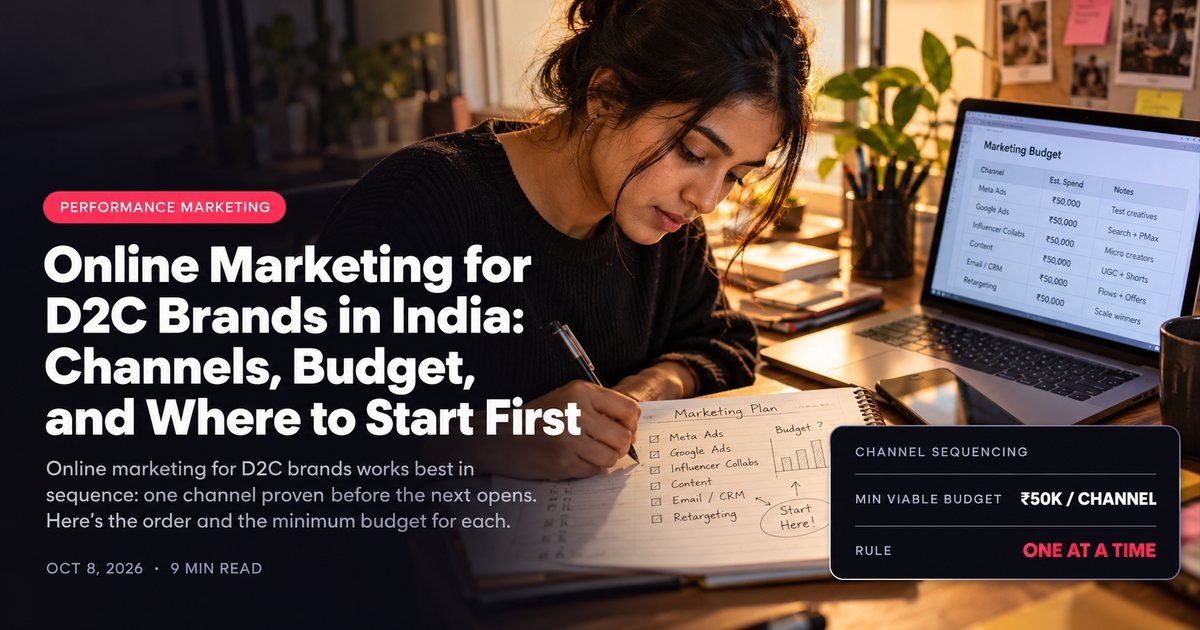
Most founders ask the wrong first question about online marketing. They ask "which channel is best," when the real question is "which channel first, and how much do I risk finding out." Order matters more than the channel list itself.
We have watched brands burn ₹3-4 lakh testing five channels in the same month, get noise instead of signal, and conclude that online marketing "doesn't work" for their category. The channels were fine. The sequence was the problem.
This is the order we'd run if we were starting your brand from ₹0 in ad spend today, with the minimum viable budget for each stage and the exact signal that tells you it's time to add the next one.
Why sequencing beats a channel list
A channel list tells you Meta, Google, influencers, and organic social all exist. You already knew that. What it doesn't tell you is that running all four at once with a small budget means each one gets too little money to produce a readable result.
₹50,000 split across four channels is ₹12,500 each. That's not enough data on any single channel to tell if it's working or if you just had a slow week. Split budget across channels before any one of them has proof, and you'll kill all four before any of them had a fair shot.
The fix is sequential, not parallel. Prove one channel. Let it fund or justify the next, then layer. If you want the fundamentals first, our guide to what performance marketing actually means for D2C brands covers the terms this post assumes you already know. Here's the order that works for most D2C brands in India, and why.
Stage 1: Meta Ads first, almost always
For most D2C categories, beauty, skincare, fashion, home, wellness, Meta is the correct first channel. It's the fastest to set up, the cheapest to test, and it gives you creative-level data within days, not weeks.
Minimum viable budget: ₹15,000-₹20,000 per month, run for at least 3-4 weeks before judging anything. Below that, the algorithm doesn't get enough conversions per day to leave the learning phase, and every number you look at is noise.
What you're testing in stage 1 is your creative and your offer, not the product itself. Run 3-4 creative concepts against one clear offer. Not just color variants of the same ad.
Watch cost per purchase stabilize, or watch it not. You can read our detailed breakdown of Meta Ads setup, budgets, and 2026 benchmarks for the exact campaign structure to use here.
The signal to move to stage 2: your Meta CAC is at or below your target for two consecutive weeks, on a budget you could double without the algorithm restarting its learning phase. That's proof, not luck.
Stage 2: Google Search, once demand exists
Google Search Ads only work when people are already searching for something close to your product or brand name. If nobody's typing your category into Google yet, Search Ads waste money on cold traffic pretending to be warm.
That's why Google comes second, after Meta has been running long enough to build some brand awareness and direct search volume. Check Google Trends or your Search Console for branded search volume before you touch Search Ads: if it's near zero, you're not ready yet.
Minimum viable budget: ₹10,000-₹15,000 per month, focused on branded terms, close competitor terms, and your 3-5 highest-intent category keywords. Skip broad category terms until you have real conversion data; they're expensive and mostly attract browsers, not buyers.
The signal to move to stage 3: Search Ads are converting at a CAC well below Meta's (they usually should, since intent is higher), and you have spare budget beyond what Meta and Google can profitably absorb.
Stage 3: Influencer marketing, for creative supply and trust
Here's the part most sequencing guides get wrong. Influencer marketing works best as a creative supply line into Meta, feeding it better content and trust signals, rather than as a separate acquisition channel fighting Meta for the same rupees.
Run 5-10 nano and micro creators (5,000-50,000 followers) on a whitelisting or spark ads arrangement, so their content runs as paid ads under your handle. This costs less than celebrity or macro deals and produces UGC-style creative that typically outperforms studio ads on cost per click.
Minimum viable budget: ₹25,000-₹40,000 for a batch of 8-10 creators, roughly ₹3,000-₹5,000 per creator for a nano/micro tier collab plus content usage rights. See our guide to influencer marketing agency costs and what they cover for a fuller pricing breakdown by tier.
The signal to move to stage 4: creator-sourced creative is outperforming your studio ads on Meta, and you have a repeatable process for briefing, casting, and getting usage rights, not one lucky viral post.
Stage 4: Organic social, for compounding reach you don't pay for every time
Organic Instagram and YouTube come last in the budget sequence, not because they're unimportant, but because they take months to compound and don't need much cash to start. What they need is consistency and a system, which is harder to buy than a media budget.
Organic's job is different from the first three stages. Rather than chasing an immediate CAC, it builds an audience that lowers your CAC across every other channel over time. People who already follow you convert cheaper everywhere else.
Minimum viable budget: near-zero in ad spend, but 3-5 posts a week minimum, ideally repurposing the creator and paid-ad content you're already producing rather than commissioning separate organic-only content. Our content marketing playbook for D2C brands covers the cadence and content mix in more detail.
The signal that it's working: follower growth stops being flat, saves and shares climb even on posts with modest reach, and DMs start converting without a paid boost.

What this looks like month by month
A brand starting from zero, spending nothing yet on ads, might roll out like this:
- Month 1: Meta only, ₹20,000, testing 4 creative concepts against one offer
- Month 2: Meta scaled to ₹35,000 on the winning concept, Google Search added at ₹12,000 for branded terms
- Month 3: Influencer batch of 8 creators (₹30,000) feeding new creative into Meta, Google spend held steady
- Month 4: Organic cadence locked in (3-5 posts/week), total paid budget now ₹80,000-₹90,000 across three proven channels
Total time to a fully staged setup: roughly 3-4 months, not the "everything live in week one" approach most first-time founders default to.
The most common mistake in this order
Founders skip Meta and go straight to influencer marketing because it feels less like "ads" and more like organic credibility. It rarely works that way when there's no paid infrastructure to amplify the content.
A great influencer video that only gets shown to that creator's own followers is a nice moment. The same video whitelisted into a Meta campaign against a tested audience can be a real acquisition engine, often at a lower cost per click than studio-shot ads run through the same targeting. Without stage 1 already proven, stage 3 has nowhere productive to land.
If you're unsure whether your category or budget fits this sequence, or want someone to build and run it rather than DIY it, a strategy call walks through your specific numbers in about 30 minutes.
The takeaway, in order
- 1Start with Meta Ads at ₹15,000-₹20,000/month for 3-4 weeks; don't judge before that.
- 2Add Google Search only once branded search volume exists, at ₹10,000-₹15,000/month on high-intent terms.
- 3Layer in influencer marketing (₹25,000-₹40,000 for 8-10 nano/micro creators) once Meta has a stable CAC to feed.
- 4Build organic social on the back of content you're already making, not a separate budget line.
- 5Move to the next stage only on a proven signal (stable CAC, existing search volume, outperforming creative), never on a calendar deadline.
Compare this to how you'd evaluate any marketing agency for your D2C brand: the right partner sequences your spend the same way, rather than launching every channel at once because it looks more impressive in a proposal.
Want us to audit where your CAC is leaking?
Book a call