Instagram Algorithm 2026: What Actually Gets D2C Brands Reach
The Instagram algorithm 2026 rewards send rate and watch time, not follower count. Here's what actually moves reach for D2C brand accounts.
Most D2C founders still think the Instagram algorithm 2026 runs on hashtags and posting frequency. It doesn't, and it hasn't for a while.
Instagram's own product team has said this plainly in interviews: there is no single algorithm. There are separate ranking models for Reels, Stories, feed, and Explore, each weighing different signals for different goals. A brand account that treats all four the same way is leaving reach on the table.
This post breaks down what each surface actually optimizes for in 2026, which signals matter for a product-led D2C account specifically, and what to change this week if your reach has been flat.
The four surfaces rank differently
Instagram doesn't have one feed. It has four separate distribution systems, and each one asks a different question before it shows your content to someone new.
Reels asks a blunt question: will people who've never seen this account watch it anyway? That's why Reels is the only surface with real reach into non-followers at scale. The model leans hardest on completion rate and rewatches. Likes barely register.
Stories asks something different: does your existing audience still care? It barely reaches non-followers, so treat it as a retention surface rather than a discovery one. Reply rate and sticker taps, polls, quizzes, sliders, carry more weight here than raw view count.
Feed posts ask whether the content is worth interrupting someone's scroll for a person they already follow. Saves and shares dominate that ranking model now, ahead of comments.
Explore runs the most personalized model of the four. It asks whether this specific viewer, based on their own history, would want more of exactly this. Generic content rarely earns a spot there, no matter how polished it looks.
A brand posting the same content type to all four surfaces and expecting the same result from each is the single biggest strategy mistake we see in D2C accounts.

The signals that actually move reach in 2026
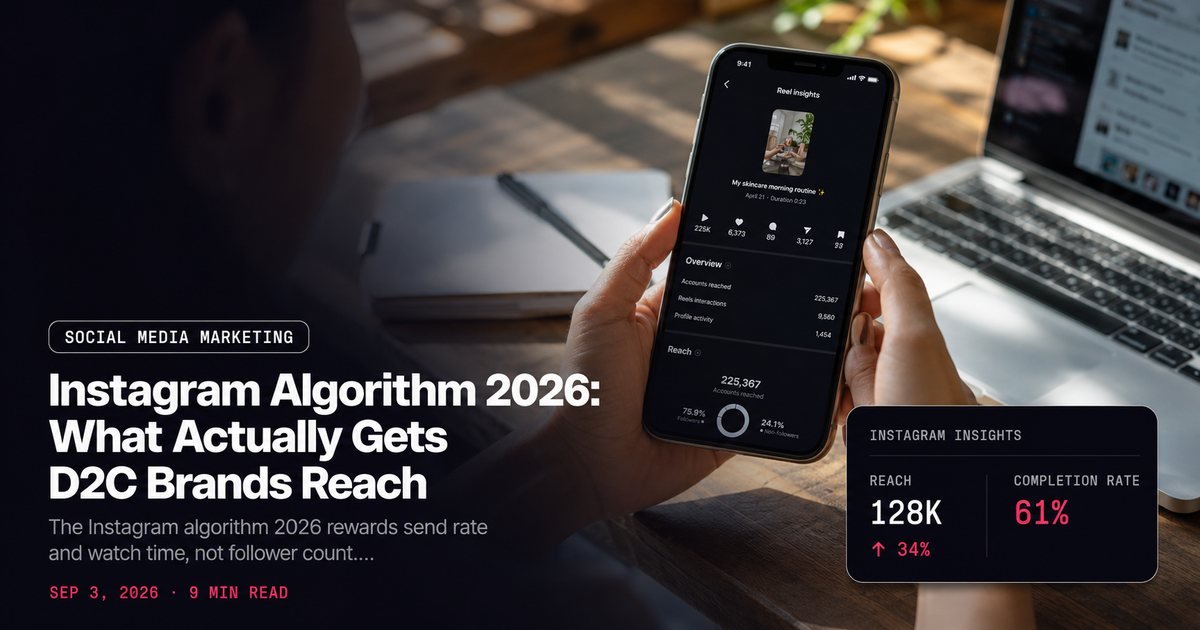
Forget vanity metrics. Watch time and completion rate carry the most weight on Reels specifically: a 12-second Reel watched to the end beats a 45-second Reel abandoned at 8 seconds, because the drop-off curve matters more than raw length.
Send rate is close behind, and arguably climbing. It measures how often people DM your post to someone else, and it's the hardest signal to fake, since it requires content genuinely worth sharing with one specific person rather than a broadcast.
Saves work as a proxy for "I'll come back to this." Skincare routines, price comparisons, and how-to breakdowns earn disproportionate saves compared with pure product shots, which mostly get scrolled past once.
Session depth matters too. Instagram tracks whether your Reel keeps someone on the app for the next several pieces of content or sends them closing out, and it actively suppresses content that reads as an "exit" trigger.
Early engagement velocity, the first 30-60 minutes after posting, still counts, but less than it did two years ago. A slow-burn Reel that keeps earning saves a week later can pick up a second wave of distribution on its own.
Follower count isn't part of this list at all. A 4,000-follower account posting content people actually send to friends will out-reach a 40,000-follower account posting product shots, and we see that exact pattern across nearly every D2C client account we've audited this year.
What this means for a product-led brand specifically
A D2C brand's Instagram problem is usually the content, not the algorithm. Most brand posts are built to look good rather than to be useful, which means they rarely earn the sends, saves, or completions the ranking models are actually watching for.
Compare two Reels from a skincare brand. One says "New serum launch, link in bio." The other says "Stop mixing vitamin C and retinol, here's what actually happens to your skin." The second gets saved by people building a skincare routine and sent to friends mid-argument about their own routine. The first gets scrolled past.
That doesn't mean stop selling. It means sequencing the content properly.
Educational and utility content, ingredient breakdowns, sizing guides, "things nobody tells you about X," earns the reach. Product and offer content then converts the people that reach brings in.
Run both, in that order. A straight product post rarely has the send-rate or completion numbers to carry your discovery on its own, no matter how good the product actually is.
Reels vs Stories vs feed: where to actually invest effort
For a growth-stage Indian D2C account, the practical split looks like this:
- 1Reels, 3-4 a week, aimed at discovery: non-followers, educational or trend-adjacent, with the first two seconds doing the work of a headline.
- 2Stories, daily, aimed at retention: heavy on polls, quizzes, and link stickers, because reply rate and sticker interaction keep the account in someone's daily habit.
- 3Feed, 2-3 posts a week, aimed at credibility and saves: carousel-heavy, since carousels get re-opened and that reads as extra session time, and less time-sensitive than Reels.
- 4Explore, which you don't post "for" directly. You earn it by consistently getting saves and sends elsewhere, and Explore then extends that content's life on its own once it's already working.
One India-specific note: with 229 million Instagram users in the country, the platform is effectively the default storefront for a huge share of D2C shoppers here, which raises the stakes on getting the surface-by-surface mix right rather than treating Instagram as one undifferentiated feed.

Why your reach might have dropped even though nothing changed
If reach fell and you didn't change your posting pattern, three things are worth checking before blaming "the algorithm changed again":
Content mix drifting toward product posts is the most common cause. It's a slow creep: a founder gets busy, product shots are faster to produce than educational content, and the send-rate signal erodes quietly over a month or two without anyone noticing the shift.
Completion rate dropping is the second. Even a small move toward longer Reels with slower hooks tanks completion rate, and Reels punishes that specifically, harder than any other surface.
The third is Stories going passive. An account that switched from daily polls and quizzes to static reposts loses its reply-rate signal, and that shows up as lower reach on Reels and feed too, because Instagram reads overall account health rather than judging each post in isolation.
Every one of these is fixable inside a week, and none of them requires an email to Instagram support.
Getting this right consistently is part of what a dedicated social media strategy built around your actual funnel stages does that a generic posting calendar doesn't: it treats Reels, Stories, and feed as three different jobs instead of one content bucket.
A quick audit you can run today
Pull your last 12 Reels and sort by reach, not likes. For your top 3 and bottom 3, check:
- 1Did the hook (first 2 seconds) state a specific, useful claim or just show the product?
- 2Was the topic something a viewer would realistically send to one specific friend?
- 3What was the completion rate (Instagram shows this in Insights per Reel)?
If your top performers are consistently useful/educational and your bottom performers are consistently product-first, you've found your reach leak, and it isn't the algorithm.
If a pattern isn't obvious from that audit alone, a short strategy call is often faster than guessing your way through another month of flat numbers.
One more thing worth checking: reach versus impressions
Before you conclude anything from this audit, separate reach from impressions. Reach counts unique accounts that saw your content. Impressions count every view, including repeat views from the same person.
A brand account can hold steady on impressions while reach quietly falls, if an existing audience is rewatching Stories or a Reel more often while fewer new accounts get shown the content at all. That distinction changes the fix entirely: a reach problem needs new-audience distribution work (better hooks, higher send rate), while an impressions-only dip is usually just posting frequency catching up with you.
Want a content engine that compounds?
Social Media Marketing