LinkedIn Ads for D2C Brands: When B2B-Style Targeting Makes Sense for Consumer Products
LinkedIn ads rarely make sense for D2C, but premium products sold to working professionals are the one real exception. Here's the math.
A premium ghee and superfood brand we spoke to last quarter had a strange problem. Their best customers weren't found through Instagram reels or influencer content. They were corporate HR teams buying festive gift boxes in bulk, at four to five times the brand's usual direct-to-consumer order value.
Nobody on the team had run LinkedIn ads. Ever. LinkedIn wasn't even on the channel list, because the platform felt wrong for a food brand.
The platform was fine. The assumption underneath it was the actual problem.
Most D2C founders write off LinkedIn before they open Campaign Manager, and most of the time that's fair. The platform is built for B2B lead generation, SaaS demos, and recruiting. A ₹699 skincare serum aimed at a 24-year-old scrolling Instagram at 11pm has no business there.
But there's a narrow case where LinkedIn's job-title-and-seniority targeting lines up almost exactly with a D2C brand's real buyer. Most brands never find it, because they stopped looking after the first glance.
This post is about that narrow case. What it looks like, what it costs, and the honest math on whether it's worth testing.
Why LinkedIn gets dismissed, and when the dismissal is wrong
The dismissal makes sense for most consumer products. LinkedIn's targeting, job title, seniority, company size, industry, is built around someone's professional capacity. Not their personal shopping habits.
A brand selling impulse-buy snacks or ₹500 fashion accessories gets nothing from knowing a prospect is a "Senior Manager." That detail says nothing about whether they'll buy a kurta.
Three patterns flip that math. First, a genuinely high average order value, where the margin can absorb an expensive click.
Second, a B2B2C angle, where a company buys on behalf of employees or clients: corporate gifting, branded merchandise, employee wellness perks.
Third, a customer base whose income and buying behavior track closely with a specific job function or seniority level that LinkedIn can isolate and Meta simply can't.

This works for a thin slice of D2C. Premium skincare and grooming at a real price point. Executive gifting and corporate hampers. Premium home office or desk accessories. High-end fitness and wellness subscriptions. Branded merchandise sold into companies rather than to individuals.
The honest cost math: LinkedIn CPCs are brutal
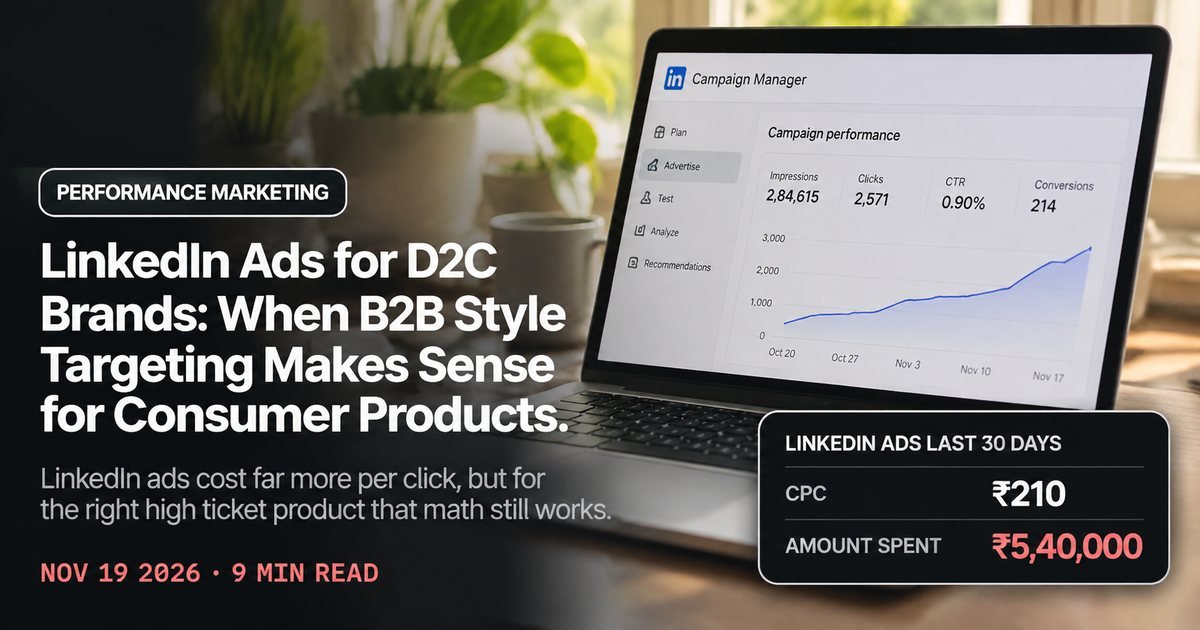
Here's the part most agencies skip when they pitch LinkedIn as the "untapped channel." Cost per click in India commonly runs ₹150 to ₹400, against ₹8 to ₹25 for a decently optimized Meta campaign in the same category. That's a real gap. Three to five times the cost, sometimes more for narrow seniority and industry combinations.
CPMs follow the same curve, often ₹800 to ₹1,500 on LinkedIn against ₹80 to ₹150 on Meta for similar reach. If you're anchored on Meta ads benchmarks, the first LinkedIn invoice stings until you check the arithmetic twice.
The arithmetic itself is simple. A ₹250 click that lands a ₹4,000 order with healthy margin and two reorders a year beats a ₹15 click landing a ₹600 order with thin margin and no repeat behavior.
CPC alone tells you nothing. CAC against AOV and LTV is what matters. LinkedIn only clears that bar for brands sitting well above the usual D2C price point.
The targeting options that actually matter
Most of LinkedIn's targeting stack is dead weight for a consumer product. Skills endorsements, Groups, and member interests rarely move anything. Four filters do almost all the work.
Job title and function
For executive gifting and premium personal-use products, function beats exact title. Targeting "Operations," "HR," or "Executive Office" as a function usually outperforms narrow title lists, which shrink the audience too far and push CPCs up without a matching lift in quality.
Seniority
Director level and above is the usual floor for premium personal products, where disposable income is the real qualifying signal. For corporate gifting, HR and admin seniority matters more than general leadership seniority. They're the actual buyers, not the recipients.
Company size
The single most useful filter for B2B2C gifting. A company with 200+ employees has a gifting budget and a procurement process already in place. A 15-person company rarely does, regardless of how senior the person you're targeting there happens to be.
Industry
Better used as a negative filter than a positive one. Excluding industries where disposable income skews low does more for efficiency than chasing one "ideal" industry, especially since LinkedIn's own industry categories are messier than they look.
Stack more than two of these and the audience shrinks below what the algorithm needs to optimize delivery. Two tight filters beat four loose ones, almost every time.
A decision framework: who should actually test this
Run your brand through this before a single rupee goes in.
Test it if your AOV sits above roughly ₹3,000 to ₹4,000 with healthy gross margin. If you have a real corporate-gifting or B2B2C angle, even a small, unbuilt one. If your customer's job function or seniority genuinely predicts who buys, rather than serving as a nice demographic overlay.
One more condition matters. You should already run a working performance marketing account elsewhere, so blended CAC can get compared honestly instead of judged on its own.
Skip it if your AOV sits under ₹1,500 to ₹2,000. If the product is an impulse buy with no consideration phase. If the test budget is under ₹50,000, which won't tell you much at these CPCs.
Also skip it if the hope is that LinkedIn turns out cheaper than Meta, since that never happens. The case for using it rests entirely on accepting the premium.
A brand building digital marketing strategy for next quarter should treat LinkedIn as its own line item with its own success bar. Judge it against Meta's CPC and it will always look like a bad deal, because that's the wrong comparison to make.
What a realistic pilot looks like
Budget ₹75,000 to ₹1,50,000 for a real first test, run over three to four weeks. That's enough spend to get a useful read at LinkedIn's CPCs without betting the quarter on an unproven channel.
Start with Sponsored Content carrying one specific offer, not a generic brand story. A corporate gifting catalog. A bulk discount tier. A product demo framed for office use.
Cold LinkedIn traffic responds to a concrete reason to click far better than to a lifestyle brand video. Lead gen forms usually beat website clicks for the corporate-gifting angle too, since procurement contacts often want a catalog or a quote, not an immediate checkout.
Track cost per qualified lead separately from cost per sale. A corporate buyer's sales cycle runs longer and involves more back-and-forth than a typical D2C checkout. Judge the campaign on day-14 ROAS the way you'd judge a Meta ads campaign, and a genuinely working LinkedIn test will look like a failure before it's had time to close.
Mistakes brands make when they do try this
The most common one: reusing the exact creative and offer that works on Meta, just re-uploaded. A lifestyle shot with a discount code does fine on Instagram and falls flat on LinkedIn, where the audience sits in a different headspace entirely. Creative needs to speak to the professional use case or the gifting angle directly.

The second mistake is stacking filters too hard, chasing a "perfect" audience of senior HR managers at companies of exactly 300 to 500 employees across three industries. That audience is often too small to spend its own budget or exit the learning phase. Start broader on one or two filters. Narrow based on what the data actually shows.
The third is quitting after two weeks because CPCs look alarming next to a Meta account. LinkedIn's buying cycle runs longer, especially for anything B2B2C. Four weeks is the realistic floor before any real verdict.
What to actually do this quarter
- 1Pull AOV and gross margin by product line. Flag anything above ₹3,000 to ₹4,000 as a LinkedIn candidate before testing anything else.
- 2Write your actual B2B2C angle in one sentence: corporate gifting, employee wellness perks, branded merchandise, even if you've never formally sold it that way.
- 3Build one Sponsored Content campaign around a single tight offer: catalog request, bulk pricing, or a quote form, not a brand-awareness push.
- 4Set a four-week minimum test window and a budget of at least ₹75,000 before drawing any conclusion.
- 5Track cost per qualified lead and sales-cycle length separately from your existing Meta or Google ROAS dashboards. Comparing them directly produces a false negative.
- 6Review the result against the decision framework above, not against what LinkedIn "should" cost, before deciding to scale or kill the test.
Want us to audit where your CAC is leaking?
Book a call