Pinterest Ads for D2C Brands: An Underused Channel Worth Testing in 2026
Pinterest ads reach shoppers who are actively planning a purchase, not scrolling for entertainment, and most Indian D2C brands haven't touched the channel yet.
A home decor client of ours spent two years running every rupee through Meta. Good CAC, decent LTV, nothing broken. Then their designer, almost as an afterthought, asked why nobody had tried Pinterest. Half her own mood boards for the brand's shoots came from there.
We set up a small test account that week.
Three months later, that "afterthought" channel was quietly delivering the lowest cost per purchase across their entire media mix, and it wasn't close.
Not a universal result. We'll get to why in a minute.
It's the kind of thing that happens when a brand finally runs Pinterest ads instead of writing the platform off as a mood board app for people who never buy anything.
Most Indian D2C marketers haven't touched Pinterest at all. The auction is thinner, CPCs are lower, and the buyers who are there tend to be further along in a purchase decision than almost anywhere else they'd see an ad.
Why Pinterest gets dismissed before anyone tests it
The reputation is sticky. Pinterest looks like a scrapbooking tool from 2013.
Most marketing teams in India have never run a single rupee through it. No internal case study to point to. No peer brand bragging about results at the conferences where everyone else compares Meta ROAS numbers.
The usual objection is some version of "nobody in India uses Pinterest." That's partly true and partly beside the point. The India user base is smaller than Meta's by a wide margin, mostly urban, skewed female, and concentrated in exactly the categories where visual discovery matters: home, fashion, beauty, weddings, food.
If your product sits outside that cluster, fine, the audience genuinely might not be there in useful numbers. If it sits inside that cluster, you're looking at a channel almost nobody in your category has tested, running against an auction nowhere near as crowded as Meta ads.
The behavioral difference that actually matters
Instagram and Facebook are built around passive scrolling. Someone opens the app to kill five minutes. An ad has to interrupt that mindset hard enough to earn a click.
Pinterest works the opposite way. People open it because they're already planning something: a wedding, a home renovation, a wardrobe refresh, a dinner party menu. They're searching with intent, saving things to boards they'll revisit, building a mental shortlist before they buy.
That changes what an ad has to do. It shows up inside a planning process someone already started, rather than interrupting one.
A pin that answers "what does a good minimalist living room setup look like" sits naturally next to organic content. A well-tagged product pin can carry a user from "saving ideas" to "add to cart," no jarring tonal shift, no Meta-ad-interrupting-a-friend's-wedding-photos moment.

Which categories this actually works for
Pinterest rewards categories where people browse for inspiration before they buy. Where they don't, it's close to useless.
Home decor and furnishings sit at the top of the list. People spend weeks or months collecting ideas before a big home purchase, and Pinterest is where a lot of that collecting happens.
Fashion and accessories work well too, especially anything tied to seasonal looks, outfit inspiration, or styling content, which is the native language of the platform.
Beauty and personal care does well when the content leans into tutorials, before-and-afters, and routine-building rather than straight product shots.
Weddings and events might be the single best-fitting category in India specifically. Indian wedding planning is enormous, visual, and long-cycle, exactly the kind of purchase journey Pinterest is built around, and this overlaps naturally with the kind of influencer marketing content wedding-adjacent brands already produce.
Food and recipes has a smaller but genuine audience, mostly around specialty ingredients, kitchen tools, and gifting occasions.
Categories that tend to flop: anything impulse-driven and low-consideration, commodity products with no visual story, B2B, and most app or subscription-based D2C plays. If your product doesn't photograph well or doesn't fit into someone's aspirational planning, don't force it here.
What it actually costs in India right now
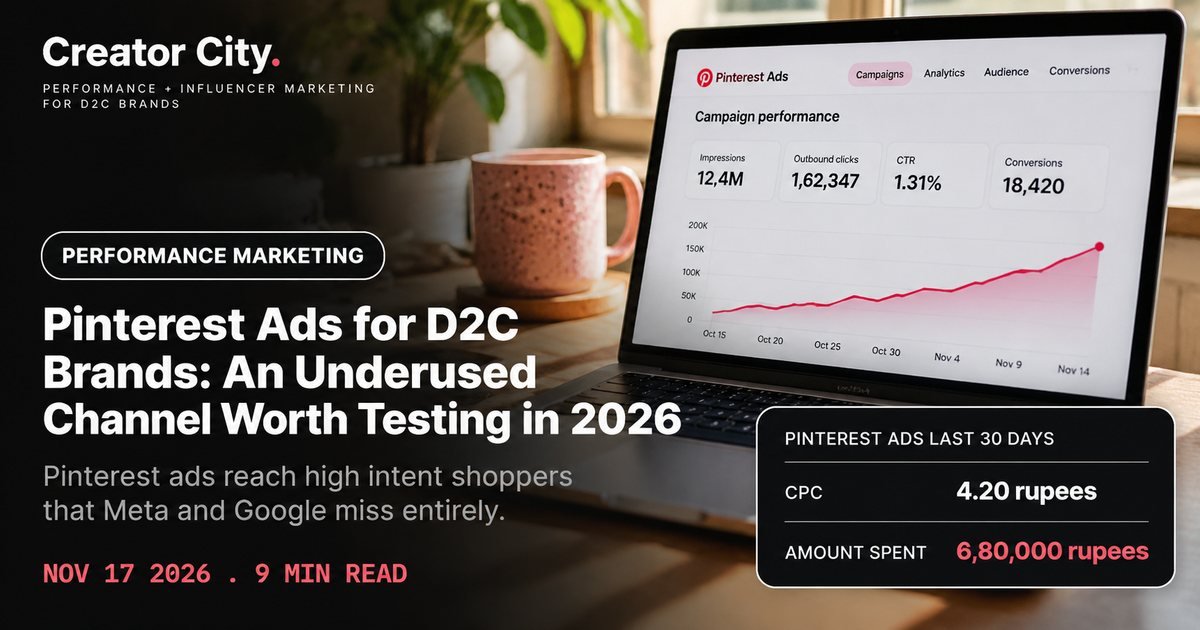
Because competition is so much lower than Meta or Google, CPCs on Pinterest in India are often meaningfully cheaper, frequently in the ₹3-₹12 range for well-targeted campaigns in the categories above. Meta CPCs, by comparison, have climbed steadily over the past couple of years. CPMs follow the same pattern: lower, simply because fewer advertisers are bidding for the same eyeballs.
That cost advantage comes with a catch worth being honest about. Volume is lower too. You won't scale a Pinterest account to the same spend levels as a mature Meta account unless your category has genuine demand on the platform. Treat it as a channel that runs efficiently alongside your main spend.
A realistic pilot budget is ₹20,000-₹40,000 over three to four weeks, enough to see whether cost per click and early conversion signals justify scaling further.

The shelf-life advantage nobody talks about
This is the part that surprises most people the first time they see it in their own dashboard. A Meta ad has a lifespan measured in days. Creative fatigue sets in fast, frequency climbs, and you're swapping assets every week or two just to keep cost per result stable.
A good pin behaves completely differently. Pinterest's algorithm keeps surfacing pins in search and related-content feeds for months after they're published, sometimes longer.
We've seen individual pins from a client's catalog still generating impressions and the occasional sale eight months after the original campaign ended, zero additional spend behind them. Almost nothing else in the paid toolkit works like that: evergreen organic reach, stacked on top of an ad that already paid for itself.
A smart Pinterest strategy blends paid promotion of a pin early on with the expectation that it keeps earning attention long after the budget stops. Build once, let it compound. That's the same instinct behind good content marketing generally, just applied to a format most brands still treat as disposable.
Setting up a Pinterest ads test the right way
- 1Claim and verify your domain in Pinterest Business, then install the Pinterest tag on your site so you can actually measure conversions, not just clicks.
- 2Upload your product catalog and enable Shopping ads if you're on Shopify; this turns existing product pins into clickable, priced listings automatically.
- 3Build 15-20 fresh pins before you launch anything paid, vertical format, real lifestyle context, not repurposed Instagram square crops, since Pinterest's own best practices and algorithm both favor native-feeling content.
- 4Start with Consideration or Conversion campaign objectives targeting your core category keywords and interests, not broad awareness, since the whole point is reaching people already in a planning mindset.
- 5Run the pilot for a minimum of three weeks before judging results; Pinterest's algorithm takes longer to find its footing than Meta's does, and early data is noisier.
- 6Track cost per click, saves, and conversion rate separately, since a pin that gets saved heavily but doesn't convert immediately may still be doing useful top-of-funnel work that pays off weeks later.
Who should skip this entirely
Be honest about fit before spending a single rupee. If your product is a commodity, your brand has no real visual identity, or you're running a pure performance play on a low-margin, impulse-buy item, Pinterest probably costs more in setup effort than it returns.
Same goes for B2B brands and most software or subscription products. The platform's entire user behavior is built around visual, tangible, often aspirational purchases. Forcing a mismatched category onto it usually produces mediocre results that confirm the "Pinterest doesn't work" assumption rather than testing it properly.
If you're already stretched thin managing performance marketing across Meta and Google, adding a third platform without the bandwidth to produce native-feeling pins will just dilute attention. Pinterest rewards a dedicated, even if small, content effort. It punishes a half-hearted one. No middle ground here.
What to actually do this quarter
- 1Check whether your category falls into home, fashion, beauty, weddings, or food; if it doesn't, deprioritize this and revisit in six months.
- 2Set up Pinterest Business, verify your domain, and install the conversion tag before spending anything.
- 3Commission or repurpose 15-20 vertical, lifestyle-first pins specifically for the platform, not recycled square creative.
- 4Run a ₹20,000-₹40,000 pilot over three to four weeks with Shopping or Consideration objectives against core category keywords.
- 5Track saves and cost per click weekly, but hold the real conversion judgment until week three or four.
- 6If the pilot clears your existing blended CAC, build Pinterest into your always-on content calendar rather than treating it as a one-off experiment.
Want us to audit where your CAC is leaking?
Book a call