User-Generated Content Strategy for D2C Brands: Sourcing to Reposting
A user generated content strategy for D2C brands: how to build a seeding list, brief creators, and repost without begging for tags.
A skincare brand we spoke to last month had 40,000 Instagram followers and almost no customer content to show for it. Every post came from the brand's own camera. Every caption sounded like the brand talking about itself.
That's the gap most D2C accounts sit in. A user generated content strategy is the difference between an account that looks like an ad and one that looks like proof, and treating it as optional leaves that proof on the table. Buyers scroll past brand claims fast, but they slow down for a stranger's honest review filmed in their bathroom.
Getting there on purpose, instead of hoping customers tag you, takes a system. Here's the one we run as part of our social media marketing work for clients.
Why "just ask customers to tag us" doesn't work
Most founders try the passive route first: a line in the packaging insert, a branded hashtag, maybe a giveaway. That generates a trickle, and a trickle is hard to build a content calendar on.
Customers usually do want to post about a brand they like. The real barrier is that posting isn't the default behavior for most buyers, even happy ones, so they need a specific, low-friction reason at the exact moment the product is top of mind. A generic ask buried in a delivery box rarely clears that bar.
Passive asks also give you zero control over quality. You'll get one usable clip for every twenty low-light, off-brand attempts, and you can't build a content calendar on luck.

A real strategy treats UGC sourcing the way you'd treat any other acquisition channel: with a target list, an outreach process, and a way to measure what's working.
Step 1: Build a seeding list, not a wishlist
Seeding means sending free product to people you've identified in advance, in exchange for content instead of a paid fee. It's the cheapest way to build a UGC pipeline, and it works best when your list is specific.
Skip the temptation to seed to anyone with a pulse and a decent follower count. A tight seeding list of 30-50 people who already fit your customer profile outperforms a scattershot list of 300. Pull from three sources:
- Existing customers who left a 5-star review or replied enthusiastically to a post
- Nano creators (1K-10K followers) in your category who already post similar products organically
- People who've tagged competitors or used your product's category hashtag without being asked
Track this list in a simple spreadsheet: handle, follower count, engagement rate, what you sent, and whether content came back. Within two months you'll see which sourcing channel actually converts to usable content, and you can stop guessing.
Step 2: Brief creators like you'd brief a paid shoot
Free product doesn't mean no brief. The single biggest reason seeded UGC comes back unusable is that the brand sent a box and hoped for the best.
Give every seeded creator three things: the product, one specific angle to cover (unboxing, first-use reaction, a before/after over a week), and two or three brands they can look at for tone, never a script. Scripts kill the authenticity that makes UGC convert in the first place.
Ask for raw footage, not a finished Reel. A creator's polished edit is theirs to post on their own account. Raw clips are what you actually need for ads and your own feed, and most creators will hand them over gladly if you ask before, not after, they've posted.
Set a soft deadline of 10-14 days. Any longer and the moment (and the creator's enthusiasm) has usually passed.
Step 3: Get usage rights sorted before you repost anything
This is the step brands skip, and it's the one that gets them a takedown request or a legal headache six months later.
A tag or a DM saying "feel free to repost" is not a license. Before reposting anyone's content on your grid, ads, or website, get an explicit written yes covering where you'll use it (organic feed only, or organic plus paid ads) and for how long.
For seeded creators, build this into the same message where you send the brief: "in exchange for the product, we'd love to repost your content on our page and possibly in ads, is that okay?" Most people say yes on the spot when it's asked upfront instead of after the fact.
If you plan to run the content as an actual ad, that's usually worth a small paid add-on, even for someone you seeded to for free. It recognizes that ad usage is a different ask than an organic repost.
For a deeper look at putting these terms in writing so nothing gets contested later, see how influencer contracts should actually be structured.

Step 4: Repost on a cadence, not whenever something shows up
Sporadic reposting looks exactly like what it is: an afterthought. A better pattern is to treat UGC as its own content pillar with a fixed slot, not filler for slow weeks.
One workable rhythm: two UGC reposts a week, alternating between Stories (fast, low-effort, great for building the sense that "everyone's using this") and feed Reels or carousels (slower, higher-effort, better for reach). Credit the creator every time, in the caption and with an on-screen tag, not buried in alt text.
Don't just repost as-is. A short brand-added intro clip, a text overlay pulling out the best line from the review, or a simple before/after edit turns raw customer footage into something that performs closer to your best organic Reels.
This is also where your social content is worth planning around when your audience is actually online, so a strong UGC post doesn't land in a dead window.
A 30-day sourcing sprint to get this running
If you're starting from zero, don't try to build the whole system in one week. Run this instead.
- 1Days 1-5: pull your seeding list from past reviews, DMs, and category hashtags. Aim for 40 names minimum.
- 2Days 6-10: send the first batch of 15-20 seeding outreach messages with the brief and usage-rights ask built in.
- 3Days 11-20: ship product, follow up once at day 10 if content hasn't come back, and log every response in your tracker.
- 4Days 21-25: review whatever's come in. Sort into "post as-is," "needs a light edit," and "not usable," and start scheduling the first two reposts.
- 5Days 26-30: send a second, smaller seeding batch to the people who responded fastest the first time; they're your highest-probability repeat source.
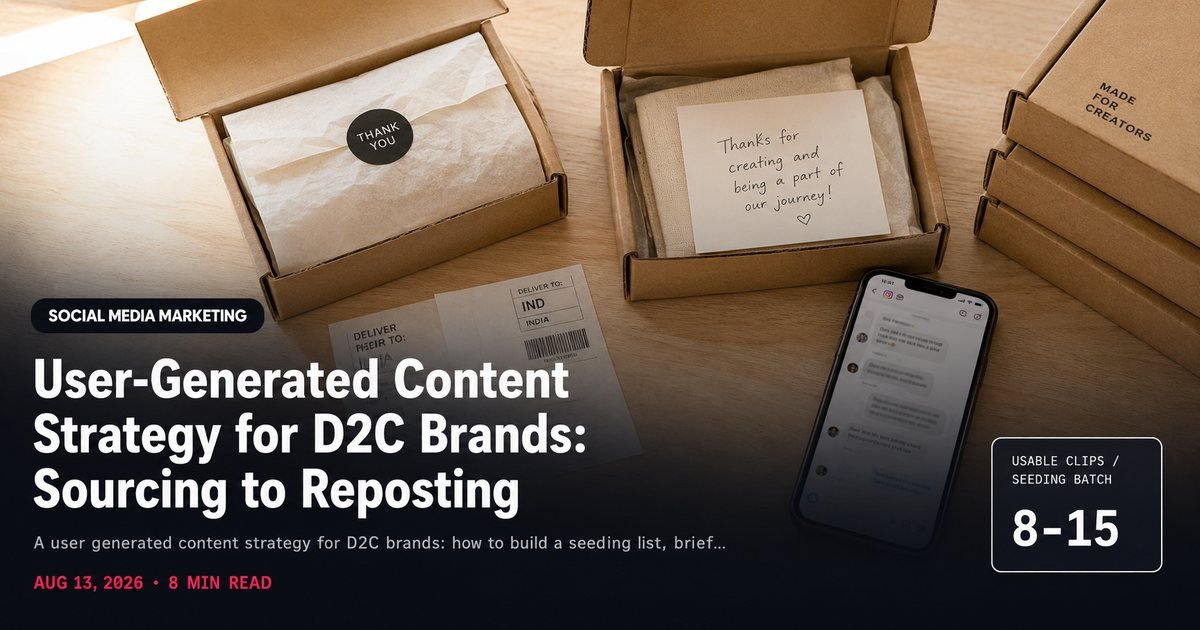
By day 30, most brands have somewhere between 8 and 15 usable pieces of content and a much clearer picture of which sourcing channel to double down on next month. That's usually enough to fill your repost slots for six to eight weeks while the next batch is out in the field.
If organic seeding alone isn't producing enough volume once you've run this sprint, it's worth comparing it against paying creators directly for content, which is a different budget conversation entirely and usually the next lever once a seeding program plateaus.
How to tell the pipeline is actually working
Content coming in and content working are two different things. Track three numbers alongside your seeding tracker instead of just logging whether a video came back.
Response rate. What share of outreach messages get a yes? Under 20% usually means your list is too broad or your ask is too generic. Tighten the list before you assume seeding doesn't work for your category.
Repost engagement versus brand-shot content. Pull save and share rates on your last ten UGC reposts against your last ten brand-produced posts. If UGC isn't beating or matching brand content on saves, the issue is usually creator fit, not the format itself.
Content-to-cost ratio. Divide product cost sent out by usable pieces returned. A ₹15,000 seeding batch that returns six usable clips is roughly ₹2,500 a piece, often a fraction of what a paid UGC creator would charge for the same output.
Track this every quarter so seeding stays the efficient channel it's supposed to be. Otherwise it quietly turns into an expensive way to give away product for nothing.
None of this replaces a real strategy conversation about where UGC fits against your paid and influencer spend; that's a fit conversation worth having on a free strategy call if you want a second set of eyes on your current mix.
Want a content engine that compounds?
Social Media Marketing