Zomato Ads vs Swiggy Ads for Restaurants in India: Where to Spend
Zomato ads vs Swiggy ads for restaurants in India: real CPC and CPO benchmarks by cuisine, and where each platform actually wins.
Every restaurant owner asks the same question once their aggregator listing goes live. Zomato ads or Swiggy ads, and how much of each? It sounds like a simple pick, and it rarely is once real order data starts coming in.
The honest answer is both, in different proportions depending on your cuisine and city, not one platform picked as a winner. Owners who go all-in on one aggregator usually leave orders on the table the other platform would have delivered cheaper.
I've managed aggregator budgets for restaurants ranging from single cloud kitchens to five-outlet chains. The pattern holds across almost all of them: the split matters more than the total spend.
What Zomato and Swiggy actually charge
Neither platform publishes a flat rate card, but real accounts settle into predictable ranges. Zomato Ads run an effective CPC of roughly ₹4-18, while Swiggy Ads land closer to ₹3-15.
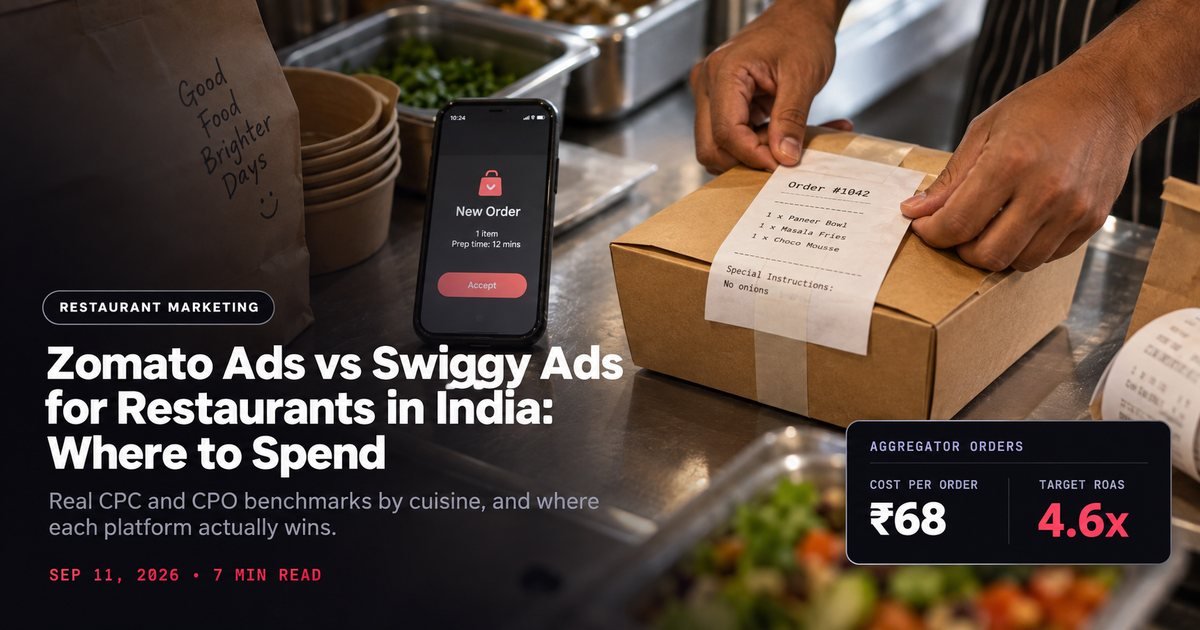
Cost per order tells the more useful story. QSR and biryani categories see a healthy CPO of ₹40-65. Pizza and Chinese sit at ₹55-85. Casual dining and cafés run higher, ₹80-120, since average order values are lower relative to the ad spend needed to win a placement.
A target ROAS of 4x to 6x is realistic once your account has enough order history for the platform's algorithm to optimise properly. Below that, you're probably still in the learning phase or your menu pricing needs a second look.

Where each platform actually wins
Zomato tends to pull ahead on brand visibility and organic search ranking, especially for premium restaurants in metro markets. If your restaurant depends on being discovered by someone searching a cuisine or occasion rather than reordering a regular, Zomato usually returns more of that discovery traffic per rupee.
Swiggy plays a different game. It performs stronger for repeat customers, residential catchments, and steady daily order volume in Tier 1 and Tier 2 cities. A neighbourhood kitchen living on weekday lunch and dinner reorders often sees Swiggy carry more of the volume.
Neither pattern is universal. Run both platforms for at least a month before cutting either one, and judge by CPO and repeat-order rate rather than by which app's account manager calls more often.
A budget-split framework by stage
A new listing with no order history should split spend close to even, roughly 55/45 in whichever direction your category leans, and let four to six weeks of data decide the real ratio. Cutting a platform early, before the algorithm has enough orders to optimise against, usually costs more than it saves.
Once you have real data, weight the split toward whichever platform delivers your category's CPO range more consistently, and keep 20-25% on the weaker platform anyway. Aggregator algorithms reward accounts that stay active, and a platform you've gone quiet on takes weeks to regain its previous placement quality if you need it again.

What multi-outlet chains should do differently
A single-location restaurant can manage its Zomato and Swiggy split by feel after a few months. A five-outlet chain can't, since each location has its own local competition, delivery radius, and repeat-customer base pulling the ratio in different directions.
Set the split at the outlet level, not the brand level. An outlet in a dense residential pocket might lean 70% Swiggy for volume, while a flagship location in a commercial district leans the opposite way for Zomato's discovery traffic. Blending all outlets into one company-wide budget number hides which locations are actually working and which are quietly overspending.
Review outlet-level CPO monthly, and reallocate budget away from the weakest-performing location's aggregator spend before assuming the whole chain's ad strategy needs a rethink. Often it's one or two outlets dragging the average down, not the strategy itself.
Mistakes that quietly inflate your CPO
Running both platforms at an identical daily budget regardless of performance is the most common one. If Zomato is returning a 5x ROAS and Swiggy a 2.5x, an even split is leaving money on Zomato's table.
Ignoring organic ranking is the second. Both platforms reward restaurants with strong ratings and fast acceptance times by improving unpaid placement, which lowers the ad spend needed to appear in the same slot. Fixing operational basics, like order acceptance speed, often does more for your CPO than adding budget.
The third: treating aggregator ads as your whole marketing plan. A restaurant relying only on Zomato and Swiggy caps its own upside, since both platforms take a commission on every order and control the relationship with the customer, not you.
How cuisine changes the math
A biryani or QSR outlet with a lower average order value and high order frequency behaves differently on both platforms than a casual dining restaurant with fewer, bigger tickets. The lower CPO range for QSR reflects volume, not lower ad efficiency, so don't panic if your fine-dining account runs a higher CPO than a friend's cloud kitchen quotes you.
Cafés sit in an awkward middle spot. Order values are modest but the occasion is often social rather than transactional, which means Instagram-driven discovery frequently outperforms aggregator ads for footfall, even while delivery orders still run through Zomato or Swiggy for the takeaway side of the business. Treat the two as separate goals with separate budgets rather than one blended number.
Building beyond the aggregators
Google Ads and a well-optimised Google Business Profile capture the "near me" searches that never touch an aggregator app at all, and that traffic converts to a customer who books directly instead of paying platform commission on every visit. Combined with Instagram content that builds repeat-visit intent, aggregator spend becomes one channel among several instead of the entire strategy.
Our restaurant and café marketing work runs exactly this combination for outlets that want off-aggregator growth alongside a well-managed Zomato and Swiggy presence, geo-fenced local ads and creator content included. If you're weighing that kind of setup, our breakdown of quick commerce ad economics covers the same aggregator-dependency tradeoff from the D2C side, and the math translates directly.
A realistic monthly plan
Cloud kitchens deserve one more note. Without a physical storefront to build organic walk-in awareness, aggregator ads carry a heavier share of total demand generation than they do for a restaurant with dine-in traffic, which usually justifies a slightly higher combined ad budget as a share of revenue in the early months.
- 1Start close to even on a new listing, roughly 55/45 toward whichever platform your cuisine typically favours.
- 2Track CPO weekly by platform, not CPC, for the first six weeks.
- 3Rebalance toward the stronger performer, but keep at least 20% on the other to protect its placement quality.
- 4Fix acceptance speed and ratings before adding budget; operational fixes often beat spend increases.
- 5Add Google Ads and GBP once aggregator CPO is stable, so off-platform growth isn't competing with an unoptimised aggregator account for attention.
Most owners we work with are surprised by how much headroom exists once acceptance speed, ratings, and off-aggregator channels are actually fixed, rather than assuming the aggregator commission is simply the cost of doing business.
None of this replaces good food or good service. It just means the ad spend behind good food actually reaches the people most likely to book, instead of getting split evenly out of habit.
If you want a second pair of eyes on your current Zomato and Swiggy split, book a free strategy call and we'll run the CPO math against your actual account data.
Book a call