Brand Marketing vs Performance Marketing: What You Lose by Skipping One
Brand marketing campaigns build the demand performance marketing later converts cheaply. Here's the right sequencing by stage for a D2C brand.
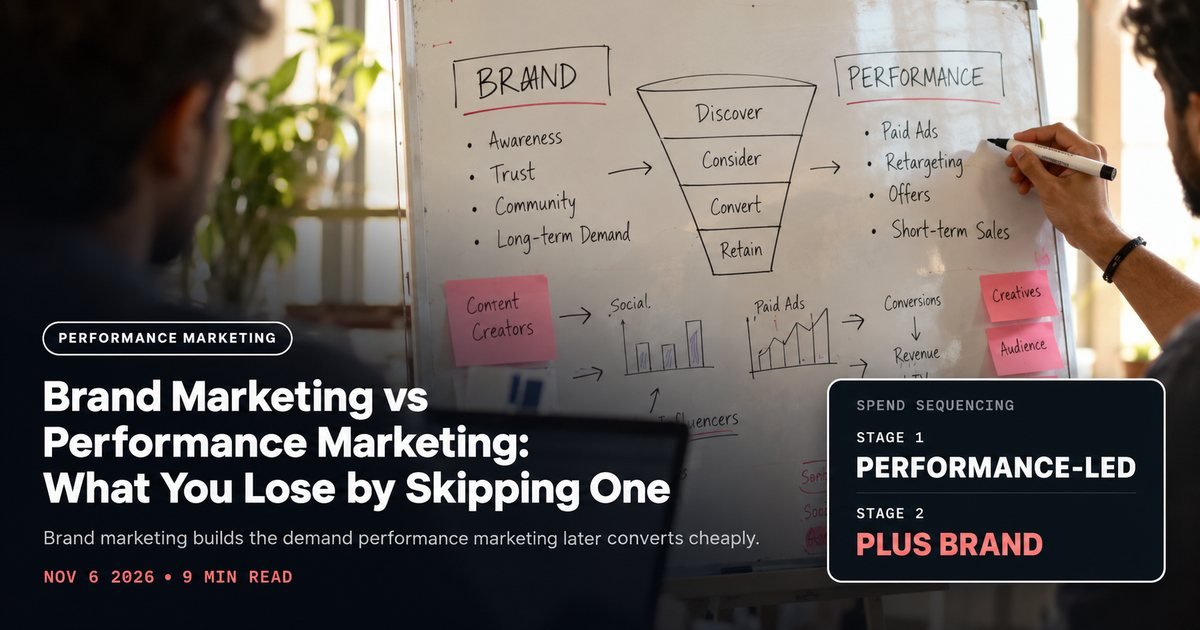
Two founders can spend the exact same ₹20 lakh over a year and end up in completely different places. One built a brand people search for by name. The other bought a year of cold clicks that disappeared the day the ad budget paused.
The difference usually comes down to sequencing between performance marketing and brand marketing campaigns, not the amount spent, and almost nobody talks about this as a sequencing problem. It gets framed instead as an either-or choice, which is the wrong frame entirely.
This post covers why performance marketing alone eventually plateaus, why brand marketing alone burns cash without a performance backbone, and a practical framework for which one leads at each stage of a D2C brand's growth.
Why performance marketing alone eventually hits a ceiling
Performance marketing is the fastest way to generate revenue on a predictable cost basis, and that's exactly why most new D2C brands start there. Google and Meta Ads let you buy attention at a known price and measure the return almost immediately.
The problem shows up later, usually somewhere between month 8 and month 18, depending on category and spend level. CAC starts drifting upward even as the team runs the same or better creative testing discipline. Auction prices for the same audience creep up as more competitors enter the category and bid for the same attention.
A brand with no independent demand of its own is entirely dependent on paid auctions for every single customer, forever. There's no compounding effect, no accumulating asset. Pause the spend and revenue goes to zero almost immediately, because nothing was built that exists outside the ad account.

The other tell is branded search volume staying flat no matter how much is spent on paid. If nobody is searching your brand name on Google, nobody remembers you between impressions, which means every single purchase has to be won fresh, from a cold click, every time.
Why pure brand marketing without performance discipline burns cash
The opposite failure mode is just as real, and we see it with founders who've read enough about "brand building" to distrust performance marketing entirely. They pour budget into awareness-style content, sponsorships, or broad-reach campaigns with no measurable path to a sale.
This can work, but only at a scale and budget most D2C brands don't have. A large FMCG company running TV and OOH can afford years of pure brand investment before it needs to show a direct sales return, because the balance sheet supports that patience.
A D2C brand doing ₹10-30 lakh a month in revenue usually cannot. Brand marketing without a performance layer underneath it has no feedback loop telling you whether the investment is working until the money is already spent. There's no click-through rate, no conversion data, nothing measurable in the short term to course-correct against.
We've seen brands spend six months and a meaningful chunk of runway on influencer and content campaigns with strong engagement numbers and almost no measurable lift in sales or branded search, because nobody connected the brand work to a performance mechanism that could capture and convert the attention it generated.
The actual relationship between the two
Brand marketing and performance marketing work less like competing budgets fighting for the same rupee and more like sequential investments that feed each other, where the order matters more than the ratio.
Performance marketing finds out, fast and cheaply, what message and product actually resonates with real buyers. That's market research paid for by sales instead of a research firm invoice. Brand marketing then takes what performance already proved works and builds durable recognition and trust around it, lowering the cost of every future performance campaign.
Done in the right order, brand investment should show up as a declining CAC trend over time (because branded search and recognition reduce how much convincing a cold ad has to do) and a rising share of direct and organic traffic relative to paid. That's the compounding effect pure performance marketing can never produce alone.

A practical sequencing framework by stage
Early stage: performance-led, 80/20 or tighter
In the first 6-12 months, or until you've found reliable product-market fit, performance marketing should lead by a wide margin, often 80% performance to 20% brand-adjacent work (which at this stage mostly means content marketing and organic social, not paid awareness campaigns).
The job at this stage is finding out what works: which product, which message, which audience, which price point. Performance marketing's tight feedback loop is the fastest and cheapest way to learn this. Spending heavily on brand marketing before you know what the brand should even stand for is spending blind.
Any content or social work during this stage should still be built around proving and amplifying what performance is already finding works, not running as an independent track with its own creative direction.
Growth stage: layering in brand, roughly 60/40
Once CAC has stabilized and you're seeing repeat purchase behavior, usually somewhere past ₹30-50 lakh a month depending on category, it's time to start layering in brand investment deliberately. This typically means a shift toward 55-65% performance, 35-45% brand-building work: better production value on content, influencer marketing that builds genuine affinity rather than just driving immediate clicks, and possibly early offline or event activity.
This is also when working with dedicated brand marketing agencies or a broader marketing strategy agency engagement starts to make sense, since the work now requires a different skill set than pure media buying and optimization: positioning, brand voice, visual identity consistency, and campaign concepts that don't need to justify themselves on a last-click basis.
The performance marketing engine shouldn't shrink in absolute spend here, just in relative share, because it's still the revenue engine funding the brand investment. A digital marketing strategy that sequences these correctly treats brand spend as compounding infrastructure, not a competing line item.
Mature stage: brand defends share, performance captures demand
Past a certain scale, often ₹1 crore-plus a month, the roles invert slightly. Brand marketing's job becomes defending category position and building the kind of recognition that keeps competitors from eroding share. Performance marketing's job narrows to efficiently capturing demand that already exists, both from brand-driven interest and from new category entrants discovering the space.
At this stage, budget ratios vary more by category and competitive intensity than by a fixed formula, but the key discipline stays the same: every brand investment should still be traceable, even loosely, to a performance metric like branded search volume, direct traffic share, or declining blended CAC. The moment that link disappears, brand spend has drifted into unaccountable territory.
How to tell if your sequencing is wrong right now
A few signals that performance and brand are out of sequence for your stage, worth checking quarterly:
- 1Branded search volume has stayed flat for six months despite steady or growing ad spend. That means paid is buying attention but building no memory.
- 2CAC keeps climbing and the only response has been to increase budget rather than diagnose why. That's treating a brand-equity gap as a spend problem.
- 3You're running awareness-style brand campaigns with engagement numbers but no attached mechanism (a landing page, a retargeting pool, a promo code) to capture the demand they generate.
- 4Your performance marketing agency cost keeps rising relative to output, and nobody's asked whether the real fix is brand investment rather than more optimization inside the same tired channel mix.
None of these mean stop performance marketing or start brand marketing instead. They mean the ratio between the two is wrong for where the brand actually is. Fixing the ratio usually matters more than fixing either channel individually.
If you want a second opinion on where your brand actually sits on this curve, book a free strategy call and bring your last two quarters of CAC and branded search data.
Book a call