Ecommerce Development Company vs Freelancer vs In-House: What a D2C Brand Should Pick
Ecommerce development company vs freelancer vs in-house hire: real costs, red flags, and the revenue point where D2C brands should switch.
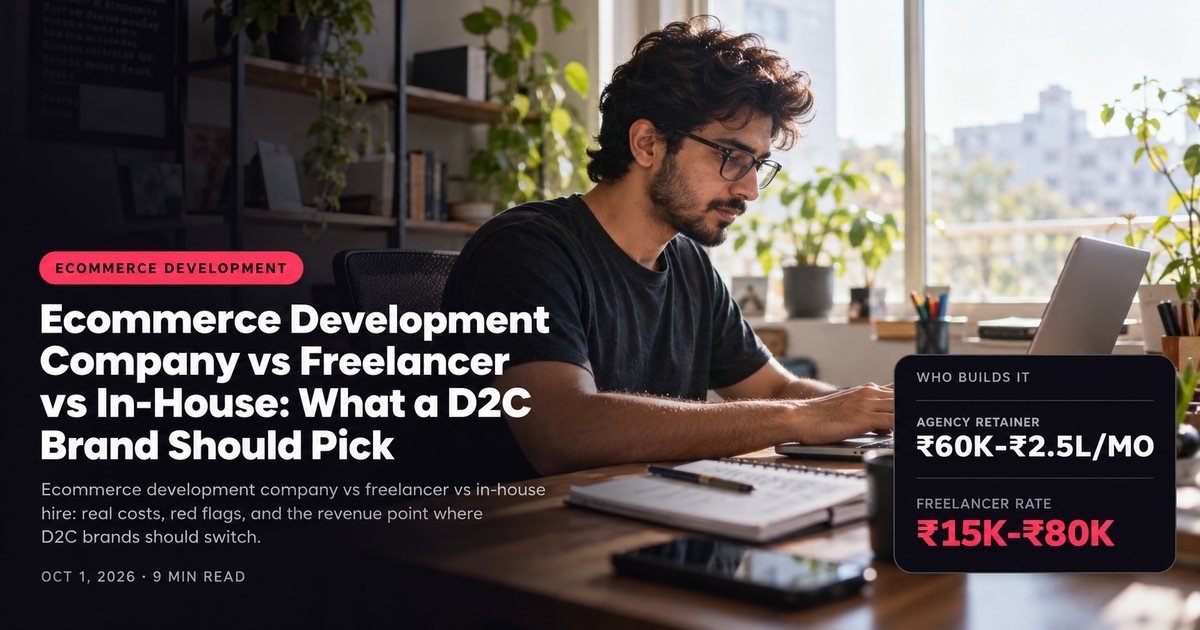
Every D2C founder hits this question around month four: who actually builds and maintains the store. A freelancer quoted ₹25,000. Your cousin's friend who "knows Shopify" is free but slow. An ecommerce development company wants a monthly retainer that feels steep for a brand doing ₹8 lakh a month.
There's no universal right answer here. There's a right answer for your revenue, your complexity, and how much of your own time you're willing to spend managing a vendor instead of running the brand.
I've watched founders make this call wrong in both directions: hiring a full-time developer at ₹60,000/month when a freelancer would've done the job for a tenth of that, and sticking with a ₹15,000 freelancer for two years past the point their site was actively losing them sales.
A store that quietly converts at 0.7% is usually the first sign; our CRO guide shows how to check. This post is the framework I wish someone had handed me instead.
What each option is actually good at
Freelancers are fast and cheap for a single, well-defined job: a landing page, a theme tweak, a Klaviyo integration. You brief them, they build it, you pay, done.
The trouble starts when the job isn't singular. If you need someone who understands your whole store's history and keeps coming back, a one-off hire stops fitting.
In-house hires know your business without a briefing. They sit in on strategy calls. They notice the checkout is slow before your CRO numbers do. That context is worth real money, but only once you have enough recurring work to keep one person genuinely busy.
An ecommerce web development company sits between the two. You get a team (a developer, sometimes a designer, a project manager), not one person's calendar and one person's skill ceiling. When your Shopify dev is on leave, someone else on the team still answers your Slack message.
Here's how the three actually compare on the things that matter:
| Freelancer | Agency | In-house | |
|---|---|---|---|
| Typical monthly cost | ₹15,000-₹50,000 project-based | ₹40,000-₹1,50,000 retainer | ₹35,000-₹90,000+ salary alone |
| Response time | Depends on their other clients | SLA-backed, usually 24-48 hrs | Immediate, same day |
| Backup if they're unavailable | None | Team covers | None unless you hire two |
| Range of skills | Narrow, whatever they specialize in | Broad: dev, design, CRO, sometimes ads | Narrow, whatever you hired for |
| Best for | One-off builds, small fixes | Ongoing growth, multiple projects at once | High-volume, always-on stores |
The real cost comparison, not the sticker price
A ₹20,000 freelancer sounds cheaper than a ₹70,000 agency retainer until you count what's missing. Freelancers rarely include ongoing monitoring, so a broken checkout on a Friday night sits broken until Monday.
We hear this exact story constantly from brands switching away from freelance setups.
Agencies price the monitoring and the redundancy into the retainer. A custom ecommerce development company managing 8-10 client stores has systems (uptime alerts, staging environments, a QA checklist) that a solo freelancer juggling five side clients usually doesn't bother building.
In-house is the most expensive on paper and often the cheapest per hour once you're big enough. A ₹70,000/month developer who's fully occupied costs less per task than a freelancer billing ₹3,000/hour for occasional fixes.
That math only works if you actually have 160 hours of real work to give them every month.
Red flags for each option
Freelancer red flags are easy to spot once you know to look. No written scope before the work starts. No version control, so you can't roll back if something breaks. They disappear for days mid-project. If they can't tell you how they'll test the checkout flow before handing it over, don't assume they will.
Agency red flags are quieter. Watch for:
- A sales call that talks entirely about "digital transformation" and never mentions Shopify, Liquid, or your specific platform
- No named point of contact, just a shared inbox that rotates people
- A contract with no defined turnaround time on bug fixes
- Portfolio stores that all look identical, meaning they clone one template repeatedly
- Reluctance to give you admin access to your own store
In-house red flags mostly show up once the hire has started. A developer who's brilliant at code but has never worked ecommerce specifically will burn weeks relearning things a Shopify or platform specialist already knows. Check their actual store experience, not just their coding test score.

When to switch: the revenue and complexity triggers
Most brands don't choose the "right" option once and stay there. They outgrow options in sequence.
The trigger is rarely revenue alone; it's revenue plus how many things are breaking at once.
Under ₹10 lakh/month, a freelancer or a small ecommerce website development company is usually enough. You have one store, one theme, a handful of apps. Complexity is low even if you're moving fast on ads and content.
Between ₹10 lakh and ₹50 lakh/month is where most brands should move to an agency retainer. You're now running multiple landing pages for different campaigns, testing checkout flows, maybe adding a subdomain for a sub-brand.
A single freelancer's bandwidth stops being enough at this stage. The cost of downtime starts mattering more than the cost of the retainer.
Past ₹50 lakh/month, or once you're running on a shopify ecommerce development company setup with genuinely complex custom logic (subscriptions, multi-warehouse inventory, a loyalty program), an in-house hire starts making sense.
Most brands at this stage keep an agency too, for overflow and specialized CRO work, rather than replacing one with the other.
A faster signal than revenue: count how many "urgent" dev requests you have in a typical week. One a month, freelancer. One a week, agency. Multiple a day, you need someone in-house, full stop, regardless of what the revenue number says.

What actually changes when you upgrade
Moving from freelancer to agency changes something deeper than headcount or cost: accountability.
A freelancer's incentive is to finish your ticket and move to the next client. An agency running your account has an ongoing relationship, so they're more likely to flag a problem before you notice it yourself, like a page load time creeping up or an app conflict slowing checkout.
If your platform decision is still open too, that's worth settling before you lock in a vendor. The short version: stay on default Shopify until order volume or checkout complexity forces your hand, and only then look at custom or headless.
There's also a companion piece on what Shopify development actually costs in India if you're still budgeting.
The vendor question and the platform question are related but distinct. A great ecommerce development company can work with any platform; the wrong platform choice will cost you more than switching vendors ever will.
It's also worth reading how brands should think about choosing between selling on their own site or on marketplaces like Amazon and Flipkart.
That decision changes how much custom dev work your store even needs.
A practical takeaway
Here's the sequence that holds up across most D2C brands we've worked with:
- 1Start with a freelancer or a small shop for your first build; keep the scope tight and get it in writing.
- 2Move to an ecommerce web development company once you're running more than one active campaign or landing page at a time.
- 3Track weekly "urgent" dev requests, not just revenue, as your trigger to reconsider.
- 4Bring dev in-house only once you have enough recurring work to fill a real role, usually past ₹50 lakh/month or once your build is genuinely custom.
- 5Whatever you pick, keep admin access to your own store. Never let a vendor, freelance or agency, be the only one who can log in.
- 6Re-evaluate every 6-9 months. What worked at ₹5 lakh/month won't work at ₹40 lakh/month, and that's normal, not a failure of your first choice.
If you're at the point where a retainer makes more sense than another one-off freelance job, our ecommerce and web development team builds conversion-first Shopify and custom stores for D2C brands at exactly this stage, and you can book a free strategy call to talk through where your store actually stands.
Book a call