Shopify Website Development Cost in India: What D2C Brands Actually Pay in 2026
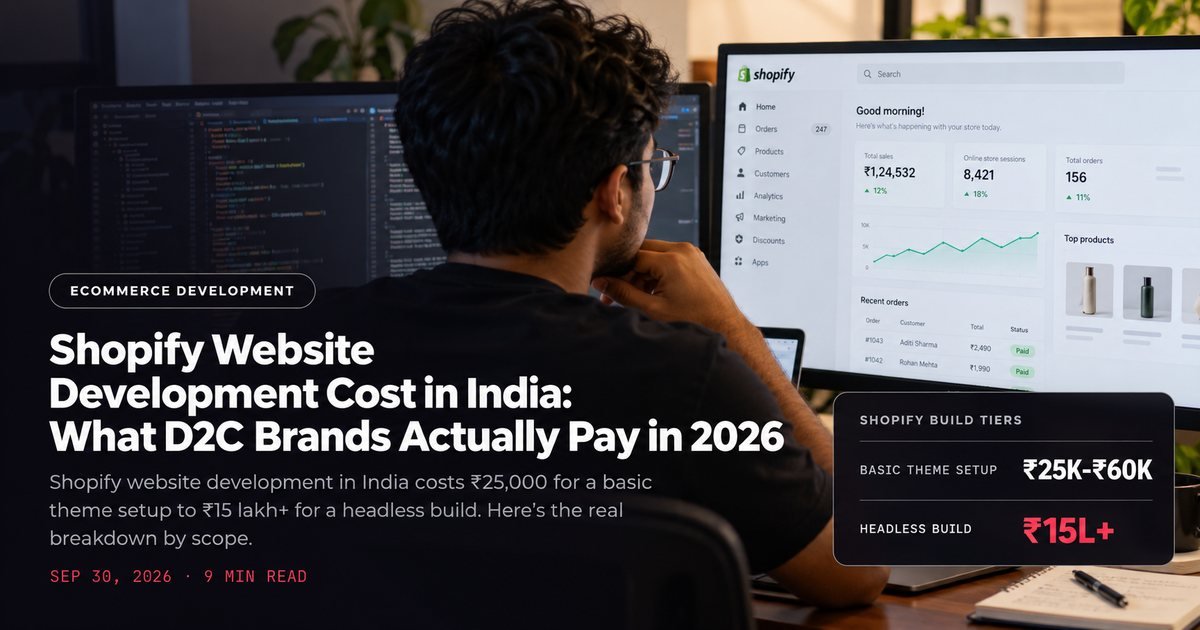
Shopify website development in India costs ₹25,000 for a basic theme setup to ₹15 lakh+ for a headless build. Here's the real breakdown by scope.
Every founder asks the same question before they sign a contract: what does shopify website development actually cost in India. The honest answer is a range wide enough to be useless on its own, so let's fix that.
A basic theme setup runs ₹25,000 to ₹60,000. A fully custom build can cross ₹5 lakh. Shopify Plus with headless architecture starts around ₹15 lakh and climbs from there. The gap between those numbers isn't padding; it's scope, and scope is where most quotes go wrong.
We've scoped and built Shopify stores for beauty, fashion, and food brands across price points most agencies won't discuss openly. This is the pricing conversation we actually have with clients, not the one that ends in a vague "it depends." Once the store's live, what it converts at matters more than what it cost to build.
The four tiers of Shopify development, priced
Shopify pricing splits into four real tiers. Each one solves a different problem, and jumping to a higher tier than you need is the single biggest way founders waste budget.
Basic theme setup (₹25,000 to ₹60,000). You pick a paid theme from the Shopify theme store, a developer installs it, configures your brand colors and fonts, sets up collections, and connects payment gateways and shipping. No custom code beyond configuration. This works fine for a brand launching its first store with a clear product catalog and no unusual requirements.
Custom theme development (₹80,000 to ₹3.5 lakh). A developer builds custom sections, product page layouts, and interactive elements on top of a theme framework, or codes a bespoke theme from scratch using Shopify's Liquid templating language. This is where most established D2C brands land, because a stock theme rarely matches a brand's actual merchandising needs by month six.
App integrations and advanced functionality (₹15,000 to ₹1.5 lakh, on top of theme cost). Subscription models, loyalty programs, advanced search, personalized quizzes, and custom checkout flows all need either paid apps or custom API integration work. A skincare brand running a subscribe-and-save program will spend far more here than a brand selling one-time purchases.
Shopify Plus and headless builds (₹15 lakh and up). Plus is Shopify's enterprise tier. It's built for brands doing ₹5 crore or more in annual revenue who need multiple storefronts, higher API rate limits, and dedicated support. Headless setups using Hydrogen (Shopify's React-based framework) decouple the frontend from Shopify's backend entirely. You get a fully custom UI while keeping Shopify's checkout and inventory engine underneath.

Most founders we talk to assume custom means expensive by default. It doesn't. A well-scoped custom theme at ₹1.5 lakh often converts better than a ₹5 lakh build stuffed with features nobody asked for.
What actually determines which tier you need
Catalog size matters more than most people expect. A brand with 40 SKUs and simple variants can run comfortably on a basic setup. A brand with 400 SKUs across multiple collections, each needing different filtering logic, usually needs custom development just to keep the browsing experience usable.
Your growth stage matters too. If you're pre-launch and validating demand, spend the least amount possible on the platform decision itself and get to market. Overbuilding before you have sales data is the most common mistake we see in this range, and it's a big reason starting a D2C brand goes better when the store stays minimal at first.
Here's a rough way to think about which tier fits:
- Under ₹50 lakh annual revenue, no unusual checkout needs: basic theme setup or light customization
- ₹50 lakh to ₹5 crore, growing SKU count, need for brand-specific UX: custom theme development
- ₹5 crore+, multiple product lines or regions, need for speed at scale: Shopify Plus, possibly headless
- Any revenue level with a genuinely unusual purchase flow (build-your-own kits, subscriptions with complex logic): budget extra for app integration regardless of tier
If you're still deciding whether to build on Shopify at all versus a custom stack, that's a separate decision with its own cost logic, and it's worth settling that before you commit either way.
Ongoing monthly costs nobody mentions upfront
The build cost is the number everyone asks about. The monthly running cost is the one that surprises people six months in.
Your Shopify plan itself runs from ₹2,000 to ₹12,000 a month depending on tier (Basic, Grow, Advanced), before Plus. That's just the platform license, not hosting, since Shopify hosts everything for you.
Apps add up fast. A typical D2C store running email marketing, reviews, upsells, and subscriptions pays ₹8,000 to ₹40,000 a month across five to eight apps. Each app looks cheap alone at ₹500 to ₹5,000 monthly, but they compound quickly once you've added a bundle builder, a loyalty program, and a post-purchase upsell tool.
Maintenance and support is the line item agencies quote lowest and deliver least on. Budget ₹10,000 to ₹50,000 a month for an agency retainer covering bug fixes, theme updates, and minor feature requests, or expect to hire a part-time developer for less if your needs are simple.

Transaction fees are the quiet one. Shopify charges 2% on top if you don't use Shopify Payments, on every single order. For a brand doing ₹20 lakh a month in sales through a third-party gateway, that's ₹40,000 leaving the table every month for no added value.
What drives cost up unexpectedly
Three things blow past initial quotes more than anything else we've seen.
Payment gateway integration is first. Standard Razorpay or PayU integration through Shopify Payments is included in most quotes. But custom payment flows, multiple gateway fallbacks for reliability, or EMI and buy-now-pay-later integrations need custom development work that a basic quote rarely accounts for.
Multi-currency and international shipping is second. If you're planning to sell beyond India, currency conversion, duty calculation, and region-specific shipping rules add real development hours. Shopify Markets handles some of this natively, but custom pricing logic per region (rounding, local psychological pricing) still needs configuration work.
Custom checkout is third and the biggest surprise for most brands. Shopify's checkout is locked down on lower plans; customizing it beyond basic branding requires Shopify Plus or checkout extensibility development. A brand wanting a one-page checkout with custom upsells at the cart stage will hit this wall regardless of how clean the rest of their store is.
Scope creep during the build is the fourth cause. This one has nothing to do with Shopify itself. Every "just one more thing" request during development adds hours beyond the original quote. Protect both sides with a fixed-scope agreement and a defined change-request process.

Once you know which tier you're building and what it'll cost monthly, the next real decision is who builds it. That choice changes the total cost picture as much as the tier does, and it's worth understanding how the hiring decision affects both price and quality before you sign anyone.
Freelancer vs agency: how it changes the number
A freelancer will quote lower on paper. Often 30 to 50% below an agency for the same theme customization work. That gap is real, but it doesn't capture the whole picture.
Agencies typically bundle project management, QA testing, and post-launch support into the quote. A freelancer's lower number often excludes all three. You either do that work yourself or pay for it separately once problems surface.
For a basic setup with a tight, well-defined scope, a freelancer is often the smarter call. For anything touching multiple app integrations, custom checkout logic, or a headless build, the coordination overhead of managing multiple freelancers usually costs more in delays than an agency's higher quote would have cost upfront.
Getting the most accurate quote for your specific store
A generic quote request gets a generic number back. Come to any conversation, ours or anyone else's, with these five things ready:
- 1Your current or projected SKU count and how often it changes
- 2Every app or integration you already know you need (subscriptions, loyalty, reviews, search)
- 3Whether you need multi-currency or international shipping in year one
- 4Your current monthly order volume, or a realistic projection for month six
- 5Any specific checkout customization you've seen elsewhere and want replicated
Answering these before the first call cuts quote-gathering time roughly in half, because the developer isn't guessing at scope. It also makes it much easier to compare two quotes side by side, since vague quotes tend to hide the biggest cost drivers in fine print.
If you'd rather skip the back-and-forth entirely, a conversion-first Shopify build scoped against your actual catalog and traffic gets you a real number in one conversation, not a range.
Most brands overpay not because development is expensive, but because nobody scoped the actual requirement before quoting the build. Get the scope right first, and the number stops being scary.
You can book a free strategy call and bring your catalog size and monthly orders.
Book a call