Facebook Lead Ads for D2C Brands: What You Lose When You Use the Wrong Format
Facebook lead ads fit some D2C funnels and waste budget on others. Here's how to tell which one your brand actually is before you launch.
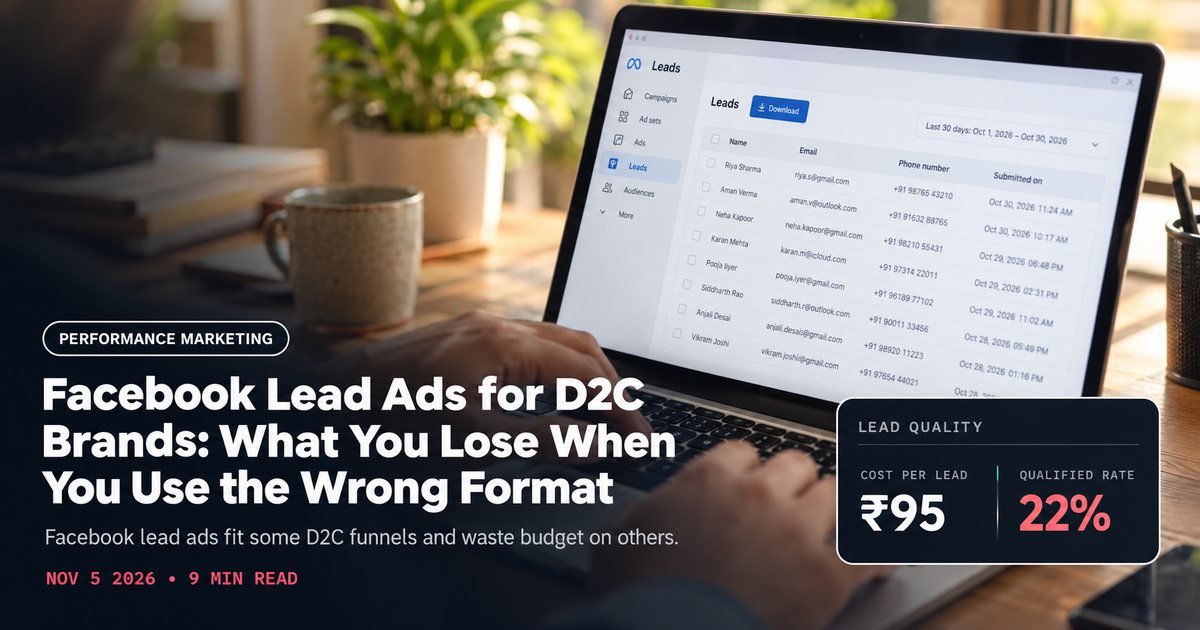
Facebook lead ads let someone fill out a form without ever leaving Instagram or Facebook. No landing page load, no checkout flow, just a pre-filled form that opens on top of the app and submits in two taps. Meta's own data consistently shows lead ads convert at a higher rate than sending the same audience to a website form, often by a wide margin.
That sounds like the obvious choice for every D2C brand. It's not. We've seen lead ads cut cost-per-lead by 40% for a wellness brand's consultation funnel.
We've also watched them drag down an apparel brand's checkout conversion, because the "leads" captured were never real buying intent in the first place. The format fits certain funnels and actively hurts others. This piece is about telling those two situations apart before you spend a rupee. If you'd rather have someone map your funnel to the right format directly, our performance marketing team does that as part of every new account setup.

How the lead ads format actually works
A lead ad looks like any other Facebook or Instagram ad in the feed. The call-to-action button opens an in-platform form instead of linking out. Meta auto-fills fields it already has, name, email, phone number, from the person's profile. Completing the form takes seconds, not minutes.
You build the form in Ads Manager with whatever fields you need: name, phone, email, and optionally custom questions like "What's your skin concern?" or "Preferred consultation time." Submitted leads land in Meta's Leads Center, which lives inside the same Meta Business Suite setup you're likely already running for Pixel and catalog management. From there, download a CSV manually, or better, connect a CRM integration that pushes leads in automatically the moment they submit.
That speed is the format's strength. It's also exactly its weakness, depending on what you're trying to capture.
When lead ads genuinely work for a D2C brand
High-consideration purchases that need a human conversation before anyone buys. Think skincare brands offering a free skin consultation before recommending a routine, or supplement brands qualifying someone's health goals before suggesting a stack. The in-platform form removes friction at exactly the point where friction was never adding value, since the real qualification conversation happens afterward on a call or WhatsApp, not on a landing page.
Waitlists and pre-launch signups. If you're building anticipation for a product drop and the goal is capturing an email list rather than processing a transaction, lead ads are close to ideal. The person wasn't going to buy anything on that visit regardless of format. You just want their contact details, and lead ads get you more of them per rupee than a landing page ever will.
Consultation-based or service-adjacent D2C offerings. Brands selling personalized products, custom nutrition plans, made-to-order furniture, bespoke skincare, benefit because the actual sale happens in a follow-up conversation anyway. The ad's only job is starting that conversation, and lead ads are the cheapest, fastest way to do exactly that.
Expect cost-per-lead in India to run ₹50-₹250 for these categories, depending on how specific your targeting is and how qualified the form questions make the lead. A form with zero qualifying questions will produce cheaper, lower-quality leads than one asking a specific question that filters out tire-kickers before they even submit.

When lead ads actively waste budget
Impulse ecommerce checkout. Say your product is a ₹600 phone case or a ₹1,200 kurta, bought in the same scroll session someone first saw it. A lead form adds a pointless extra step before the thing that actually matters: checkout.
You're capturing contact details for a purchase decision the person was ready to make immediately. Then hoping to convert that lead into a sale later, through a follow-up most impulse buyers never respond to.
Any funnel where the "lead" has no real intent behind it. This is the trap. Lead ads convert at a higher rate than landing page forms precisely because they're frictionless. Frictionless also means some people submit without meaning to buy anything.
Just curious, or tapping through without reading carefully. For a straightforward ecommerce funnel, that inflates your lead count while actual sales conversion craters, often below 5%. A meaningful chunk of those submissions were never real intent.
When you don't have a real follow-up system. Lead ads only work if someone calls, messages, or emails that lead within hours, not days. We've audited accounts running lead ads into a Leads Center nobody checked more than once a week.
Those leads go cold fast. The brand ends up paying acquisition cost for contacts that convert at a fraction of what a same-day follow-up would get.
Lead quality problems and how to actually fix them
The most common complaint we hear about Facebook lead ads is "the leads are garbage," and it's almost always a form design problem, not a platform problem.
Add one real qualifying question beyond contact details. A question like "What's your biggest skin concern right now?" with multiple choice answers does double duty: it filters out people who aren't genuinely interested, and it hands your sales team context for the first conversation instead of a cold name and number.
Avoid auto-fill-only forms for anything beyond ₹5,000 price point. The easier you make submission, the more low-intent leads you'll collect. For higher-ticket consultations, a slightly longer form with 2-3 questions produces fewer but meaningfully more qualified leads, which is almost always the better trade for sales team time.
Test instant form vs higher-friction form against the same audience. Run both for two weeks and compare not lead volume, but actual booked calls or completed sales per lead. The cheaper cost-per-lead format often loses this comparison once you follow the funnel all the way through.
CRM integration realities
Manually downloading CSVs from Leads Center and uploading them to your CRM works for a brand running one small campaign. It falls apart fast once you're running multiple ad sets across multiple form variants.
Set up a direct integration before you scale spend, not after. Meta supports native integrations with major CRMs, and Zapier or Make can bridge most of the rest within an hour of setup. The goal is a lead hitting your sales team's queue within minutes of submission, not sitting in an export file until someone remembers to check.
If your brand is running Google search ads alongside Meta, the same lead-quality logic applies there too. Google ads for lead generation tend to produce higher-intent leads than Meta on average, since the person is actively searching rather than scrolling, but at a meaningfully higher cost-per-lead. Which platform wins depends on whether you need volume or intent more.
The actual decision framework
Ask one question before choosing the format: does the purchase decision get made in that same scroll session, or does it require a conversation first? If it's the former, send traffic to a landing page or straight to checkout. If it's the latter, lead ads remove friction at exactly the step that was never adding real value anyway. If you're still deciding which marketing partner should own this decision for you, our guide to choosing a marketing agency covers the right questions to ask before signing anything.
Our Meta ads for D2C brands guide covers the broader account setup lead ads sit inside, including Pixel and Conversions API configuration that still matters even when you're optimizing for leads rather than purchases.
Takeaways
- 1Facebook lead ads fit high-consideration purchases, waitlists, and consultation-based funnels where a real conversation happens after the form, not during checkout.
- 2They actively hurt impulse ecommerce funnels, adding friction-free noise to a purchase decision that was already happening in the same session.
- 3Expect ₹50-₹250 cost-per-lead in India depending on category and how qualifying your form questions are.
- 4Add at least one real qualifying question beyond contact details to filter low-intent submissions before they reach your sales team.
- 5Set up direct CRM integration before scaling spend; leads sitting unchecked in Leads Center for days convert at a fraction of same-day follow-up rates.
If you're not sure whether your funnel actually fits the lead ads format, book a free strategy call and we'll map it against your actual purchase cycle before you spend on it.
Book a call