Social Media Advertising Across Platforms: Where D2C Budgets Actually Convert Best
A platform-by-platform breakdown of social media advertising for Indian D2C brands: where Meta, Pinterest, Snapchat, LinkedIn and YouTube actually convert.
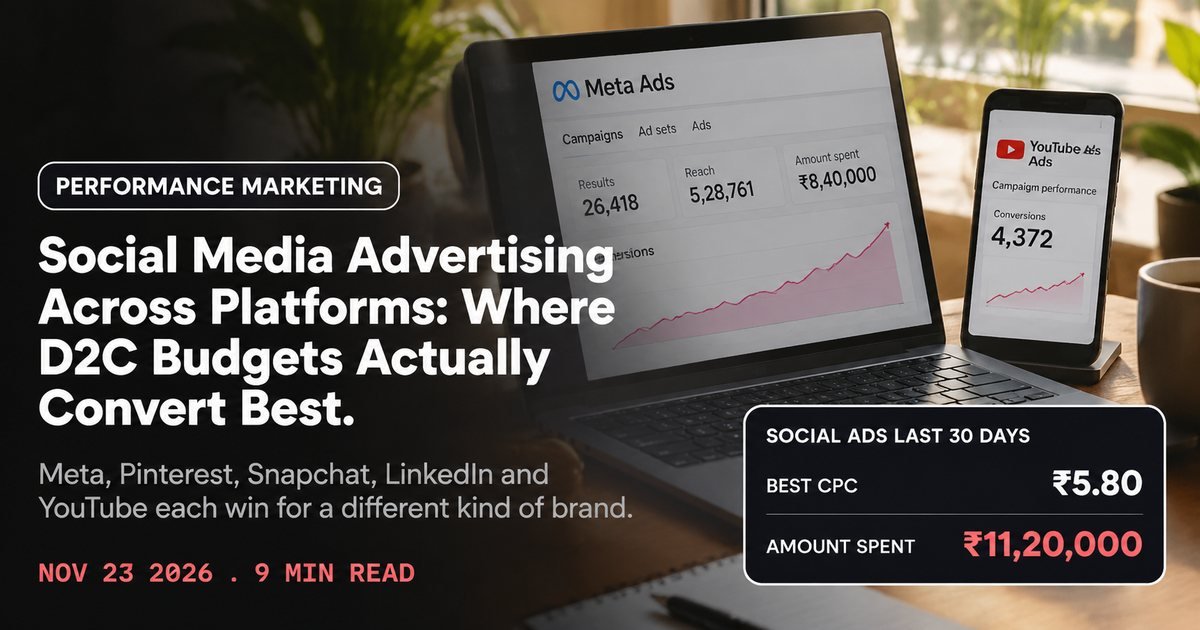
A skincare founder messaged us in September asking why her LinkedIn ads weren't converting. She'd heard LinkedIn was "where the real buyers are" and moved ₹40,000 off Meta to test it. Three weeks in: 1,200 impressions, four link clicks, zero sales. Her product retails at ₹899. LinkedIn's audience skews toward B2B decision-makers reading posts at their desks, not people scrolling for a moisturizer on their lunch break.
Social media advertising gets treated as one channel with five logos stapled on top of it. Each platform has a different audience, a different cost structure, and a different reason a scroll turns into a cart. Treating Meta, Pinterest, Snapchat, LinkedIn and YouTube as interchangeable line items is how budgets get burned on platforms that were never going to work for that product.
This piece is a head-to-head on where paid social budget actually converts for Indian D2C brands right now, and in what order you should test these platforms. It skips organic content strategy and agency pricing; those live elsewhere.
Meta and Instagram: still the default, and usually correctly so
Meta remains the first channel almost every D2C brand should turn on. For most categories, it should stay the biggest line item too. The combined Facebook and Instagram inventory gives you the broadest reach in the country. It also has the most mature ad formats (Reels, Stories, Advantage+ catalog ads, collection ads) and a creative-led delivery engine that rewards good video over granular targeting.
Where Meta wins: apparel, beauty, food, home goods, supplements. Basically anything visual with an impulse or near-impulse purchase cycle. CPMs in India currently run ₹15 to ₹60 depending on category and season, cheaper than most people assume given how saturated the platform feels. If you're still setting up an account or benchmarking cost, our detailed Meta ads cost breakdown covers current numbers.
Where Meta struggles: long consideration cycles, high ticket B2B products, categories where the buyer researches heavily before purchase. Think enterprise software, not skincare. The platform's strength is fast creative-driven decisions. That becomes a weakness once a product needs three weeks of research before someone buys.

Pinterest: narrow but genuinely high-intent
Pinterest gets dismissed too fast by Indian marketers because the user base here is smaller than Meta's. That's true. It's also beside the point. Pinterest users search with purchase intent closer to Google than to a social feed. Someone pinning "small bedroom decor ideas" is often eighteen months from a wedding or a home purchase, actively building a shortlist.
This makes Pinterest a strong fit for home decor, fashion, beauty, and wedding-adjacent categories specifically. Anything impulse-driven, anything targeting men under 30, and most F&B or supplement brands tend to underperform here.
The CPCs are often lower than Meta, simply because fewer brands bid there. That's the main argument for testing it even with a modest budget: ₹15,000 to ₹25,000 a month is enough to see a directional read within six weeks.
Don't expect Pinterest to replace Meta. Expect it to add an incremental, cheaper acquisition channel for the right product category, running alongside your existing social content strategy rather than instead of it.
Snapchat: a narrow but real Gen Z lane
Snapchat's Indian user base skews young, urban, and more male than Pinterest's. For most D2C brands this is simply the wrong audience. For a specific set, mostly gaming-adjacent products, youth fashion, energy drinks, and certain beauty subcategories targeting 16 to 24 year olds, it can outperform Meta on cost per engaged view.
The honest caveat: Snapchat's ad inventory in India is thinner than Meta's. That means less room to scale spend before CPMs climb sharply. Treat it as a test-and-hold channel, not a platform you build a media plan around.
Run it at 5 to 10% of total paid social spend. Measure for eight weeks. Only scale it if cost per acquisition actually beats your Meta baseline for that same audience segment.
LinkedIn: expensive, and only right for a specific shelf
LinkedIn CPCs in India run anywhere from ₹150 to ₹400, five to ten times what you'd pay on Meta for a comparable click. That cost only makes sense for products where the buyer's job title and seniority matter more than their scroll habits: premium B2B SaaS, high-AOV professional services, enterprise hardware, executive education.
For a consumer D2C brand under ₹3,000 AOV, LinkedIn is almost always the wrong platform. Full stop, regardless of how premium the brand feels. There's a narrow exception: a high-ticket item, think ₹25,000-plus, where the buyer persona genuinely overlaps with LinkedIn's working-professional base. Even then, keep it a small test budget, not a core channel.
Most founders who try LinkedIn for a sub-₹1,000 product end up paying B2B rates to reach an audience that was never going to buy on impulse.
YouTube: builds awareness, rarely converts standalone
YouTube sits in an odd spot for paid social. It's awareness infrastructure more than a direct-response channel. Skippable in-stream ads and Shorts placements build brand recall at scale, cheaply, often ₹0.30 to ₹1 per view. Driving a last-click conversion on their own is where they struggle.
The brands that use YouTube well run it alongside Meta retargeting rather than as a standalone funnel. Cold awareness on YouTube, warm retargeting and conversion on Meta or search. Measured in isolation, YouTube's direct ROAS usually looks weak. Measured as a lift on other channels' performance, it often earns its spend back.
Sequencing paid social against search and other channels is a bigger question than this post covers; our cross-channel budget framework goes into that allocation logic.
The decision framework: category, AOV, and audience, in that order
Run this filter before allocating a single rupee to a new platform:
- 1Start with category fit. Visual, impulse-driven products default to Meta. Home, fashion, and beauty add Pinterest as a secondary test. Youth-skewing categories add Snapchat. High-ticket B2B or premium products should consider LinkedIn.
- 2Check AOV against platform cost. Anything under ₹1,500 AOV shouldn't be testing LinkedIn at all. Anything over ₹20,000 AOV can justify LinkedIn's CPCs if the audience overlaps with working professionals.
- 3Confirm the audience's actual demographic, not your assumed one. Pull existing customer data on age, gender, and location before assuming Snapchat or Pinterest fits. Plenty of founders guess wrong here.
- 4Sequence tests instead of running them all at once. Meta goes first, always, since it's your baseline. Add one secondary platform at a time with a six to eight week test window and a fixed budget cap.
- 5Treat YouTube as a layer, not a line item. Budget it as a share of your Meta spend for retargeting lift, not as a channel expected to pay for itself on direct response alone.

What to actually do this quarter
- 1Pull last 90 days of Meta performance as your cost-per-acquisition baseline before testing anywhere else.
- 2Check your actual customer demographic data (not assumptions) against Pinterest's and Snapchat's user base before committing budget to either.
- 3If your AOV is under ₹1,500, cancel any LinkedIn test currently running and redirect that spend to Meta or Pinterest.
- 4Allocate 10 to 15% of total paid social budget to one secondary platform test, capped and time-boxed to eight weeks.
- 5If you're running YouTube, pair it with Meta retargeting and measure lift on Meta's conversion rate, not YouTube's standalone ROAS.
- 6Revisit this allocation every quarter; platform costs and audience behavior shift fast enough that last quarter's mix isn't a safe default.
Want us to audit where your CAC is leaking?
Book a call