Digital Advertising Channels for D2C Brands: A 2026 Budget Allocation Framework
A practical 2026 digital advertising budget split across Google, Meta, YouTube, Pinterest, Snapchat, LinkedIn and WhatsApp, mapped to funnel stage.
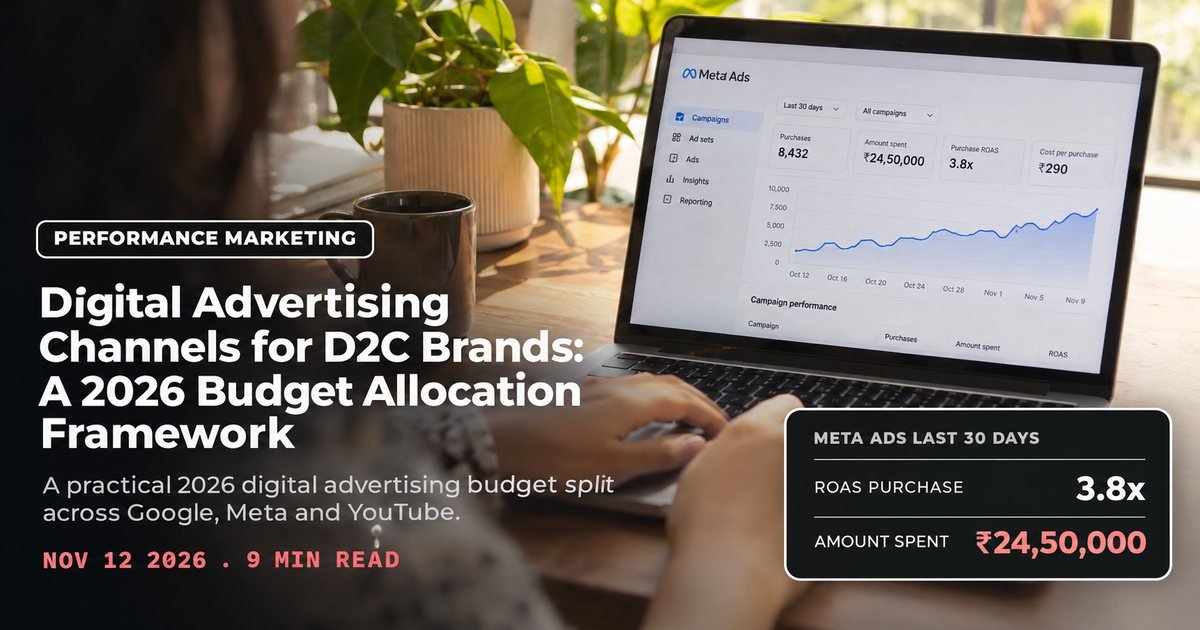
A founder we work with runs a skincare brand doing about ₹18 lakh a month in revenue. When we first looked at her media plan, it was 70% Meta, 20% Google, 10% "trying things." No YouTube, no Pinterest despite selling a visually obvious product, nothing on WhatsApp beyond customer support.
Leaning on Meta made sense for her stage. Letting one channel decide her entire digital advertising strategy by default, rather than by design, is where the plan broke down.
That's the pattern we see most often. Brands pick a channel early, usually because it's where they first found product-market fit, and then keep adding budget to it as revenue grows.
It works until it doesn't. Usually around the ₹1-2 crore annual spend mark, that one channel's CPMs climb faster than its conversion rate, and growth stalls even though the team is doing everything "right" inside Meta Ads Manager.
The real fix is a budget split that matches each platform to the funnel stage it's actually good at, held disciplined enough to see if it's working before anyone panics and reshuffles it again.
This piece lays out how we'd allocate a digital advertising budget across Google, Meta, Instagram, YouTube, Pinterest, Snapchat, LinkedIn and WhatsApp for an Indian D2C brand in 2026. Real percentage ranges by funnel stage and company size, not a generic list of "channels you should try."
Why funnel stage, not platform popularity, should drive the split
Most budget allocation mistakes come from ranking channels by how good they feel rather than what job they do. Meta feels productive because you see creative performance daily. Google Search feels transactional and slightly boring. YouTube feels expensive before it's proven anything. None of those feelings tell you where a rupee is best spent.
A cleaner way to think about it: every channel sits somewhere on a spectrum from demand capture (someone already wants this, show up when they look) to demand creation (nobody was looking, make them want it).
Google Search and Shopping sit firmly on the capture end. Meta, Instagram, YouTube, Pinterest and Snapchat sit on the creation end, with real differences in how each one creates demand. WhatsApp and LinkedIn sit apart from both: WhatsApp works mainly as a retention and conversion-assist layer, and LinkedIn is B2B-skewed enough that it rarely belongs in a consumer brand's core mix.
Once you sort channels this way, the budget question gets simpler. How much of your business right now depends on capturing existing demand versus creating new demand determines your split, not which platform your competitor is loudest on.

The baseline split for an early-stage D2C brand (under ₹50L/year ad spend)
At this stage, most brands don't have enough data volume to run eight channels well. The discipline is picking two or three and going deep rather than spreading thin.
A workable baseline: 50-60% Meta/Instagram, 25-35% Google Search and Shopping, 10-15% held for testing one additional channel (usually YouTube or Pinterest depending on category).
That weighting has a reason behind it. At low budgets, Meta's algorithm needs enough spend concentrated in one place to find your audience, and splitting ₹3 lakh a month across six platforms means none of them ever get enough signal to optimize.
Google Search gets the second-largest share even at this stage. Branded and category search, however small, is close to free margin: someone typing your brand name or a specific product term is already sold.
Not bidding on that traffic is leaving money on the table. For more on structuring that early Google spend correctly, our breakdown of first-time Google Ads setup mistakes covers the most common ways brands waste this easy win.
The 10-15% test allocation should run for a full quarter minimum before you judge it. A smaller slice of a test channel that never gets enough runway tells you nothing.
The scaling split for a growth-stage brand (₹50L-5Cr/year)
This is where most of the real allocation decisions happen, because this is the range where a single-channel brand hits its ceiling.
A reasonable target: 35-45% Meta/Instagram, 20-25% Google Search and Shopping/PMax, 10-15% YouTube, 5-10% Pinterest (higher for home, beauty, fashion), 5-10% Snapchat or WhatsApp depending on audience skew, and the remainder as flexible test budget.
YouTube earns a meaningfully larger share here. At this scale, brand awareness becomes a real lever on Meta and Google performance.
Cheaper Meta CPMs and better branded search volume both correlate with audiences who've already seen you somewhere else first. YouTube is often the most efficient way to build that familiarity at volume. Our piece on why YouTube ads sometimes run cheaper than Instagram breaks down why that surprises founders used to thinking of YouTube as expensive.
Pinterest deserves a real line item for visually-driven categories: home decor, beauty, fashion, jewelry, where people search with intent well before they're ready to buy. It's a slower-converting channel but a genuinely cheap one for the intent quality you get. Most Indian D2C brands have never tried it seriously enough to know whether it works for them.
Snapchat is a narrower bet, worth testing specifically if your customer skews under 25 and your current channels are drifting older than your ideal customer.
Where LinkedIn actually fits for a consumer brand
For most D2C brands, LinkedIn shouldn't get a consumer acquisition budget line at all. It's priced for B2B lead generation, and the CPMs don't make sense against a typical D2C average order value.
The exception is narrow but real. If you're hiring aggressively, raising funds, or selling a premium product where the founder's personal brand drives disproportionate trust (think D2C wellness or finance-adjacent categories), a small LinkedIn spend can earn its place.
Keep it under 5% of total budget, aimed at brand credibility and recruiting rather than direct sales. Treat it as a separate line with separate goals rather than forcing it into the funnel math above.
WhatsApp's real role: conversion assist, not acquisition
WhatsApp consistently gets misallocated because brands either ignore it entirely or treat it like a sixth acquisition channel competing with Meta and Google for the same credit.
WhatsApp's actual value sits later in the funnel: cart recovery, COD order confirmation, size and spec questions that would otherwise bounce someone off a landing page. Budget for it as a layer on top of existing traffic, typically 3-8% of total spend, rather than giving it its own acquisition target.
Our deeper dive into WhatsApp ads for Indian D2C brands covers the conversation-based pricing model and where it earns real ROI versus where it's just a nice-to-have.
The mature-brand split (5Cr+/year) and why diversification matters more here
Past this scale, concentration risk becomes the bigger threat than inefficiency. A brand spending ₹8 crore a year with 70% on one platform is exposed to a single algorithm change, policy update, or account issue in a way that can genuinely damage a quarter.
At this level we'd target something closer to 30-35% Meta/Instagram, 20-25% Google, 15-20% YouTube, 10% Pinterest or Snapchat combined, 5-10% WhatsApp as conversion layer, and 5-10% genuinely experimental spend on whatever's emerging (new ad formats, retail media if you sell on quick commerce, connected TV where available).
No single platform should be able to take down your acquisition engine if it has a bad month. If you're not sure your current spend is already over-indexed on one channel, an account audit is usually the fastest way to find out before you reallocate anything.
What to actually do this quarter
- 1Pull your last 90 days of spend by channel and funnel stage, not just by platform name, and compare it honestly against the ranges above for your revenue tier.
- 2If one channel is over 55% of total spend and you're past ₹50L/year in ad budget, treat that as a concentration risk worth addressing, not a sign of strength.
- 3Pick exactly one new channel to test this quarter, fund it at a level that can actually produce signal (not a token 3%), and commit to a full quarter before judging it.
- 4Reclassify WhatsApp in your reporting as a conversion-assist metric, not an acquisition channel, so it stops competing unfairly against Meta and Google in attribution reports.
- 5If LinkedIn is on your media plan and you're not B2B or hiring-driven, cut it or cap it under 5% and redirect that budget to Google Search or YouTube.
- 6Revisit this split every quarter, not every month; channel performance needs more than four weeks of data to separate real signal from normal variance.
If you want this framework applied against your actual spend data and category instead of general ranges, a free strategy call is the quickest way to get a real number instead of a guess.
Book a call