YouTube Ads vs Instagram Feed Ads in 2026: Where Your Budget Is Actually Being Wasted
YouTube CPMs are running far below Instagram feed CPMs for Indian D2C brands in 2026. Here's the actual math and how to test the channel.
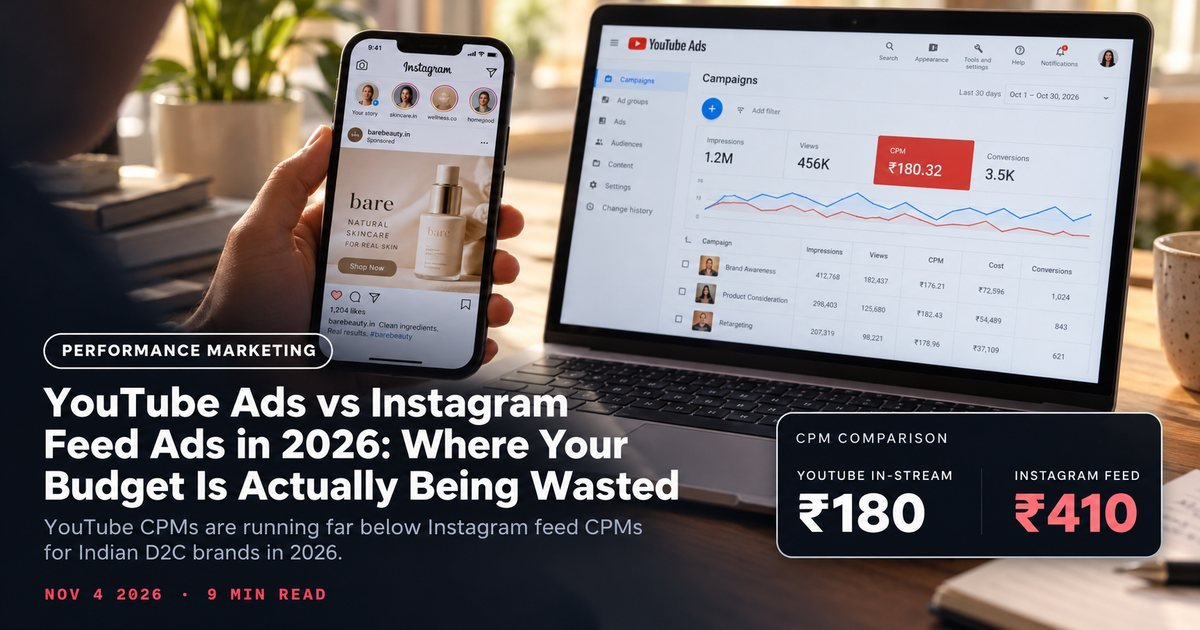
Two numbers worth sitting with. A mid-funnel Instagram feed placement for a D2C beauty brand in India currently runs ₹28-₹45 CPM. The same brand's in-stream Google Ads on YouTube campaign, running in front of relevant content with similar targeting, lands at ₹8-₹18 CPM.
That's no rounding difference. It's inventory costing a third to half as much, for a format most founders still treat as an afterthought.
The gap exists because of a straightforward supply and demand mismatch. Every D2C brand in India has an Instagram strategy. Very few have put real budget behind YouTube as a paid acquisition channel, rather than just a place to park long-form brand content.
Less competition for the auction means cheaper inventory. That imbalance hasn't corrected yet going into 2026.

Why the Price Gap Exists
Instagram's ad auction is crowded because every brand with a Meta pixel defaults there first. It's the obvious channel, the one where the creative team already produces content, with near-zero setup friction if you're already running feed and story ads.
That default behavior pushed up competition and, with it, CPMs. Beauty, fashion, and wellness feel it most, where dozens of brands bid for the same 25-40 age bracket.
YouTube sits in a strange middle ground. It has enormous reach in India, arguably the largest video audience in the country outside short-form platforms. Most D2C marketing budgets still treat it as a hosting platform rather than an acquisition channel.
The ad inventory exists at scale. The demand for it, from a performance marketing standpoint specifically, hasn't caught up. That's the arbitrage.
It won't last forever. As more brands start testing YouTube for direct response rather than just brand awareness, CPMs will climb toward parity with other channels. Right now, in late 2026, the gap is still wide enough to matter.
The Format Breakdown: In-Stream, In-Feed, and Shorts
YouTube isn't one ad product, and treating it like one is where a lot of first attempts go wrong. Three formats matter for D2C performance marketing right now.
Skippable in-stream ads play before, during, or after a video. You only pay once someone watches 30 seconds or interacts, whichever comes first. This is the cheapest format in our testing, usually ₹8-₹15, but it demands a hook strong enough to survive the first five seconds before the skip button appears. A weak opening here wastes the entire placement.
In-feed ads show up as a thumbnail and headline within YouTube's search results and home feed, styled like organic content. These run closer to ₹15-₹25 CPM. They work best for products with strong visual appeal, where the thumbnail itself does selling work, similar to a strong product shot in a Google Shopping listing.
Shorts ads play between YouTube Shorts in a vertical, full-screen format almost identical to Instagram Reels ads. CPMs here run ₹12-₹22, sitting between in-stream and in-feed. They're the easiest format to repurpose creative into, since most brands already have a library of vertical UGC built for Instagram and Meta's own Reels placements.
A Realistic Test Framework
Don't move 30% of your Meta budget to YouTube on week one. That's how brands end up concluding "YouTube doesn't work for us" after one poorly structured test, when the real issue was testing it like a copy-paste of their Meta strategy.
Start with 10-15% of monthly ad spend, run as a dedicated test budget separate from your core Meta account, for a minimum of four weeks. Four weeks matters. YouTube's learning phase, much like Meta's, needs volume to stabilize, and a two-week test rarely clears enough data to judge properly.
Use skippable in-stream as your primary format for this first test. It's the cheapest inventory, and the most direct read on whether your creative can hold attention in a video-first environment.
Track cost per click and view-through conversions separately from click-through conversions. YouTube's attribution window captures people who saw your ad, didn't click, and converted later through a different channel. That's real influence a naive last-click view will undercount.

Set a clear kill or scale threshold before you start, not after you see results. If blended CAC across the test comes in at or below your current Meta CAC within four weeks, scale the budget to 20-25% of total spend for a second month.
If it's meaningfully worse with no improving trend by week three, pause and revisit creative before abandoning the channel entirely. A flat test often means the creative needs rework. It rarely means the channel itself is wrong for your brand.
Creative That Actually Works Here
The single biggest mistake brands make moving into YouTube is reusing Instagram Reels creative unedited. It usually underperforms. The content isn't bad, but viewer intent and context differ sharply.
Someone scrolling Instagram sits in a browsing, impulse-friendly headspace. Someone watching a YouTube video they chose has made a more deliberate decision, so your ad interrupts that choice. The hook needs to acknowledge the interruption rather than pretend it's native content.
What performs: a direct, fast opening that states what the product does and who it's for, all within the first three seconds, before the skip option appears at second five. Founder-led or testimonial-style content tends to beat polished brand edits here. It reads as more credible in a format where viewers are primed to skip anything that looks like a traditional ad.
If your team already runs social media marketing content for Instagram and YouTube organically, you likely have raw footage that can be recut for this. No new shoot required. The creative cost to test YouTube properly is usually lower than brands assume, since it's mostly a re-edit problem rather than a re-shoot problem.
Measurement Pitfalls That Skew the Comparison
A common mistake is comparing raw CPM alone and declaring YouTube the winner without adjusting for funnel position. Instagram feed ads, especially retargeting placements, usually work lower in the funnel against warmer audiences. A higher CPM there can still produce a better immediate CAC than a cheaper upper-funnel YouTube placement targeting cold viewers.
Compare the two fairly by matching funnel stage to funnel stage. Cold YouTube in-stream against cold Instagram feed, not against Instagram retargeting.
Attribution windows differ by default between the platforms too, and leaving them mismatched produces misleading side-by-side numbers. Google Ads defaults to a 30-day click and view-through window for YouTube. Meta's default windows vary by campaign objective and recent iOS-related policy changes. Align both platforms' reporting windows manually before any head-to-head budget decision, or at least flag the mismatch internally.
One more pitfall: frequency. YouTube's cheaper inventory tempts teams to push volume aggressively in month one, spiking frequency past the point where the format still feels novel. We've seen click-through rate drop by nearly half between week one and week three of an aggressive push, purely from fatigue setting in faster than expected. Treat the low CPM as room to test more creative variants, not as license to blast the same two ads repeatedly.
Where This Fits Against Meta
None of this argues for abandoning Meta. For most D2C brands, Meta remains the stronger channel for lower-funnel, high-intent retargeting, given how granular the Pixel and Conversions API data gets. Our deeper comparison of Google ads against Meta ads over a 30-day test breaks down where each channel earns its place in the funnel.
YouTube, right now, is best positioned as an upper-to-mid funnel addition that happens to come with a pricing advantage most brands haven't noticed yet.
If you're running a blended account already, it's worth checking in on what your Google Ads setup is actually doing beyond the obvious search campaigns, since YouTube inventory sits inside the same Google Ads platform and often gets ignored by teams focused only on Search and Shopping.
Takeaways
- 1YouTube in-stream CPMs in India currently run ₹8-₹18, often less than half of comparable Instagram feed CPMs.
- 2Start a YouTube test at 10-15% of monthly spend for a minimum four-week window before judging results.
- 3Skippable in-stream is the cheapest and most direct format to test creative fit first.
- 4Reusing Instagram creative unedited usually underperforms; recut hooks for an interruption-based viewing context.
- 5Track view-through conversions separately from click conversions since last-click attribution undercounts YouTube's real influence.
Want help structuring a proper YouTube test alongside your existing Meta and Google accounts? Book a free strategy call and we'll map out a budget split based on your current CAC and category.
Book a call