What a Fractional CMO Does in the First 90 Days: The Gaps They Find That Nobody Else Catches
What a fractional CMO actually does in the first 90 days at a D2C brand, week by week, from audit through strategy to execution and team structure.
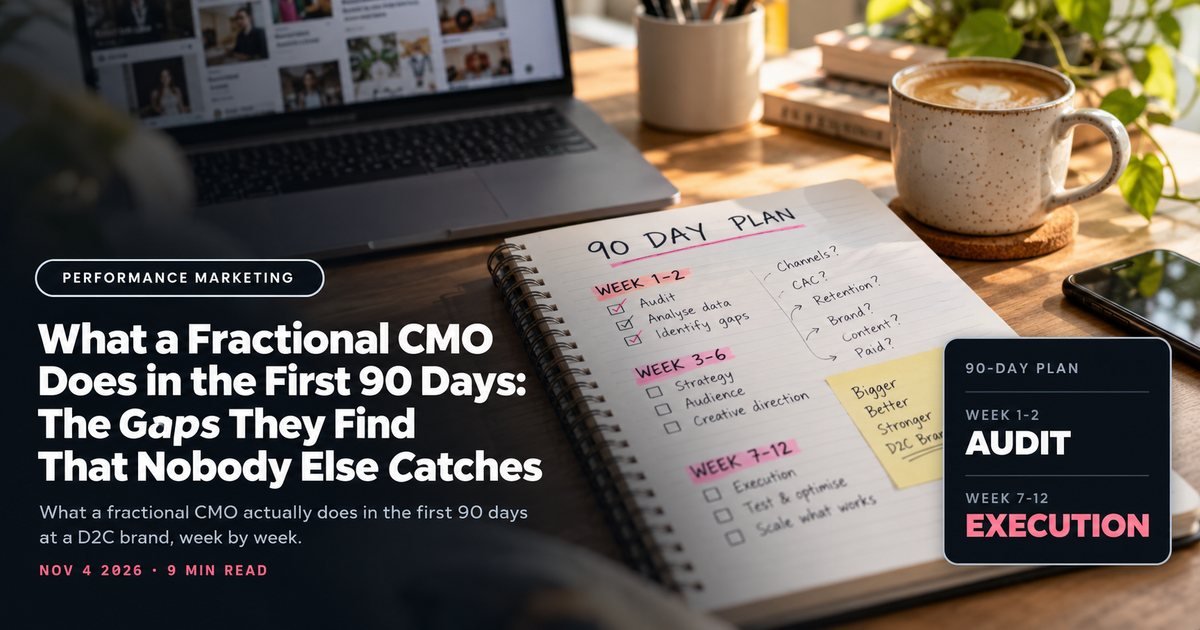
The phrase fractional CMO gets thrown around loosely. Most founders have no real picture of what the person actually does day to day. It sounds like a glossary term: a part-time chief marketing officer, billed hourly or on retainer, who brings senior strategy without the full-time salary. That's technically accurate. It's also useless as a description of the actual work.
Here's what the first 90 days genuinely look like. This is based on how the role plays out at D2C brands doing anywhere from ₹15 lakh to ₹3 crore in monthly revenue, the range where a fractional CMO makes the most sense. Below that, a junior in-house hire usually fits better. Above it, a full-time executive often does.

Weeks 1-2: Audit and Stakeholder Interviews
Nothing gets decided in the first two weeks. This stage is almost entirely diagnostic. Skipping it is the fastest way a fractional CMO engagement goes wrong, since every recommendation that follows gets built on whatever picture emerges here.
The audit covers the obvious ground first: ad account structure and spend across Google and Meta, website analytics and conversion funnel data, email and SMS flows if they exist, and whatever reporting the brand has used to judge performance so far.
It also covers what founders rarely hand over unprompted. Old agency contracts. Past campaign results that were quietly dropped. Internal Slack or email threads where marketing decisions actually got made, often different from how the org chart says they should get made.
Stakeholder interviews run alongside the audit, well beyond the founder. The ops lead who hears every complaint. The customer support person who knows exactly which product claims trigger refund requests.
Sometimes even a warehouse manager gets pulled in, since they can say which SKUs actually move versus which ones the founder is emotionally attached to.
A fractional CMO who skips this and goes straight to the dashboards misses half the real picture. Dashboards show what happened. They rarely show why.
By the end of week two, the deliverable is a blunt internal document, not a polished strategy deck. What's working, what's quietly broken, where money is leaking, and where the team has been avoiding a hard conversation because nobody owned the full picture enough to force it.
Weeks 3-6: Strategy and Quick Wins
This is where the work becomes visible, and it needs to. A fractional CMO who spends six weeks only planning, with nothing shipped, loses the room. Founders and teams need to see movement early, before they'll trust the slower strategic work that follows.
Quick wins come first, and they're usually smaller than people expect. Fixing a broken Meta pixel that's been under-reporting conversions for months. Pausing an ad set bleeding ₹8,000 a week on an audience overlap nobody caught. Correcting a checkout flow issue silently dropping 12% of mobile buyers at the payment step.
None of this is glamorous. All of it buys credibility fast. The results show up in the numbers within days, not quarters.
Parallel to the quick wins, the real 90-day strategy takes shape. Channel sequencing: what gets budget first, and why. A realistic CAC target, benchmarked against actual unit economics rather than a number pulled from a competitor's case study. A content and creative plan matched to what the brand can actually produce, not an aspirational calendar nobody will execute.
Our own breakdown of digital marketing strategy sequencing for D2C brands covers the same channel-ordering logic a fractional CMO applies here, adapted to each brand's specific constraints.
By week six, the brand should have a written strategy document with specific owners assigned to specific pieces. Not a 40-slide deck sitting untouched in a shared drive. If a quick win hasn't landed by this point, that's a signal worth investigating rather than papering over.

Weeks 7-12: Execution and Team Structure
This stretch is where the fractional CMO shifts from diagnosing and planning to actually running the operation. More precisely: deciding who runs what, and holding that structure accountable.
Most D2C brands at this revenue stage run on some combination of freelancers, a part-time agency relationship, and maybe one junior in-house marketer. None of them usually has a clear mandate across the whole picture.
Part of weeks 7-12 is simply deciding, explicitly, who owns Google and Meta performance day to day, who owns influencer casting, who owns the website and CRO backlog. Then making sure those people actually talk to each other, instead of operating in separate silos reporting only to the founder.
If the brand lacks the internal team to execute, this is also when a fractional CMO typically recommends and vets specialist partners rather than running every channel personally. The real value here is strategic ownership and judgment, not physically building every Google Ads campaign.
If influencer marketing is part of the plan, understanding what an influencer marketing agency actually costs and delivers helps set realistic expectations before signing anything.
By day 90, the brand should have a documented strategy with clear channel priorities, a CAC target the team measures against weekly, and defined ownership across every active channel. Early proof points from the quick wins should justify continuing past the initial sprint.
What a fractional CMO should not still be doing at day 90 is personally executing every tactical task. That would mean the structure never transferred, leaving the brand dependent on one person rather than a functioning system.
What Changes If the Brand Is Earlier or Later Stage
The 90-day arc above assumes a brand with some existing marketing infrastructure, even if it's messy. The shape shifts at the extremes.
For a very early brand, say under ₹10 lakh monthly revenue with no prior paid spend history, weeks 1-2 look different. There's less to audit and more to establish from scratch: basic tracking, a Shopify or website analytics setup that actually works, a first attempt at defining a reasonable CAC target for that category.
The quick wins in weeks 3-6 tend to be structural rather than optimization-based here, since there isn't an existing account to fix yet.
For a more mature brand already doing ₹1-3 crore monthly with an established in-house team, the first 90 days lean harder into team structure and ownership questions than tactical quick wins. Execution is often already reasonably competent at this stage.
The audit in weeks 1-2 focuses more on where channels sit siloed from each other, and where reporting doesn't tell the real story. The strategic value here is less about fixing mistakes and more about building the cross-channel decision-making structure a growing internal team hasn't needed before, but will as spend scales further.
In both cases, the sequencing logic holds even as the specific tasks change. Diagnose honestly before recommending anything. Prove value early with something concrete. Then build a structure that outlasts the engagement, rather than leaving the brand permanently dependent on one person's attention.
What Separates a Good Engagement From a Bad One
The failure pattern is predictable. A fractional CMO who never gets past the audit phase. Beautiful strategy decks nobody implements because ownership was never assigned. Or someone pulled into day-to-day execution so deep that "fractional" stops meaning anything, and the brand ends up paying executive rates for a full-time operator's hours.
A good engagement looks different. Specific, dated deliverables at each stage. Visible quick wins early. A team that's more capable and better structured at day 90 than at day one, regardless of whether the brand keeps the fractional CMO on past that point.
Our growth marketing team structures every engagement this way by default. If you're weighing a fractional CMO against hiring a full-time marketing lead, the how to choose a marketing agency for a D2C brand checklist covers several of the same diligence questions, even though a fractional CMO and an agency aren't quite the same thing.
Takeaways
- 1The first two weeks should be pure audit and stakeholder interviews, with no strategy decisions made before that's complete.
- 2Quick wins need to land within the first six weeks or the engagement loses credibility before the real strategy gets a chance to work.
- 3By week six, expect a written strategy document with named owners, not a slide deck nobody executes.
- 4Weeks 7-12 are about assigning clear channel ownership and vetting specialist partners, not the CMO personally running every campaign.
- 5By day 90, the team should be measurably more capable and structured than before the engagement started, independent of whether it continues.
If you're considering a fractional CMO for your brand and want to see how an audit like this would actually look for your account, book a free strategy call and we'll walk through what the first two weeks would uncover.
Book a call