Restaurant Marketing Agency vs In-House: What Should a Restaurant Owner in India Choose
Restaurant marketing agency or in-house team: the real breakeven by outlet count, cost comparison, and what a restaurant-specific agency does differently.
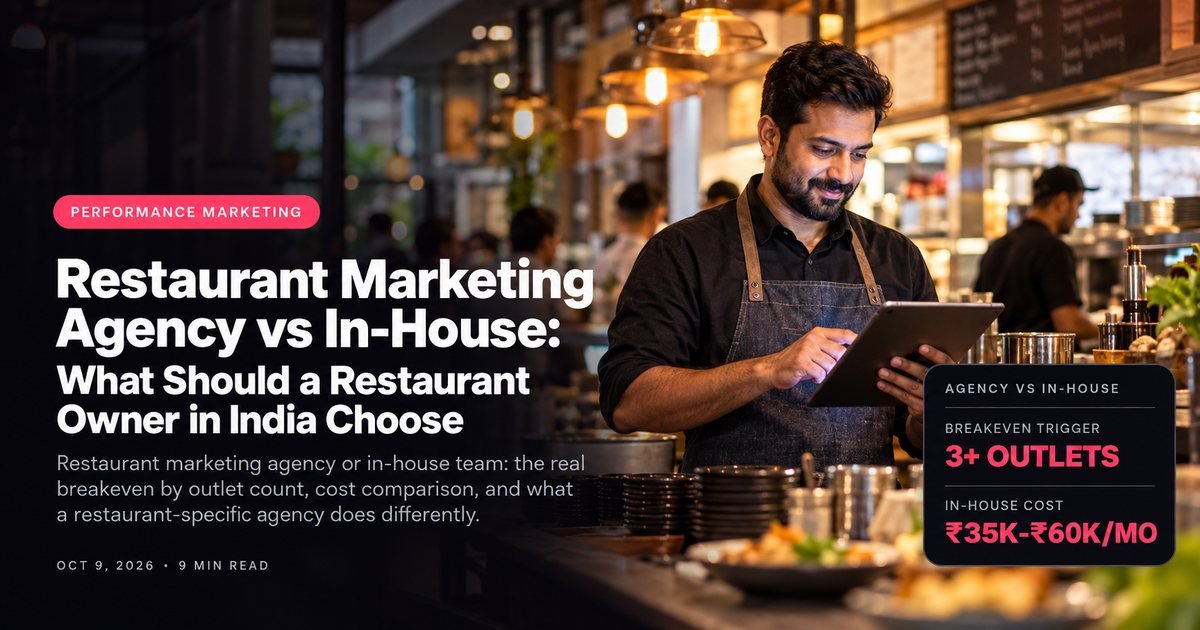
A restaurant owner in Bengaluru asked us a blunt question last month: "Do I hire a restaurant marketing agency, or just get my manager to post on Instagram and run some Zomato ads herself?" Her outlet was doing fine on weekends and dead on weekdays. She didn't need a philosophy lesson. She needed a number.
So here's the number-driven version of this decision, not the vague "it depends" answer most agency blogs give you.
The real question isn't agency vs in-house, it's outlet count
Single-outlet restaurants and five-outlet chains face completely different marketing math. A one-location café spending ₹15,000 a month on ads doesn't need a dedicated strategist watching CAC by daypart. A four-outlet QSR chain spending ₹3-4 lakh a month across Zomato, Swiggy, Meta, and Google absolutely does.
The breakeven point sits around 2-3 outlets or ₹1.5 lakh in combined monthly ad and platform spend. Below that, in-house (even a part-time person) usually wins on cost. Above it, the hours a specialist agency saves start outweighing the retainer.
We've watched single-outlet owners try to justify a ₹40,000/month agency retainer on ₹20,000 of actual ad spend. The math never works. We tell them to manage it in-house and call us again once they open outlet two.
What in-house actually costs, line by line
Owners underestimate this constantly. A single marketing hire who can competently handle Instagram, Zomato and Swiggy ad management, Google Business Profile, and basic Meta ads costs ₹25,000-₹40,000/month in most Tier 1 Indian cities. That's before tools.
Add a scheduling tool (₹1,500-₹3,000/month), basic design software, and the ad spend itself, and a single-outlet restaurant running a lean in-house setup lands at roughly ₹35,000-₹55,000/month all-in, ads included.
The catch is skill breadth. One person rarely does all of it well. Most in-house hires are strong at one thing, usually Instagram content, and weak at paid media math. That gap is invisible until you check your Zomato Ads dashboard and realize you've been paying ₹180 per order for three months straight with nobody watching.
For the full breakdown by channel, our restaurant marketing cost guide covers per-platform pricing in detail. This post is specifically about who should be doing the spending, not how much it should cost.
What a specialist restaurant agency does that a general D2C agency doesn't
Most marketing agencies in India are built for ecommerce and D2C product brands. Restaurants are a different animal, and it shows the moment you hand your account to a generalist.
A restaurant-specific agency runs a few things a general agency typically doesn't touch well:
- Zomato and Swiggy ads treated as a primary channel. Aggregator ad spend often exceeds Meta/Google spend for a restaurant, and the bidding logic (cost per order, not CPC) needs its own playbook.
- Google Business Profile as a conversion engine. Restaurants live and die on "restaurants near me" searches. A GBP optimized with menu links, order buttons, and a fast review-response cadence pulls in bookings a generic website never will.
- Local SEO tied to a physical radius, not a national keyword strategy. Nobody searches "best Italian restaurant" nationally; they search it within 3 km of where they're standing.
- Festive and event calendars specific to dining. Diwali corporate bookings, wedding season private dining, New Year's Eve prix fixe menus. A D2C agency plans around sale days; a restaurant agency plans around tables filling up on specific nights.
A restaurant agency treats aggregators and GBP as first-class channels. That's the actual differentiator. A general agency defaults to what it already knows, usually Meta and Google Search, and quietly underinvests in the two channels that drive the most walk-ins.
Where in-house genuinely wins
In-house isn't the lesser option by default. For a single outlet with a tight budget, it often wins outright.
You own the relationships. Your in-house person knows your regulars, your slow Tuesday, your chef's new dish before it hits the menu. That context takes an agency weeks to build and your own team already has it for free.
You also control speed. If a dish sells out at 8pm, your in-house social lead can post the update in two minutes. An agency workflow, even a good one, usually has at least a same-day lag for anything outside the planned content calendar.
The tradeoff is depth. Your in-house hire almost never has real paid-media expertise across four platforms simultaneously. They'll run ads, but rarely optimize them against a cost-per-order target the way a specialist would. That gap costs real money once your spend crosses six figures a month.
Where a specialist agency earns its retainer
Once you're running multiple outlets, or your monthly ad and platform spend crosses ₹1.5-2 lakh, the math flips. Here's why.
A restaurant marketing agency spreads specialist cost across channels you'd otherwise need three separate hires for: a Zomato/Swiggy specialist, a paid social buyer, and a local SEO person. Bundled, that's typically ₹60,000-₹1.2 lakh/month depending on scope and outlet count.
Three separate salaries for the same coverage would run ₹1.5-2 lakh minimum.
Agencies also bring benchmark data your single restaurant never sees on its own. They know what a good cost-per-order looks like across cuisine categories, because they manage multiple accounts.
Your in-house hire only has your own numbers to compare against. That means they can't tell if ₹150 CPO is great or terrible for your category.
Multi-outlet chains almost always need the coordination an agency provides. Running consistent festive campaigns, brand voice, and GBP hygiene across five locations with one in-house person is a full-time job that person doesn't have bandwidth for alongside everything else.
We've seen this play out with clients managing food influencer campaigns across multiple outlets. The coordination overhead alone, syncing creator content with each location's opening dates and local offers, justifies a dedicated team.

A simple test you can run this week
Before hiring anyone or signing a retainer, run this test on your own numbers.
Add up your last 90 days of Zomato ads, Swiggy ads, Meta ads, Google ads, and any scheduling or design tools. Divide by three to get a monthly average. If that number is under ₹80,000/month and you run one outlet, in-house wins on cost almost every time.
If it's above ₹1.5 lakh, or you run two or more outlets, get quotes from restaurant-specific agencies and compare against what three specialist hires would cost you. The agency retainer usually comes in lower, and you get people who've already solved your exact problem for other restaurants.
Somewhere in the middle, ₹80,000-₹1.5 lakh, is a genuine toss-up. That's where we tell owners to hire in-house for content and creative, and bring in an agency or freelance specialist just for paid media management. A hybrid model, not an all-or-nothing choice.
If you want a second opinion on your specific numbers, a restaurant and café marketing partner can usually tell you within one call whether your spend justifies a dedicated agency yet.
Takeaways
- 1Breakeven for agency vs in-house sits around 2-3 outlets or ₹1.5 lakh/month combined spend.
- 2A lean in-house setup costs ₹35,000-₹55,000/month for a single outlet, ads included.
- 3Restaurant-specific agencies treat Zomato/Swiggy ads and Google Business Profile as primary channels, not side projects.
- 4In-house wins on speed and context; agencies win on specialist depth and cross-channel benchmarking.
- 5A hybrid model (in-house content, agency-managed paid media) fits most restaurants in the ₹80,000-₹1.5 lakh/month band.
- 6Run the 90-day spend average test before committing to either path.
If you'd rather talk through your own numbers than guess, you can book a free strategy call and we'll tell you honestly which side of the breakeven you're on.
Book a call