How Much Does Restaurant Marketing Cost in India? A 2026 Pricing Guide
Restaurant marketing cost in India ranges from ₹25,000 to ₹8 lakh a month depending on stage. Here's the real channel-by-channel breakdown.
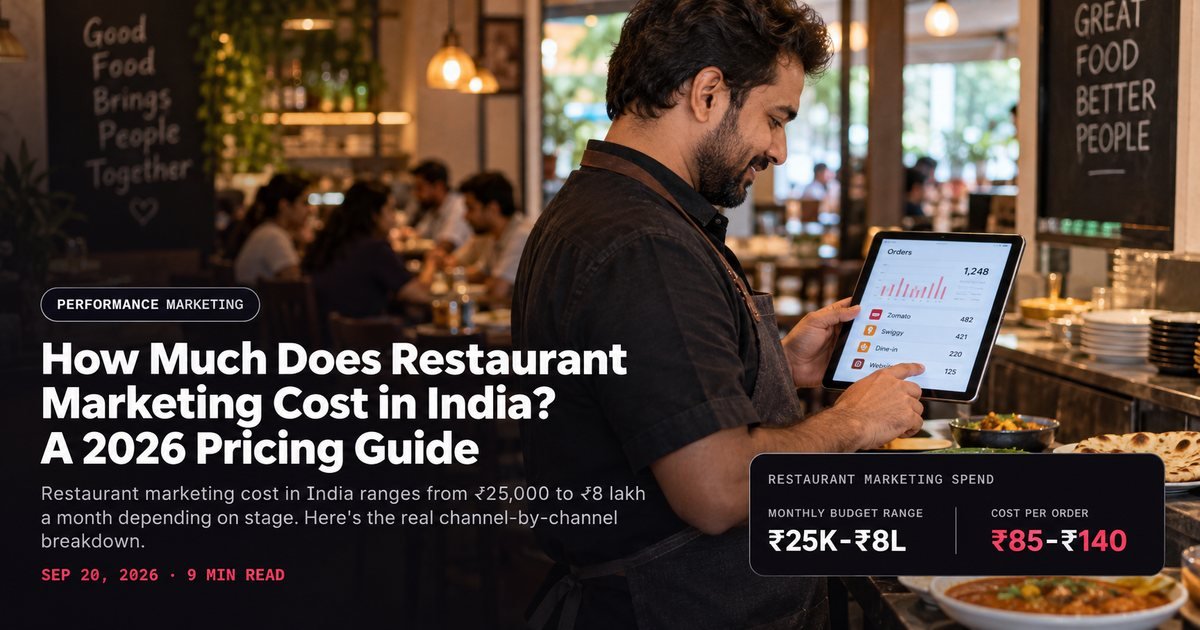
Ask three agencies what restaurant marketing cost in India looks like and you'll get three hourly-rate ranges, none of them useful. A first-time restaurant owner doesn't need a rate card. They need to know where every rupee goes: how much on Google Ads, how much on Meta, how much on Zomato and Swiggy, how much on a food blogger's Reel.
We run performance marketing for D2C and hospitality brands, and restaurant budgets break down the same way every time, just at different scale. This guide gives you the actual numbers by channel and by restaurant stage, so you can build a budget instead of guessing at one.
Why restaurant marketing costs don't compare to D2C or retail
A D2C brand's marketing cost is mostly ad spend against a CAC target. A restaurant's cost stack has two things D2C doesn't: aggregator commission (Zomato and Swiggy take 18-25% of every order they bring you) and a hard geography ceiling. You can't advertise to all of India; you can only advertise to the 3-5 km radius that will actually walk in or order.
That changes the math. A restaurant spending ₹1 lakh a month on marketing isn't necessarily underspending or overspending, it depends entirely on outlet count, footfall goal, and how much of that ₹1 lakh is commission versus working media.
Single outlet, just opening: ₹25,000-₹60,000 a month
A new single-location restaurant or cafe needs visibility before it needs scale. Budget should skew toward Google Business Profile setup, local Google Ads, and a small aggregator spend to get initial reviews and order volume flowing.
Google Business Profile management runs ₹5,000-₹12,000/month if you hire it out: photos, Q&A seeding, review responses, weekly posts. This is the single highest-ROI line item for a new restaurant. Most owners skip it anyway.
Google Ads, geo-fenced to a 3-5 km radius and targeting "restaurant near me" plus cuisine-specific local intent, needs ₹8,000-₹20,000/month in ad spend. Expect ₹15-40 per click in a metro. Less in tier-2 cities.
Meta Ads run ₹5,000-₹15,000/month, mostly reach and traffic campaigns around opening week, then dialed back to retargeting past visitors and menu-page traffic.
Zomato and Swiggy ad spend adds ₹3,000-₹8,000/month in sponsored listing on top of the 18-25% commission per order. New listings need that paid push just to rank above established restaurants in the same category.
A single-outlet cafe rarely needs paid influencer collabs in month one. Barter (a free meal for a Reel) covers early social proof at close to zero cash cost.
Established single outlet, 1-3 years in: ₹60,000-₹1.5 lakh a month
Once a restaurant has a review base and repeat customers, the budget shifts from "get discovered" to "defend and grow share." This is where restaurant marketing budget allocation gets more channel-diverse.
- Google Ads: ₹15,000-₹35,000/month, split between local search and a small remarketing slice for past website visitors.
- Meta Ads: ₹15,000-₹40,000/month, running conversion campaigns to table reservations or order links, not just reach.
- Influencer and food-blogger collabs: ₹15,000-₹50,000/month for 2-4 paid collabs with local micro-influencers, 10K-100K followers. A single food-blogger Reel typically runs ₹8,000-₹25,000 depending on city and follower count.
- Zomato and Swiggy spend plus commission: commission alone, 18-25% of aggregator order value, is often the largest line item once online ordering passes 30% of covers. Budget another ₹10,000-₹25,000/month in sponsored placement on top of that.
- GBP management: ₹8,000-₹15,000/month, now including a proper review-response SLA, since review volume compounds.
A well-shot food influencer collaboration can outperform a month of Meta ads for driving weekend footfall. That's the trade worth testing first.
A restaurant doing ₹8-12 lakh in monthly revenue should expect total marketing spend, commission included, to land between 8-14% of revenue. Below 8%, you're probably invisible to new customers; above 14% and you're likely over-reliant on aggregator commission rather than owned channels.
Multi-outlet chain (3-10 locations): ₹2-5 lakh a month
At multi-outlet scale, cost per outlet actually drops because Google Business Profile setup, creative production, and campaign management amortize across locations. But total spend rises because you're now geo-fencing multiple radii and running location-specific offers.
Here's a realistic split for a 5-outlet chain:
- 1Google Ads across locations: ₹50,000-₹1 lakh/month, structured as separate location campaigns, not one blended account, since each outlet competes on its own local intent.
- 2Meta Ads: ₹40,000-₹90,000/month, split between brand-level reach and location-level conversion campaigns.
- 3Influencer marketing: ₹40,000-₹1 lakh/month across a mix of macro (one per quarter, ₹40,000-₹1.5 lakh per collab) and recurring micro-influencer collabs per city.
- 4Zomato and Swiggy commission plus ads: the biggest single cost center at this scale. Frequently ₹1.5-3 lakh/month in commission alone once five outlets are running serious aggregator volume.
- 5GBP management across locations: ₹25,000-₹50,000/month. Review response volume and Q&A seeding multiply by outlet count.
A chain this size should structure Google Ads by location, not one generic city-wide keyword set, since "near me" queries resolve to the nearest outlet, not the brand overall. The hyperlocal targeting logic is close to what quick commerce platforms already use to bid by pin code, worth studying even outside food delivery.
What an agency actually charges on top of ad spend
Agency management fees for restaurant marketing in India typically run one of two ways: a flat retainer or a percentage of managed ad spend.
- Flat retainer: ₹20,000-₹75,000/month for a single outlet, ₹75,000-₹2.5 lakh/month for a multi-outlet chain. Covers strategy, campaign management, creative, and reporting.
- Percentage of ad spend: typically 15-20% of managed media budget, which scales naturally as you grow spend.
Restaurant marketing agency cost should never include your Zomato or Swiggy commission. That's a platform fee, not an agency deliverable. Agencies can still help you optimize your listing to reduce dependency on it over time.
Ask any agency to show a channel-by-channel plan before you sign, the way this guide breaks it down. If they can only quote you an hourly rate with no breakdown by Google Ads, Meta, influencer, GBP, and aggregator spend, that's a sign they don't run restaurant accounts often.
Seasonal budget bumps to plan for
Festive periods and wedding season pull restaurant marketing spend up 30-60% above baseline, mostly on Meta Ads for private dining bookings and corporate party packages. If you're mapping this against a full-year calendar, a festive season marketing checklist built for the Indian calendar helps you plan the spend bump before Diwali week, not during it.
Weekday lunch-hour Google Ads spend can also drop 20-30% versus weekend dinner spend for most cuisines, since weekday lunch is largely repeat/office-crowd driven rather than discovery-driven.
The mistake most first-time owners make
Owners who open their first restaurant usually make the same call: spend everything on aggregator sponsored placement and nothing on Google Business Profile. It feels safer. Zomato and Swiggy show you the order right away, so the spend feels like it's working.
GBP shows up differently, usually three months later, as someone who searched "biryani near me," read your reviews, and walked in without ever opening an aggregator app. That customer costs you zero commission. Most owners never connect the two.
The fix is simple, not easy: cap aggregator sponsored spend at a fixed number and put the rest into Google Ads and GBP even when it feels slower. A restaurant that does this for two quarters usually sees its blended commission rate drop, because more orders are coming direct.
There's a second mistake worth naming. Owners often treat influencer spend as a one-time launch tactic instead of a recurring line item. One Reel from a 50K-follower food account gets you a good week. Four Reels a quarter, from a rotating mix of smaller creators, gets you a habit customers actually build around your restaurant.
How to budget in three steps
- 1Start with your outlet stage (new single outlet, established single outlet, or multi-outlet chain) and use the ranges above as your floor, not your ceiling.
- 2Separate commission from working media. Track Zomato/Swiggy commission as a cost of sale, not a marketing line item, so you can see what you're actually spending to acquire customers versus what you're paying to fulfill orders you already won.
- 3Review the split quarterly. A restaurant that's over-indexed on aggregator spend should shift budget toward Google Ads and GBP to build direct/owned traffic that doesn't carry a 20% commission tax.
If you want a full breakdown of where your existing spend is leaking, Creator City runs a restaurant and cafe marketing program built specifically around this channel mix, not a generic small-business template.
Worth comparing your current Zomato and Swiggy spend against what those platforms actually cost per order before you commit next quarter's budget, since the ratio between the two shifts by cuisine and city.

If you'd rather have someone model this against your own P&L, you can book a free strategy call and walk through your current spend line by line.
Book a call