Snapchat Ads for D2C Brands: Does the Audience Still Justify the Spend
Snapchat ads deliver a real Gen Z audience in India, but only a narrow set of D2C categories see it pay off. Here's who should test it.
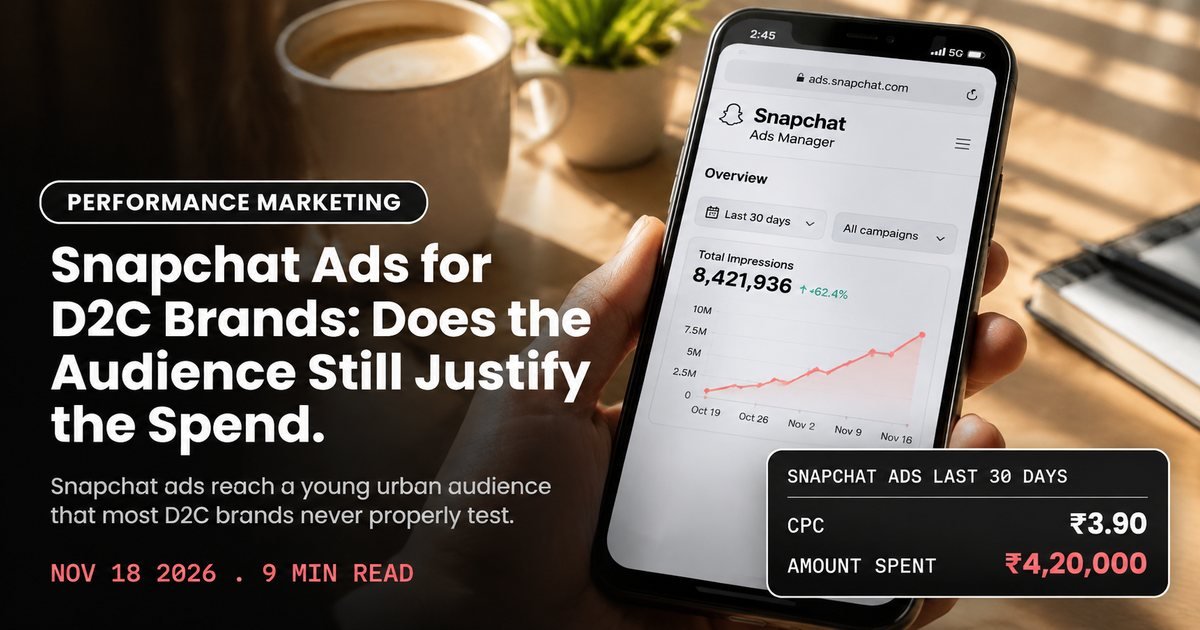
A skincare founder we spoke with last month had ₹40,000 sitting unspent in a Snapchat ad account. Her media buyer had set it up eight months earlier after a conference pitch about "untapped Gen Z reach," run two campaigns that barely moved the needle, then quietly stopped touching it. The account sat there as a line item nobody wanted to explain in the monthly review.
That's the typical Snapchat story for Indian D2C brands. Someone hears Snapchat ads pitched as the next Instagram, before the algorithm got expensive. They test it with a generic campaign built for Meta and ported over with minimal changes. It underperforms. The platform usually isn't the real problem; the brand and the audience were never a fit to begin with.
The honest answer is more specific than "try it" or "skip it." Snapchat's India audience is real, young, and genuinely different from Instagram's. For a handful of categories, that specific audience and one particular ad format are worth real budget. For most D2C brands, the platform is a distraction dressed up as an opportunity. This piece walks through which side you're on.

Who is actually on Snapchat in India
Snapchat's India user base skews younger than almost any other major ad platform you'd consider, 16 to 24 years old is the dense core, with a meaningful tail up to 28. Compare that to Instagram, where your addressable audience stretches comfortably from 18 to 45, and the gap becomes obvious fast.
That age concentration comes with a geography and income pattern attached. Snapchat usage in India is heavily urban and tier-1/tier-2 city skewed. College students and early-career professionals make up the bulk of it. Not yet high disposable income, but spending on fashion, food, gaming, and personal care in ways that matter for specific D2C categories.
The platform's own stated India user numbers put it in the tens of millions of monthly actives. That's a real audience, but nowhere close to Instagram or even YouTube in raw scale.
Anyone selling you Snapchat ads as a blanket replacement for your Meta budget is misreading the numbers. Think of it as additive reach for a specific slice of buyers, a layer on top of your existing channels rather than a parallel universe at the same scale.
Where the audience genuinely fits your category
Five categories consistently show up when Snapchat ads actually move revenue for D2C brands in India.
Youth fashion and streetwear. If your customer is a college student or someone within five years of graduating, buying statement pieces, sneakers, or accessories that signal identity more than utility, this is close to the platform's exact demographic.
Our social media marketing strategy for D2C in 2026 guide covers how to sequence a youth-first channel like this against your core Instagram presence rather than letting it compete for the same budget conversation.
Gaming-adjacent products. Energy drinks, gaming peripherals, merchandise tied to esports or streaming culture. Snapchat's user base overlaps heavily with gaming audiences in a way Instagram's broader user base doesn't concentrate as cleanly.
Beauty and skincare, specifically Gen Z-targeted lines. Not your general skincare brand selling to 25-40 year old working women. We mean brands built explicitly around a younger cohort, acne-focused ranges, trend-driven makeup, skincare marketed through the exact slang and visual language this audience uses daily.
Food delivery and QSR targeting college-age users. Quick commerce and limited-radius delivery brands near college campuses and tier-1 city hostels have real success here, because the audience density in those geographies maps directly onto Snapchat's usage pattern.
AR try-on-driven categories: beauty, eyewear, accessories. This one deserves its own section, because it's the platform's genuine structural advantage, not just an audience overlap.
If your brand doesn't land in one of these five buckets, the audience match is weak enough that you should think hard before committing budget, no matter how good the pitch deck looked.
The AR lens ad format: Snapchat's real differentiator
This is the one thing Snapchat does that no other major ad platform does as well, and it's worth understanding on its own terms even if you never run a campaign.
Snapchat's Lens ads let users try on a product virtually through the camera before buying. That's actual AR, a real-time render on your own face, hardly a filter gimmick.
A shade of lipstick on your own face. A frame style on your own eyes. A watch or a piece of jewelry on your own wrist. The user doesn't imagine the product; they see it, live, on themselves.
For eyewear, beauty, and accessory brands, this closes a gap that static product photography can't. A huge share of pre-purchase hesitation in these categories comes from uncertainty about fit and look on the individual buyer, not uncertainty about the product's general quality. AR try-on removes that hesitation at the exact moment someone's deciding.
The catch: building a good Lens ad takes real production investment, far more than a standard static or video ad unit. You need 3D asset creation, testing across device types, and a brand willing to iterate on the AR experience itself, not just the surrounding ad copy.
If your category fits (beauty, eyewear, watches, jewelry, some fashion accessories) and you have the budget to build the Lens properly, this is the single strongest reason to test Snapchat at all. If your category doesn't involve something visually worn or applied, skip this format entirely; it won't translate.
When the audience quality justifies test budget
Run a Snapchat test if two or more of these are true: your core customer is genuinely under 25, your product is visually tryable (worn, applied, or styled), your current Meta audience is aging past your ideal buyer and you need a fresh acquisition channel for younger cohorts, or you're already seeing organic traction with Gen Z on other platforms and want to formalize that into paid spend.
A realistic test budget is ₹30,000 to ₹75,000 over four to six weeks, enough to get past the initial learning phase without betting your whole month on an unproven channel. Build creative natively for the platform rather than repurposing Instagram assets; that single decision determines more of the outcome than targeting settings do.
If you're weighing this against doubling down on a channel you already understand, our breakdown of Google Ads vs Meta Ads in a 30-day test walks through the same test-budget logic applied to a more familiar comparison.
When it's a waste of budget, said plainly
If your average customer skews 28 and above, Snapchat is the wrong channel regardless of how compelling the CPM looks in a sales deck. If your product needs explanation, a considered purchase like a mattress, a supplement stack, or anything requiring education before conversion, Snapchat's fast, ephemeral format works against you, not with you.
If you're already stretched thin managing Meta and Google well, adding a third platform with a smaller, harder-to-reach audience usually means worse execution everywhere, not incremental gains.
Our media buying agency vs performance marketing agency piece gets into this exact tradeoff, platform breadth versus depth of execution, and it applies directly here. Run Snapchat badly with an overstretched team and you'll burn budget while learning nothing useful about the audience.
And if your brand's whole value proposition rests on trust signals, reviews, detailed specs, comparison content, this isn't the platform for that job. Save that budget for channels where considered buying behavior actually happens.
Setting up the test the right way
Start the campaign objective on conversions, not awareness or reach, even if your account is new and conversion volume looks thin at first. Snapchat's delivery system needs that signal from day one to learn correctly.
Build at least three creative variants before launch, not one. Vertical, full-screen, sound-on by default since most Snapchat usage happens with sound. Keep copy minimal; this audience scrolls fast and skips anything that reads like a traditional ad.
Install the Snap Pixel properly before spending a single rupee, and connect it to your actual purchase event, not just page view. Without clean conversion tracking, you're flying blind on an already-small sample size, and four to six weeks won't tell you anything reliable.

What to actually do this quarter
- 1Check your actual customer age distribution from your CRM or order data before assuming Snapchat fits; don't guess based on who you imagine your brand should attract.
- 2If you're in youth fashion, gaming-adjacent products, Gen Z beauty, college-area food delivery, or AR-tryable categories, allocate a four to six week test budget of ₹30,000 to ₹75,000.
- 3Build creative natively for the vertical, sound-on format rather than repurposing Meta assets.
- 4If your category involves something worn or applied, scope out what a proper AR Lens ad would cost to produce before dismissing the format.
- 5Install and verify the Snap Pixel against your real purchase event before launching anything.
- 6If two or more of the "skip it" signals in this piece apply to you, redirect that test budget into deepening your existing Meta or Google spend instead.
If you want a second opinion on whether your specific category and customer profile justify a Snapchat test, book a free strategy call and bring your current customer age data; that single number settles most of this conversation in the first five minutes.
Book a call