Ad Budget Won't Fix a D2C Brand: What's Actually Missing Isn't Money
Most D2C brands plateau from a decision-making gap, not a budget gap. Here's why nobody owning the full picture across channels costs more than spend.
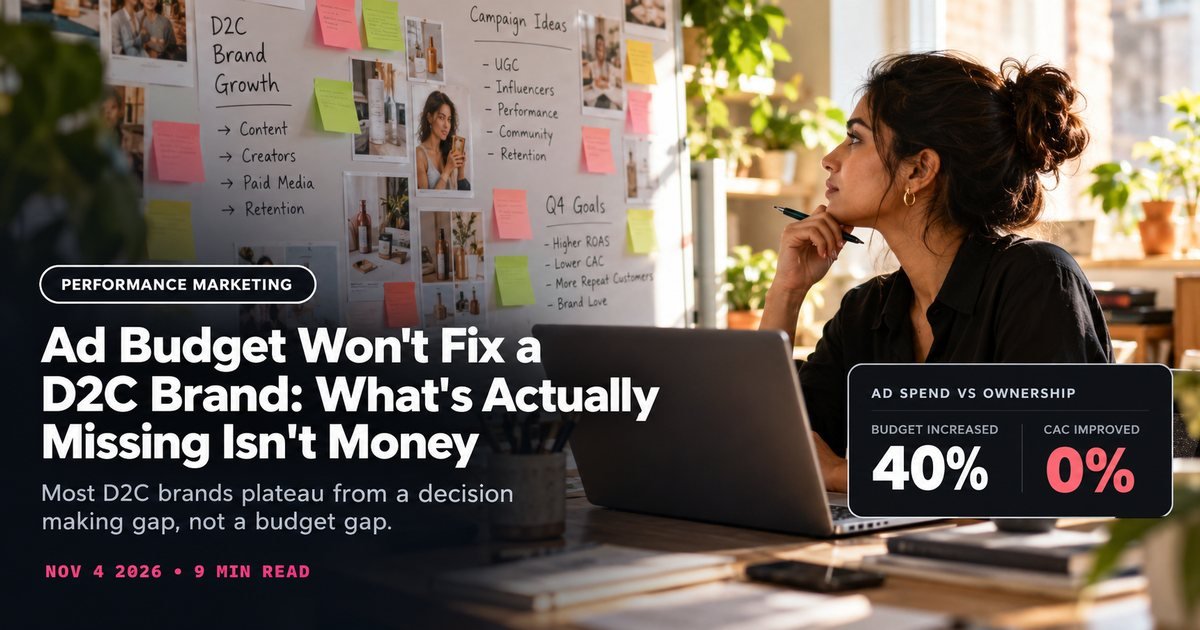
A founder messaged us recently asking whether doubling their monthly ad budget would fix a CAC that had been creeping up for three months straight. The honest answer, once we looked at the account, was no.
Nobody on their team had checked the Google Ads account in six weeks. The Meta creative had run unchanged since a product launch two months earlier. Influencer campaigns were being booked independently of what the paid data actually showed about which audiences converted. More spend into that setup would have just burned faster, without fixing a single underlying problem.
This is the pattern we see constantly working with Indian D2C brands, and it's the reason we built this entire content series around Google and Meta performance marketing. Most plateaus have little to do with a growth marketing agency choice or a raw budget number.
They're a decision-making gap. Nobody owns the full picture across Google, Meta, influencers, and CRO at once, so each channel optimizes in isolation while the brand's actual unit economics quietly drift.

The Budget Gap Is Usually a Decision Gap in Disguise
When CAC rises, the instinct is almost always to either cut spend or add more of it, as if the dial itself is the lever. Rarely is it.
In our experience across accounts we've taken over mid-contract, the real cause is usually one of three things. Settings configured once and never revisited. Channels running without reference to each other's data. Or nobody with the authority and time to make a hard call, like killing a campaign the founder personally likes.
We wrote a detailed breakdown of exactly which Google Ads settings go stale after the first month, because this is one of the clearest, most measurable versions of the decision gap. Negative keyword lists untouched since launch. Bidding strategies still set for a learning phase that ended months ago.
None of it traces back to budget size. It traces back to nobody watching, and watching is a decision-making function, separate entirely from spending.
The same applies at the channel-allocation level. We ran a structured 30-day test comparing Google and Meta ads for the same offer specifically because founders keep asking "which platform should get more budget," when the real question is which platform does which job in their funnel. Few teams actually track that distinction instead of judging both on the same flat CAC number.
Where the Gap Shows Up Most
The clearest symptom is channels operating as separate kingdoms. Performance marketing optimizes toward its own CAC target without reference to what influencer campaigns drive in assisted conversions. Influencer casting gets decided on follower count and vibe, rather than on which past creators actually moved conversion-tracked traffic.
The website and CRO backlog gets whatever attention is left over after ad campaigns. A broken checkout flow quietly taxes every single channel feeding it traffic, yet almost never gets treated as urgent.
We've increasingly seen brands explore YouTube as a channel priced well below Instagram's current feed inventory. The brands that actually capture that advantage are the ones where someone owns the cross-channel view enough to notice the arbitrage in the first place and act on it before it closes.
A brand running Google and Meta on autopilot, with nobody looking sideways at YouTube or quick commerce ads, will simply never find that kind of opportunity. Looking for it isn't in anyone's job description.
This is exactly the gap a fractional CMO is built to close. We laid out what that role actually does across the first 90 days, since the job title gets thrown around vaguely enough that most founders can't picture the actual work. The role isn't a budget increase. It's someone whose explicit job is owning the full picture and making the calls nobody else on the team has the authority, time, or cross-channel visibility to make.

What Ownership Actually Looks Like
Real ownership is a job function, not a title on a slide. It shows up as specific, dated decisions someone is accountable for making and defending.
Did someone decide, explicitly, to kill the underperforming campaign this week instead of letting it run because nobody wanted that conversation with the founder? Did someone reallocate budget from Meta to Google based on actual blended CAC data rather than habit? Did someone look at the influencer roster and cut the creators who generate likes but no tracked conversions?
Brands with this kind of ownership in place, whether through an internal hire, a fractional CMO, or an agency genuinely operating across the full funnel, tend to plateau less and recover from CAC spikes faster. Someone is actually watching for the spike, rather than discovering it three months later in a quarterly review.
Our own digital marketing strategy playbook for D2C brands walks through how to sequence channels properly. Sequencing only works, though, if someone actually holds that sequence accountable week over week, instead of designing it once and filing it away.
If you're trying to figure out whether your current setup has this kind of ownership or is missing it entirely, our checklist for choosing a marketing agency covers the specific diligence questions that surface the gap fast, usually within one conversation.
Why More Budget Makes a Bad Setup Worse, Not Better
This part surprises most founders under pressure to grow faster. Pouring more budget into an account nobody is actively managing doesn't average out the inefficiency. It amplifies it.
A stale negative keyword list wastes a fixed percentage of spend regardless of total budget, so doubling spend doubles the waste in absolute rupees. A Meta account running fatigued creative converts worse at any budget level. More impressions against that same tired creative just accelerates the fatigue curve further.
This is the uncomfortable truth behind most "we need more budget" requests we hear from founders. What they actually need, nine times out of ten, is someone to go through the account with a fine-tooth comb, make the unglamorous fixes, then establish an ongoing review cadence so the account doesn't quietly rot again in two months.
The budget increase, when it comes, should follow that fix. It shouldn't substitute for it.
Building the Decision-Making Layer Into Your Brand
If you're a founder reading this and recognizing your own account in it, the fix is fairly simple, even if it takes real effort to implement. Start by assigning explicit ownership: one person, whether internal or a fractional CMO brought in specifically for this, accountable for the cross-channel view and empowered to kill underperforming campaigns without needing founder sign-off on every call.
Follow that with a weekly review cadence covering search terms, creative fatigue, assisted conversions, and budget allocation across every active channel, not just whichever one had a bad week.
This is the thesis behind everything we do at Creator City, and it's why our performance marketing work is never run as an isolated channel service. We build the cross-channel ownership layer into the engagement itself.
A brand that gets its Google Ads tuned perfectly, but still has nobody deciding how that interacts with influencer spend and CRO priorities, hasn't actually solved its growth problem. The same gap has simply moved one level deeper.
Takeaways
- 1Rising CAC is more often a sign that nobody is actively managing the account than a sign spend is too low.
- 2Channels operating in isolation, each optimizing its own number without reference to the others, is the clearest symptom of a decision-making gap.
- 3A stale account setup wastes a fixed percentage of budget regardless of size, so more spend amplifies inefficiency rather than diluting it.
- 4Fixing the gap means assigning explicit, accountable ownership across the full funnel, not just increasing any single channel's budget.
- 5Budget increases should follow a fix to account ownership and review cadence, not substitute for one.
If your growth has plateaued and you suspect it's a decision gap rather than a budget gap, book a free strategy call and we'll walk through your current account setup together before recommending anything, including whether more spend is actually the right next move.
Book a call